
5 Ways to Improve Athletic Recovery With Light Therapy


Table of Contents
- How Light Therapy Speeds Up Athletic Recovery
- Red vs. Near-Infrared: Which Wavelength Does What
- 1. Photobiomodulation for Athletes: The Cellular Engine Behind Faster Recovery
- 2. Easing Delayed Onset Muscle Soreness and Inflammation After Training
- 3. How Long to Use Red Light Therapy for Recovery: Dosing, Timing, and Session Length
- 4. Integrating Light Therapy With Hyperbaric Oxygen for Deeper Recovery
- 5. Choosing a Device in Atlanta: Clinical Systems vs. At-Home Panels
- Conclusion
- Frequently Asked Questions
Last Updated: September 23, 2026
How Light Therapy Speeds Up Athletic Recovery
Light therapy is not a single treatment. Wavelength, dose, and timing each change the outcome, so the same panel can help one athlete and do very little for another.
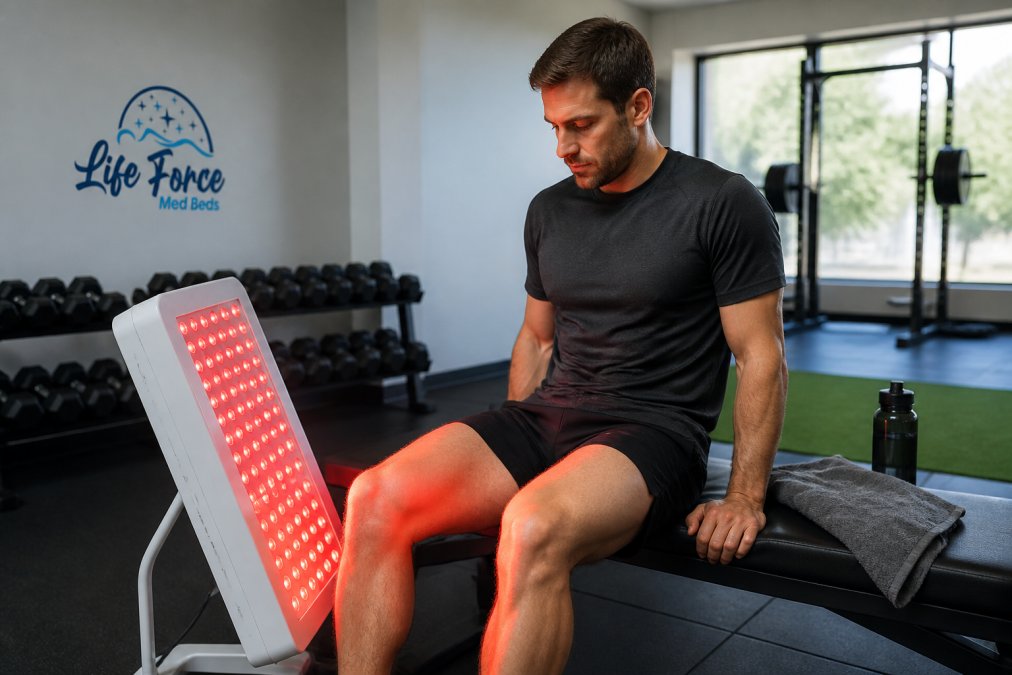
Red vs. Near-Infrared: Which Wavelength Does What
Red light at roughly 630 to 670 nanometers works mainly on skin and surface tissue, while near-infrared light at roughly 810 to 850 nanometers penetrates deeper into muscle, tendon, and joint tissue. That penetration depth is the most important specification when choosing a device.
- Red light (630-670 nm): absorbed closer to the surface; supports skin healing and superficial tissue repair
- Near-infrared light (810-850 nm): reaches deeper muscle and joint tissue; the wavelength most studied for post-exercise recovery
- Dual-wavelength panels: combine both, which is why most recovery-focused devices pair 660 nm with 850 nm
1. Photobiomodulation for Athletes: The Cellular Engine Behind Faster Recovery
Photobiomodulation is the process by which light photons are absorbed by chromophores in your cells, primarily in the mitochondria, triggering a cascade that increases energy availability and reduces oxidative stress. The upshot: your muscle cells get more usable energy to repair damage between sessions.
2. Easing Delayed Onset Muscle Soreness and Inflammation After Training
Delayed onset muscle soreness, or DOMS, is the stiffness and tenderness that peaks 24 to 72 hours after unfamiliar or intense exercise, particularly eccentric loading like downhill running or the lowering phase of a squat. It is driven by microscopic muscle damage followed by inflammatory signaling that recruits repair cells. Light therapy targets that wave at two points: it reduces exercise-induced oxidative stress inside the muscle cell, and it moderates the systemic inflammatory response so repair stays local rather than spilling into whole-body fatigue.
Stacking Light Therapy With Other Recovery Modalities
Light therapy works best as one layer in a stack, not as a standalone fix. A common pattern among recovery-focused practitioners is to sequence modalities so each supports the next:
- Light therapy + cold exposure (cryotherapy or cold plunge): Use light therapy after the cold session, not before. Cold constricts blood vessels; light therapy supports circulation and cellular energy. Doing light first and then immediately icing can work against the vasodilation you just encouraged.
- Light therapy + compression boots or pneumatic compression: Apply light therapy to the target area first, then run compression. The compression helps move fluid and metabolites while the light has already primed the tissue.
- Light therapy + massage or soft-tissue work: Light therapy before manual work can make tissue feel more pliable and reduce the tenderness that makes deep work uncomfortable. Some athletes prefer it after, to calm the tissue down.
- Light therapy + hyperbaric oxygen: Covered in section 4, but worth flagging here, this pairing targets both the energy side and the oxygen-delivery side of recovery.
If you are new to stacking, add one modality at a time and keep a simple log of soreness, sleep, and how you feel on the next training day. Without a log, you cannot tell which layer is actually helping.
What Light Therapy Will Not Do
It will not replace sleep, protein intake, or hydration, and it will not make a poorly programmed training block recoverable. Used consistently across a training block, though, it can shorten the peak soreness window and make back-to-back hard sessions more manageable.
3. How Long to Use Red Light Therapy for Recovery: Dosing, Timing, and Session Length
Three variables control your dose:
- Irradiance: the power output of the device at the treatment surface, measured in milliwatts per square centimeter
- Time: how long the light is applied to a given area
- Distance: how far the panel sits from your skin, which changes the effective irradiance
| Recovery Goal | Typical Session Length | Timing | Frequency |
|---|---|---|---|
| Pre-workout pre-conditioning | 5-10 minutes | 30-60 minutes before training | Training days |
| Post-exercise recovery | 10-20 minutes per area | Within 2-4 hours after training | Training days |
| DOMS management | 10-15 minutes per area | Once or twice daily during peak soreness | 2-3 days |
| Joint and tendon support | 10-20 minutes per area | Daily | Ongoing |
Doubling your session length does not double the benefit. Exceeding the manufacturer’s recommended dose can reduce the effect and, in some cases, leave you more sore than before.
A practical rule: start at the lower end of the range, track how you feel over a week, and adjust upward only if you are not seeing a response.
4. Integrating Light Therapy With Hyperbaric Oxygen for Deeper Recovery
Integrating light therapy with hyperbaric oxygen pairs two mechanisms that support each other: light therapy stimulates cellular energy production and tissue repair, while hyperbaric oxygen therapy increases oxygen available to tissues under pressure. Together they target both the energy and oxygen-delivery sides of recovery.
5. Choosing a Device in Atlanta: Clinical Systems vs. At-Home Panels
Most articles on light therapy for athletic recovery explain the science and stop. This section fills that gap with the decision criteria that matter when choosing equipment, whether for yourself or for a clinic in the Atlanta area.
The Four Specifications That Actually Matter
- Wavelength: Look for 660 nm (red) and 850 nm (near-infrared) as the core pair. Red handles surface tissue; near-infrared reaches muscle, tendon, and joint. A device that only offers red will not reach the tissue most athletes are trying to treat.
- Irradiance (power density): Measured in milliwatts per square centimeter at the treatment surface. Higher irradiance means shorter sessions to reach a therapeutic dose, but only if the device is designed to deliver it safely. Consumer panels are typically lower; clinical systems are higher.
- Treatment area / coverage: A handheld device is fine for a single tendon but impractical for full-leg recovery. A panel covers more area per session; a full-body system covers everything at once.
- Adjustability: Timing controls, pulsing options, and the ability to set dose per area matter more than raw wattage for recovery work, because over-dosing can blunt the benefit.
Matching the Device to the Use Case
| Option | Best For | Key Strength | Trade-off |
|---|---|---|---|
| Consumer LED panel | Individual athletes at home | Portable, easy daily use | Lower power output |
| Handheld light device | Targeted small areas | Compact for travel | Limited coverage |
| Clinical light system | Clinics and recovery centers | Higher irradiance, full-body coverage | Larger footprint |
| Integrated MedBed system | Athletes and clinics wanting multiple modalities | Red and near-infrared light combined with PEMF, frequency, and oxygen support | Higher upfront investment |
The Med Bed Sales lineup, developed by Dr. Louis Hilliard, the inventor of the med bed, brings red and near-infrared light arrays together with PEMF, frequency, and oxygen technologies in one system. That matters for athletes who currently juggle a light panel, a PEMF mat, and a separate recovery tool. Consolidating means one protocol instead of three, and one set of settings to track.
Where Atlanta Athletes and Clinics Fit In
- Individual athletes in neighborhoods like Midtown, Buckhead, and Decatur are typically best served by a dual-wavelength home panel with adjustable timing. It fits a spare room, runs on standard power, and supports daily use between sessions.
- Clinics, sports medicine practices, and recovery studios need equipment that can handle throughput. That means higher irradiance, broader coverage, and a system that does not require an operator to stand over it for every session.
If you are in Atlanta and unsure whether you need a clinical system or a home panel, book a consultation before buying. Equipment selection depends on how many athletes you treat, not on how impressive the spec sheet looks.
If you are searching for light therapy near me in the Atlanta area, start by defining your use case. Write down your answers to the four specifications above, then compare devices against those answers, not against each other.
Conclusion
Recovery is where adaptation actually happens, and most athletes leave it to chance. The five approaches above, from photobiomodulation and DOMS management to dosing, hyperbaric integration, and device selection, give you a structure rather than guesswork.
Frequently Asked Questions
Can red light therapy help with athletic recovery?
Yes. Light therapy, also called photobiomodulation, uses red and near-infrared wavelengths that penetrate tissue and support cellular energy production. Research in sports medicine suggests it may reduce delayed onset muscle soreness, ease inflammation, and support tissue repair after training. Results depend on wavelength, dose, and consistency, so most athletes use it as one part of a broader recovery protocol rather than a standalone fix.
How long should I use red light therapy for recovery?
Most recovery protocols call for sessions of roughly 10 to 20 minutes per targeted area, delivered a few times per week or after hard training days. The right duration depends on the device’s irradiance and the distance from your skin, since both change the dose your tissue receives. Start conservatively, track how you feel over two to three weeks, and adjust from there.
What is the difference between red and near-infrared light for recovery?
Red light sits around 630 to 660 nanometers and is absorbed closer to the skin’s surface, which suits superficial tissue and skin recovery. Near-infrared light, around 810 to 850 nanometers, penetrates deeper into muscle and joint tissue. Many recovery devices combine both wavelengths so you get surface-level and deeper effects in one session.
How does light therapy complement other recovery modalities like hyperbaric oxygen?
Light therapy and hyperbaric oxygen work on different parts of the recovery picture. Hyperbaric oxygen increases oxygen availability in tissue, while light therapy supports cellular energy production and circulation. Pairing them in one session, or back to back, is a common approach in clinics that offer both. Talk with a qualified professional before combining therapies, especially if you have a medical condition.
What is the recommended duration for light therapy sessions?
Session length varies by device, but many protocols run 10 to 20 minutes per area. Clinical systems with higher irradiance often need less time than at-home panels. The key is total dose, not just minutes, so follow the manufacturer’s guidance for your specific device and avoid overdoing it in the first week.
