
7 Ways to Use Biosensing Technology for Athletic Performance


Table of Contents
- 7 Ways to Use Biosensing Technology for Athletic Performance
- 1. Real-Time Physiological Monitoring During Training
- 2. Wearable Biosensors for Athletes: Tracking Metabolic Load
- 3. Hydration and Electrolyte Monitoring for Endurance Performance
- 4. Biomechanical Analysis and Motion Capture for Injury Prevention
- 5. How to Optimize Recovery with Bioresonance Technology
- 6. Machine Learning and Predictive Analytics for Performance Gains
- 7. Data Privacy and Ethical Considerations in Athletic Biosensing
- Summary: 7 Ways to Use Biosensing Technology for Athletic Performance
- Frequently Asked Questions
Last Updated: September 29, 2026
7 Ways to Use Biosensing Technology for Athletic Performance
Biosensing technology transforms athletic performance by providing real-time data on physiological responses. Whether you’re a competitive athlete or fitness-focused individual, integrated biosensing systems offer measurable insights into metabolic processes, injury prevention, and recovery efficiency.
Quick Picks:
- Best for Comprehensive Monitoring: Life Force MedBed, integrates multiple biosensing modalities in one system
- Best for Wearable Tracking: IMU Step, delivers granular biomechanical data during movement
- Best for Team Performance: Kinexon, enterprise-grade load and tactical analysis
1. Real-Time Physiological Monitoring During Training
Real-time physiological monitoring captures your body’s response to training stress as it happens. Wearable sensors track heart rate variability, blood oxygen saturation, and skin temperature during workouts, removing the guesswork of training by feel. When heart rate variability drops, your nervous system is under load. When blood oxygen saturation dips below baseline, your aerobic capacity is being challenged.
The practical benefit: you can adjust intensity mid-workout. If your data shows you’re spiking into anaerobic zones too early, you dial back the pace. If you’re not reaching target zones, you push harder. This real-time feedback loop prevents the common mistake of training too conservatively or crossing into overtraining territory without realizing it.
Establish your personal baseline before using real-time monitoring in competition. Train with sensors for 2-3 weeks to understand your normal ranges for heart rate variability, blood oxygen, and skin temperature at different intensities. Your baseline becomes your reference for detecting abnormal responses.
2. Wearable Biosensors for Athletes: Tracking Metabolic Load
Wearable biosensors measure metabolic load, the cumulative physiological stress your body experiences during training. Unlike step counters, they track heart rate, movement acceleration, sweat composition, and breathing patterns. Two athletes performing the same workout experience vastly different physiological demands; biosensors capture this individual variation.
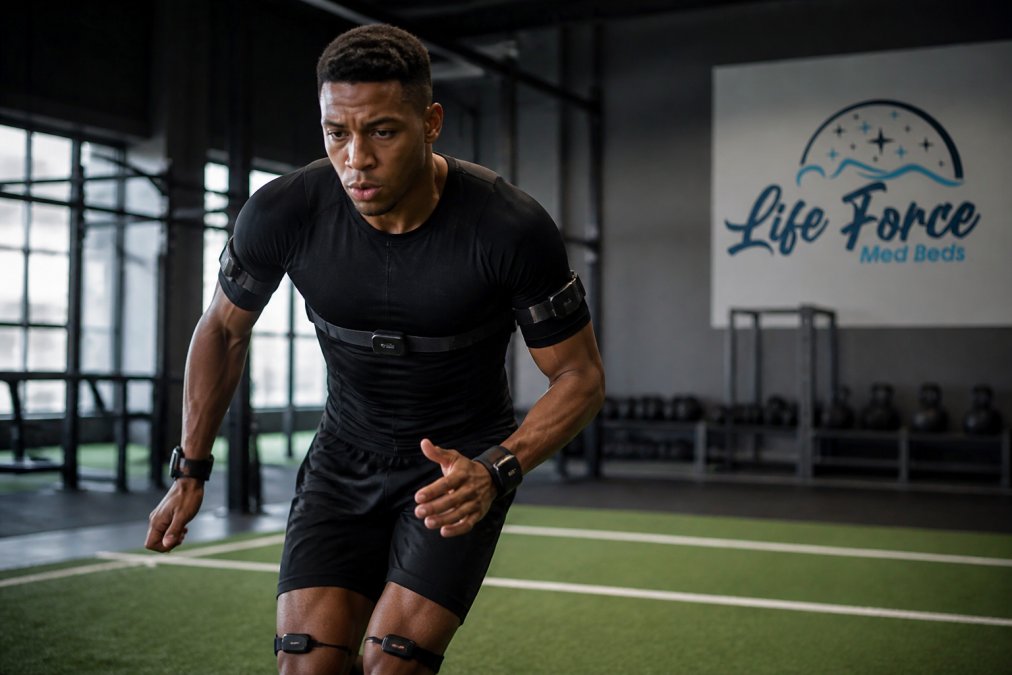
Metabolic load predicts recovery needs better than workout duration. Biosensors quantify this so you can match recovery protocols to actual demand. They also detect asymmetry, when one side of your body works harder than the other, an early warning signal that often precedes injury.
Metabolic load data transforms how you structure training weeks. Instead of following a generic “hard day, easy day” template, you can build training blocks based on actual physiological demand your body experienced.
3. Hydration and Electrolyte Monitoring for Endurance Performance
Hydration and electrolyte balance directly impact endurance performance. Biosensors measure sweat pH, sodium concentration, and fluid loss in real time. Dehydration doesn’t feel the same to every athlete; some feel thirsty at 2% fluid loss, others not until 5% loss. Heavy sweating depletes sodium faster than water, causing cramping and reducing muscle function even when drinking enough fluids.
Sweat biosensors track sodium loss per hour, letting you calculate exact electrolyte replacement needs. A runner losing 1,200 mg of sodium per hour needs different replacement than one losing 600 mg per hour. During training, use this data to dial in your hydration strategy before competition.
4. Biomechanical Analysis and Motion Capture for Injury Prevention
Biomechanical analysis uses motion capture and inertial measurement units to detect subtle asymmetries and loading patterns that lead to injury. Motion capture systems measure joint angles, acceleration, and force distribution in real time. Asymmetry, when one leg absorbs more impact or one shoulder carries more load, is the primary risk factor for overuse injuries.
Baseline your movement pattern with biosensors during healthy training. As training volume increases, monitor for asymmetry, an early warning sign. Addressing movement patterns at this stage prevents injury. Biomechanical data also reveals when fatigue degrades form, allowing you to dial back intensity before breakdown triggers injury.
Don’t ignore biomechanical alerts. When your motion capture data shows increasing asymmetry or form degradation, reduce training volume by 20-30% for 3-5 days. Pushing through these signals often results in acute injury that sidelines you for weeks.
5. How to Optimize Recovery with Bioresonance Technology
Recovery optimization has evolved beyond ice baths and sleep tracking. Bioresonance technology, which uses frequency-based systems to support the body’s natural recovery processes, can be integrated with biosensing data to create personalized recovery protocols.
The Life Force MedBed combines biosensing with bioresonance, PEMF (pulsed electromagnetic field) therapy, red and near-infrared light, and frequency-based systems. This integrated approach allows you to monitor physiological state while simultaneously supporting recovery through multiple modalities.
Here’s the practical advantage: instead of applying generic recovery interventions, you use biosensing data to identify what your body actually needs. If your heart rate variability is low (indicating high nervous system load), you might prioritize grounding and electron-balancing systems. If muscle soreness is high (detected through movement quality sensors), you layer in red light therapy and PEMF.
Bioresonance technology works on the principle that the body operates at specific frequencies. By applying those frequencies back to the body, you support cellular function and accelerate recovery. When combined with real-time biosensing, you can adjust frequency protocols based on how your body responds.
The recovery timeline matters. Most athletes see measurable improvements in heart rate variability, sleep quality, and movement symmetry within 7-10 days of consistent bioresonance use paired with biosensing feedback. The key is consistency, daily or near-daily sessions produce better results than sporadic use.
6. Machine Learning and Predictive Analytics for Performance Gains
Machine learning algorithms analyze your biosensing data across multiple training sessions to identify patterns humans miss. These algorithms detect which training protocols produce the best performance outcomes for your unique physiology.
Predictive analytics take this further. By analyzing your historical biosensing data, machine learning models can predict when you’ll reach peak performance, when you’re at risk of overtraining, and which recovery interventions will work best for you specifically.
Here’s a concrete example: a machine learning model trained on your data might discover that you perform best when your heart rate variability is above 80 ms and your sleep debt is below 4 hours. The model can then predict performance outcomes for upcoming competitions based on your current biosensing metrics. If your HRV drops to 60 ms the week before a race, the model flags this as a risk factor.
Data-driven coaching transforms training decisions from intuition-based to evidence-based.
Machine learning doesn’t replace coaching, it augments it. Use predictive analytics to inform your coach’s decisions, not to replace their judgment. The best outcomes come from combining human expertise with algorithmic insights.
7. Data Privacy and Ethical Considerations in Athletic Biosensing
As biosensing technology becomes more sophisticated, the data it collects becomes more sensitive. Heart rate variability, sweat composition, movement patterns, and sleep data reveal intimate details about your physiology. How this data is stored, used, and protected matters.
Summary: 7 Ways to Use Biosensing Technology for Athletic Performance
| Method | Primary Benefit | Best For | Key Metric |
|---|---|---|---|
| Real-Time Physiological Monitoring | Adjust intensity mid-workout | All athletes | Heart rate variability |
| Wearable Biosensors | Track metabolic load and asymmetry | Endurance and strength athletes | Cumulative physiological stress |
| Hydration & Electrolyte Monitoring | Optimize fluid replacement strategy | Endurance athletes | Sweat sodium concentration |
| Biomechanical Analysis | Detect injury risk early | All athletes | Movement asymmetry |
| Bioresonance Recovery | Accelerate recovery between sessions | All athletes | Heart rate variability recovery |
| Machine Learning Analytics | Identify personalized performance patterns | Data-driven athletes | Predictive performance score |
| Data Privacy Framework | Protect sensitive physiological data | All athletes | Data governance compliance |
Biosensing technology transforms athletic performance from guesswork into data-driven optimization. The seven strategies above represent the most practical applications for athletes at any level. Whether you’re monitoring real-time physiological responses during training, using wearable sensors to track metabolic load, or optimizing recovery with integrated systems like the Life Force MedBed, biosensing data provides the feedback loop that accelerates improvement.
Frequently Asked Questions
How does biosensing technology improve athletic performance?
Biosensing technology captures real-time physiological data, heart rate variability, blood oxygen saturation, metabolic load, and movement mechanics, allowing athletes to make immediate training adjustments. This data-driven approach identifies overtraining patterns, optimizes recovery windows, and reveals performance bottlenecks that traditional training logs miss. Athletes using integrated biosensing systems can fine-tune intensity, volume, and recovery timing based on actual physiological response rather than perceived effort.
What are the most common biosensors used in sports training?
The most widely used biosensors include wearable accelerometers and gyroscopes for motion capture and biomechanical analysis, chest-mounted heart rate monitors for cardiovascular load tracking, optical sensors for blood oxygen and heart rate variability measurement, and bioimpedance sensors for hydration and electrolyte status. Advanced systems integrate multiple sensor streams, GPS for positioning, inertial measurement units (IMUs) for gait analysis, and sweat pH sensors, into unified performance dashboards that coaches and athletes can monitor in real time.
Can biosensing data help prevent sports-related injuries?
Yes. Biosensing systems detect early warning signs of overuse and fatigue that precede injury. Motion capture identifies asymmetry in gait or movement mechanics, biomechanical analysis reveals compensatory patterns, and physiological load monitoring shows when the body is under excessive strain. Athletes who respond to these signals by adjusting training intensity or prioritizing recovery reduce injury risk significantly. Real-time feedback on form and fatigue allows trainers to intervene before minor imbalances become structural damage.
How does bioimpedance analysis support recovery for athletes?
Bioimpedance measures the body’s electrical resistance to assess hydration status, muscle mass, and systemic recovery state. This data reveals how well an athlete is rehydrating between sessions, whether electrolyte balance is optimal, and when the nervous system has genuinely recovered from training stress. Integrated recovery systems like the Life Force MedBed combine bioimpedance monitoring with bioresonance therapy and oxygen therapy to accelerate physiological restoration, allowing athletes to train harder more frequently without compromising adaptation.
What is the role of wearable biosensors for athletes in real-time performance monitoring?
Wearable biosensors provide live feedback during training and competition, allowing athletes and coaches to adjust tactics and intensity on the fly. Heart rate variability, lactate threshold indicators, and movement quality metrics stream continuously to performance dashboards. This real-time telemetry prevents athletes from pushing into counterproductive zones and ensures they’re working at the right intensity for their training goal. Data-driven coaching based on live biosensor input produces faster performance gains than traditional methods relying on feel and experience alone.

