
Business Plan for Health and Wellness Center: Strategy, Services, and Growth


Your business plan is more than just a document; it's the blueprint for your dream. It lays out the entire strategy for your health and wellness center, covering everything from your core vision and market analysis to your services and financial forecasts. Think of it as the critical tool that turns your passion for well-being into a tangible, fundable business, guiding your decisions from day one.
Crafting Your Vision and Executive Summary
The executive summary is your elevator pitch on paper. It’s the very first thing potential investors, partners, or lenders will see, and frankly, it might be the only thing they read if it doesn't hook them immediately. This isn't just an introduction; it's a powerful, condensed version of your entire business plan that needs to get them excited about what you're building.
This is where you articulate your mission with clarity and passion. What's the fundamental purpose of your center? Who are you helping, and what transformation will you offer them? You need to paint a clear picture of what makes your wellness center different and necessary.
Defining Your Unique Value Proposition
Every thriving wellness center has a unique edge. Your business plan needs to shout this from the rooftops. What’s your secret sauce?
Maybe you're targeting a specific niche, like holistic pre-natal care or advanced athletic recovery. Or perhaps you're introducing a game-changing technology.
For instance, building your center around the groundbreaking Life Force Med Beds immediately sets you apart. Highlighting that this technology comes directly from its inventor, Dr. Louis Hilliard, the owner of Life Force Medbeds, adds a layer of authority and credibility that's hard to beat. That’s a powerful competitive advantage.
Your executive summary should definitively answer three key questions for anyone reading it: Why this business? Why now? And why you?
Key Components to Include
A great executive summary gives a bird's-eye view of your entire plan without getting bogged down in the details. It has to be concise but packed with the most crucial information about your venture.
Make sure you touch on these core points:
- Mission Statement: A single, powerful sentence that captures the heart of your center's purpose.
- Company Description: Briefly explain what your wellness center is, its legal setup, and the specific gap it fills in your community.
- Service Highlights: Showcase your main offerings, especially unique ones like Life Force Med Bed technology. You can get more ideas for a high-tech facility in our guide on how to open a medical spa.
- Market Opportunity: Briefly describe your ideal client and the clear demand for what you're offering.
- Financial Overview: A quick summary of your numbers—think startup costs, revenue goals, and how much funding you need to get off the ground.
This summary truly sets the stage. It's not just about presenting data; it’s about telling a compelling story that showcases your vision, your expertise, and the undeniable potential of your health and wellness center.
To dive deeper into our business models and technology, please visit our website for more information or call 770-948-4511.
Getting to Know the Health and Wellness Landscape
Before you even think about ordering equipment or scouting locations, you have to get your hands dirty and really dig into the world your new wellness center will inhabit. A solid market analysis is the bedrock of your entire business plan. This isn't about pulling a few generic stats off the internet; it's about developing a deep, data-backed understanding of the opportunities and hurdles right in front of you.
Your first job is to figure out who, exactly, you're trying to help. "Everyone who wants to be healthy" isn't a target market—it's a wish. You need to get granular. Are you building a sanctuary for burnt-out professionals in their 40s? Or maybe you're creating a high-tech recovery hub for local athletes, from the high school phenom to the weekend warrior. Building out these specific customer profiles will shape every single decision you make, from the services you offer to the way you talk about them.
Nailing Down Your Ideal Client
To get a crystal-clear picture of your future clients, you need to think about:
- Demographics: How old are they? What’s their income and profession? Are they single, married, or raising a family?
- Psychographics: What do they value? What's their lifestyle like? Are they driven by a need for stress relief, pain management, better performance, or simply living a longer, healthier life?
- Pain Points: What specific problems keep them up at night? It could be chronic back pain from hunching over a laptop all day or that persistent brain fog they can't seem to shake. Your services, especially something as unique as a MedBed, need to be framed as the direct answer to these problems.
The health and wellness market has absolutely exploded, hitting a mind-boggling $6.8 trillion globally. To put that in perspective, that's 6.12% of the entire world's GDP. This massive scale highlights the incredible opportunity for businesses that can offer something truly effective, like the quantum healing systems from Life Force Med Beds, which are perfect for wellness centers, clinics, or even home use.
From 2019 to 2024, the industry grew by 35%, with wellness real estate and mental wellness leading the charge—both areas where MedBed technology can be a natural fit. Looking ahead, the market is projected to reach nearly $10 trillion by 2029, fueled by an aging population and a growing focus on preventative care. You can dive deeper into these trends in the Global Wellness Institute's latest report.
Sizing Up the Competition to Find Your Edge
Once you know who you’re serving, you need to know who else is trying to serve them. Start by making a list of every single competitor in your area—other wellness centers, spas, chiropractors, you name it. But don't just stop at a list. Go undercover. Scour their websites, dissect their customer reviews, and if you can, book a service to see what the experience is really like from the inside.
Figure out what they’re great at and, more importantly, where they’re dropping the ball. Maybe the local spa has amazing massage therapists but zero tech-forward recovery options. That gap? That’s where you come in. This is how you carve out your own defensible space in the market. By featuring technology from Dr. Louis Hilliard, the inventor of the med bed and owner of Life Force Medbeds, you instantly give yourself a powerful advantage that no one else can easily copy.
A great competitive analysis isn't about mimicking what everyone else does. It's about finding the unmet needs in your community and positioning your center as the only logical place to solve them.
When you're done, you'll have a clear picture of your competitive advantage. You'll know precisely who your clients are, what they're desperately looking for, and how your center, with its unique Life Force Med Bed offerings, can become their go-to solution.
For more information on weaving this technology into your business plan, please go to the website for more information or call 770-948-4511.
Designing Your Services and Revenue Streams
This is where the rubber meets the road. Your business plan shifts from a vision into a real, tangible business that actually makes money. The services you offer are the absolute heart of your wellness center—they define the client experience and drive your profitability. Think of your service menu less as a price list and more as a strategic plan to attract clients, keep them coming back, and build lasting relationships.
Your entire offering should hinge on what makes you unique. By centering your services around groundbreaking technology like the Life Force Med Beds—whether it's the Ultra, Canta Elite, Cube, or Pod models—you immediately set yourself apart. This isn't just another massage or yoga class; it's a powerful, advanced wellness experience that most competitors simply can't offer. This technology, from inventor Dr. Louis Hilliard, who is the owner of Life Force Medbeds, gives you an incredible foundation to build upon.
Structuring Your Core Offerings
In the wellness world, one size rarely fits all. To cast a wide net and appeal to clients with different needs, goals, and budgets, you need to be smart about how you package your services. A tiered approach is almost always the best way to go. It makes you accessible to newcomers while creating a clear path for dedicated clients to invest more in their health with you.
A great way to structure this is a multi-layered model:
- Single Sessions: This is your handshake, the entry point for curious first-timers. It lets someone experience a MedBed session without a big commitment, making it a perfect low-risk trial.
- Bundled Packages: Think in terms of 5, 10, or 20 session packs offered at a slight discount. This is a classic, effective way to encourage repeat visits and lock in revenue upfront, which is a huge help for your cash flow.
- Monthly Memberships: This is the holy grail for predictable, recurring revenue. You can create different tiers—let's call them Silver, Gold, and Platinum—that offer a set number of MedBed sessions per month, plus valuable perks like priority booking, guest passes, or discounts on other services.
A tiered service menu meets people where they are. It gives them an easy "yes" to try you out, a compelling reason to return, and an irresistible incentive to make your center a core part of their wellness routine.
Building Complementary Revenue Streams
Relying solely on MedBed sessions, no matter how popular they are, is like trying to stand on a one-legged stool. A truly resilient business integrates multiple, synergistic sources of income. These complementary services do more than just increase your average revenue per client; they transform your center from a single-service stop into a comprehensive, one-stop wellness hub.
The key is to think about what your MedBed clients already want. They're clearly invested in improving their health, which makes them the ideal audience for related offerings that help them achieve their goals faster.
To give you a clearer picture, here’s how you might map out your revenue streams.
Sample Revenue Model for a Life Force Med Bed Center
| Service Category | Offering Example | Pricing Structure | Target Audience |
|---|---|---|---|
| MedBed Sessions | Single "Discovery" Session | Pay-Per-Session | New clients, drop-ins, gift certificate users |
| Package Deals | 10-Session "Wellness Boost" Pack | Upfront Payment (Discounted) | Regular clients committed to a specific goal |
| Memberships | "Elite Wellness" Monthly Plan | Recurring Monthly Fee | Dedicated clients seeking ongoing maintenance |
| Ancillary Services | Nutritional Counseling Session | Add-on Service Fee | Clients looking for a holistic approach |
| Retail Products | High-end supplements, wellness tech | Individual Item Price | All clients; great for impulse buys and add-ons |
This table is just a starting point, of course. The real magic happens when you tailor these offerings to your specific market and client base, creating a financial engine that’s both profitable and sustainable.
Smart Service Additions to Consider
So, what else can you offer? The goal is to build an ecosystem where one service naturally flows into the next. This not only enhances the client's journey but also significantly boosts your bottom line.
Here are a few powerful additions that pair perfectly with MedBeds:
- Nutritional Counseling: A client using a MedBed for athletic recovery or chronic pain is almost certainly interested in how diet can support their progress.
- Hyperbaric Oxygen Therapy (HBOT): This is a natural fit. HBOT works at a cellular level, just like MedBeds, offering a powerful one-two punch for vitality and recovery.
- Curated Wellness Products: Don't underestimate the power of retail. Offering a small, carefully selected range of high-quality supplements, organic skincare, or at-home wellness tech can become a fantastic, high-margin revenue stream.
- Health Coaching: For the client who wants it all, you can create high-ticket, personalized coaching programs. These packages would integrate MedBed sessions with lifestyle guidance and accountability, delivering a truly transformative experience.
By thoughtfully designing both your core and complementary services, you're not just selling appointments. You're building a robust economic engine fueled by long-term client relationships.
For more hands-on guidance in structuring your service menu and revenue models, please go to the website for more information or call 770-948-4511. We’ve helped countless centers get this right.
Building Your Financial Projections
A compelling vision and a brilliant service menu are essential, but let's be honest: the financial projections are where potential investors and lenders spend most of their time. This is where you prove that your passion for well-being is also a sound, profitable business venture. It’s time to translate your operational plans into a clear financial story.
The first step is to get granular with your startup costs. These are all the one-time expenses you'll face just to get the doors open. Be meticulous here; underestimating these costs is one of the most common and dangerous pitfalls for new wellness centers.
Calculating Your Startup Costs
Think through every single expense, from the big-ticket items down to the small but necessary details. I find it helps to break the list down into clear categories so anyone reading your plan can easily follow your logic.
- Equipment Investment: This will likely be your largest initial outlay. You'll want to itemize the cost for each Life Force Med Bed model you plan to purchase, whether it's the Ultra, Canta Elite, Cube, or Pod. This technology is from Dr. Louis Hilliard, the inventor of the med bed and owner of Life Force Medbeds.
- Facility Build-Out: Account for any construction, renovation, plumbing, and electrical work needed to create a welcoming and functional space.
- Professional Fees: Don't forget the less glamorous costs! This includes legal fees for business registration, accounting fees for setting up your books, and any consultant retainers.
- Initial Inventory: This covers any retail products, supplements, or consumables you'll need for your ancillary services on day one.
- Technology and Software: Factor in the costs for your booking system, payment processor, and any office computers or tablets.
- Initial Marketing Campaign: Set aside a realistic budget for your pre-launch and grand opening marketing. You need to build buzz and attract those crucial first clients.
If you're looking for a cost comparison for similar high-tech wellness equipment, our guide on cryotherapy equipment costs offers some valuable perspective.
Forecasting Your Revenue Realistically
Once you have your costs pinned down, the next piece of the puzzle is projecting your income. The most credible way to do this is with a "bottom-up" approach. Instead of just picking a big revenue number out of thin air, you build your forecast based on your center's actual capacity and realistic client traffic.
Start by calculating your maximum daily session capacity. From there, project a conservative occupancy rate for your first year—perhaps starting at 25-30% and gradually increasing each quarter as your marketing gains traction. This shows you have a practical understanding of the ramp-up period nearly every new business goes through.
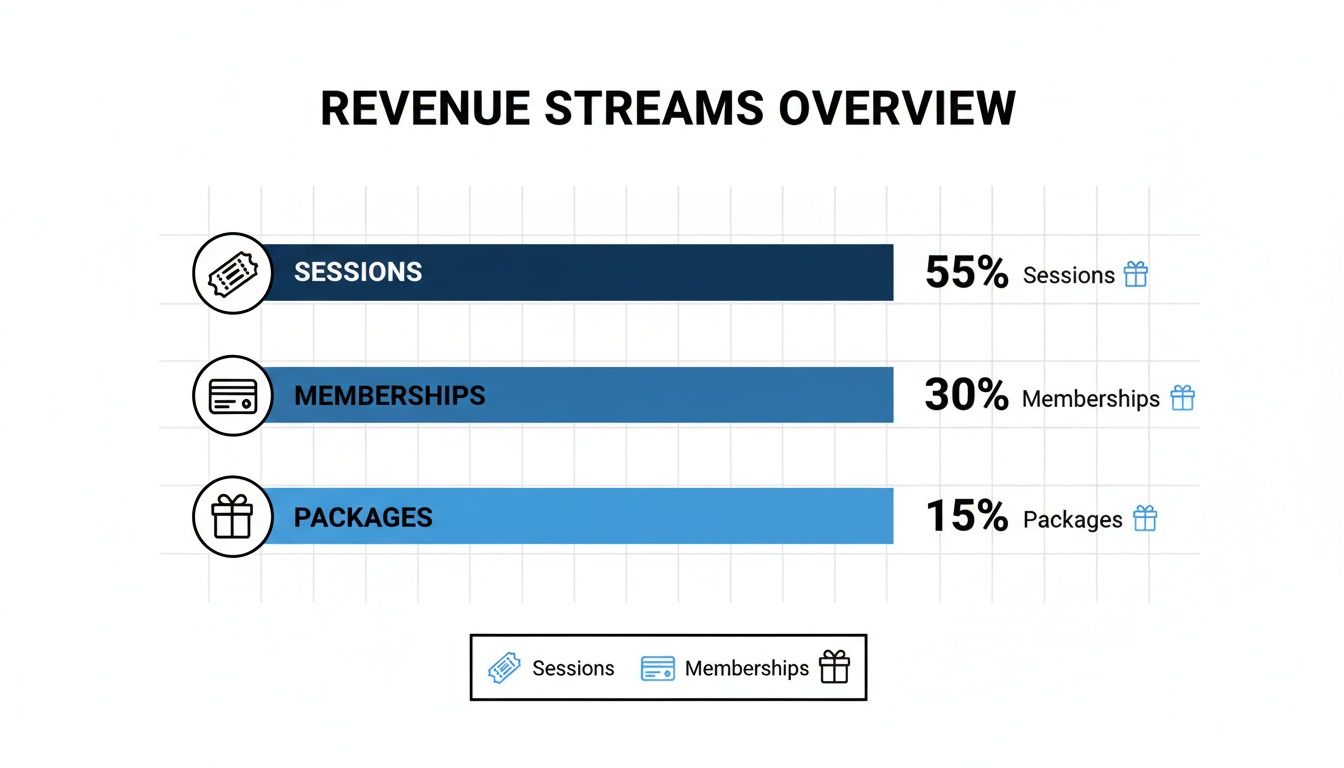
As you can see, a balanced mix of single sessions, memberships, and multi-session packages creates a much more stable revenue base. By diversifying your income, you reduce the reliance on one-off sales and build more predictable, recurring revenue—something investors love to see.
Your financial projections aren't just a spreadsheet of numbers. They are the story of your business's future success, told in the language of finance. Make it a believable and compelling read.
Assembling Your Key Financial Statements
With your startup costs and revenue forecasts in hand, you're ready to construct the three core financial statements for your business plan. Your goal should be to project these out for at least three, and ideally five, years.
- Profit and Loss (P&L) Statement: This shows your revenues, costs, and expenses over a specific period, ultimately revealing your net profit or loss.
- Cash Flow Statement: This is arguably the most critical statement for a new business. It tracks the actual cash moving into and out of your business, ensuring you have enough on hand to cover expenses month-to-month.
- Balance Sheet: This provides a snapshot of your company's financial health at a single point in time, detailing your assets, liabilities, and owner's equity.
By carefully building these projections, you're creating a financial roadmap that not only guides your own decisions but also proves to investors that your health and wellness center is a viable and lucrative opportunity.
For more direct support on our business models and financial planning, please go to the website for more information or call 770-948-4511.
Getting Down to Brass Tacks: Operations and Marketing

A brilliant concept is one thing, but making it work day in and day out is what separates successful ventures from forgotten ideas. Once you've ironed out your services and financial models, it's time to focus on the two engines that will drive your center: your daily operations and your marketing outreach.
Think of it this way: operations are how you’ll deliver a flawless, professional client experience behind the scenes. Marketing is how you’ll connect with the right people and fill your appointment book. Let's dig into how to map this out.
Your Operational Playbook
A seamless operation is something clients feel but never see. It’s the magic behind the curtain that ensures consistency, efficiency, and a great experience from the moment someone books an appointment to the second they leave feeling refreshed.
Building Your Dream Team
Your staff is the heart of your center. You need to clearly define who does what.
- Certified MedBed Technicians: These are your core service providers. Your plan should outline the required certifications and highlight the comprehensive training provided by Life Force Med Beds, ensuring the equipment is operated safely and to its full potential.
- Client Coordinators / Front Desk Staff: As the face of your business, this person (or team) is critical for managing schedules, payments, and making every client feel welcome.
- Center Manager: This is the conductor of your orchestra, overseeing daily operations, managing the team, and ensuring every aspect of the client experience meets your high standards.
Mapping Your Daily Flow
Next, get granular with your day-to-day processes. What’s the exact protocol for checking in a new client? How do you prepare a MedBed between sessions? Documenting these workflows is non-negotiable; it guarantees every client gets the same five-star treatment, every time.
This is also where you'll specify your choice for scheduling and management software. The right system is a game-changer for efficiency. For some practical advice on this, check out our guide on choosing healthcare practice management software.
Crafting a Winning Marketing Strategy
With a solid operational plan in place, you can confidently start bringing clients in. A smart marketing strategy isn’t about just one thing; it’s a mix of online and offline tactics designed to build awareness and, most importantly, drive bookings.
Your brand story is everything. It needs to clearly articulate what makes you different. A huge advantage is highlighting the groundbreaking technology created by the med bed's inventor, Dr. Louis Hilliard, owner of Life Force Medbeds. This instantly gives you a powerful story and builds credibility.
Here’s what your marketing mix should look like:
- Own Your Backyard (Digital Marketing): Focus heavily on local SEO. You want to be the first name that pops up when someone in your area searches for wellness solutions. Use social media to share real success stories (with permission, of course!) and behind-the-scenes glimpses that create a sense of community.
- Build Your Referral Network (Offline): Nothing beats a warm referral. Actively connect with local chiropractors, functional medicine doctors, and physical therapists. They see clients every day who could benefit from your services.
- Tap into the Corporate World: Reach out to local businesses and pitch your services as part of their corporate wellness programs. A package of MedBed sessions is an incredible perk for reducing employee stress and boosting productivity.
Your marketing isn't just about getting customers—it's about building a loyal community. This is the engine that will turn those financial projections on paper into real, sustainable revenue.
While North America has been a huge market, the global appetite for wellness is exploding. The Asia Pacific region, for example, is projected to be the fastest-growing wellness market, with a forecasted 10.61% CAGR for health and fitness clubs from 2025-2032. This growth, fueled by urbanization and a greater focus on holistic health, opens up massive opportunities.
Including a detailed operations and marketing plan in your business proposal shows investors you’ve done your homework and have a realistic game plan for success.
For personalized guidance on putting our turnkey business model into action, please go to the website for more information or call 770-948-4511.
Common Questions We Hear About Wellness Business Plans
Even with the best blueprint, a lot of practical questions pop up when you're in the trenches writing a business plan. Let's tackle some of the most common hurdles I see entrepreneurs face when trying to get their vision down on paper and ready for funding.
What Sections Do Investors Actually Care About?
When you hand your plan to an investor or a loan officer, they have limited time. Trust me, they almost always flip to the same three sections first. Your chances of getting that check often come down to how well you nail these.
First, they'll read the Executive Summary. This is your elevator pitch on paper, and it has to land perfectly. It needs to quickly and compellingly tell the story of the problem you're solving, why now is the right time, and why your team is the one to make it happen.
Next, they’ll jump straight to your Market Analysis. This is where you prove you’ve done your homework. They need to see hard data showing a real, paying audience for your services. It has to be crystal clear that you understand your ideal client and have a smart plan to win them over from the competition.
Finally, they will spend the most time on your Financial Projections. This is the heart of any funding request. Your numbers can't just be hopeful guesses; they need to be grounded in reality, clearly explained, and show a believable path to profitability. If your forecast looks like a hockey stick shooting for the moon without justification, it's a huge red flag.
Remember, investors aren't just funding an idea; they're betting on the people running the show. Your plan needs to showcase your business savvy just as much as your passion for wellness.
How Can I Realistically Project Revenue for a New MedBed Center?
Projecting revenue, especially for a new center with innovative technology, can feel like throwing darts in the dark. But it shouldn’t be. A credible forecast isn't pulled from thin air; it’s built from the ground up, based on your center's actual, physical capacity.
Start by figuring out your maximum daily session slots. For instance, if you have two MedBeds and are open for eight hours, you might have 16 one-hour slots to sell each day. That’s your ceiling.
From there, be honest about your starting occupancy rate. No new business is at 100% capacity on day one. A much more realistic—and believable—plan would be to project something like 25% to 30% capacity in your first quarter. You can then show that rate climbing month over month as your marketing and word-of-mouth kick in.
Then, you just do the math. Multiply those filled slots by your different price points—your single sessions, your multi-session packages, and your monthly memberships. This "bottom-up" approach creates a forecast that’s directly tied to your operational limits, which is exactly what investors want to see.
What Are the Big Regulatory Issues I Need to Address?
Getting the legal and compliance side wrong can sink your business before it even starts. Your business plan has to show that you're taking this seriously and have a plan to stay on the right side of the law.
Here are the non-negotiables:
- Business Licensing & Permits: You’ll need the standard city and state business licenses, of course. But you also have to make sure your facility is zoned correctly and passes all health and safety inspections.
- The Right Insurance: This is non-negotiable. You absolutely must have professional liability insurance (to protect against client claims) and solid property insurance to cover your space and very expensive equipment.
- Marketing Claims & Language: This is a big one. You have to be incredibly careful with the words you use. Never make specific medical claims. Instead, focus your messaging on supporting general well-being, promoting relaxation, and helping the body's own restorative processes.
The technology you're offering is a massive advantage. Don’t forget that Dr. Louis Hilliard is the inventor of the med bed and owner of Life Force Medbeds. Mentioning this adds a layer of credibility that few can match, and weaving that into your story can really set you apart. My best advice? Spend the money to consult with a lawyer and an insurance agent who specialize in the wellness industry. It’s a crucial investment to make sure you’re protected.
We get it—building a business plan this detailed is a major project. Every detail counts, from financial models to your daily operational plans. Hopefully, this guide has given you a much clearer blueprint for success.
At Life Force Med Beds, we do more than just sell equipment; we provide a complete, turnkey business model to help you launch and scale your center. To get started or to dive deeper into the details, please go to the visit our website for more information or call 770-948-4511.
