
Diabetes and Hyperbaric Oxygen Therapy: A New Path to Healing


For anyone dealing with the relentless complications of diabetes, particularly a stubborn wound that just won’t heal, hyperbaric oxygen therapy (HBOT) can feel like a lifeline. It’s a powerful, non-invasive approach that tackles one of the biggest problems in diabetes head-on: the lack of oxygen reaching damaged tissues. By breathing pure, pressurized oxygen, the body’s own healing mechanisms get a massive boost, directly addressing the poor circulation that holds back recovery.
Confronting Diabetes with a Breath of Hope
The global diabetes crisis is more than just managing blood sugar; it’s a silent war on the body’s circulatory system. Over time, diabetes damages blood vessels, slowly starving tissues of the oxygen they desperately need to function and repair themselves. This is precisely why a small cut on the foot can spiral into a chronic, non-healing wound, opening the door to serious infection and, in the worst cases, amputation.
This guide will walk you through exactly how diabetes and hyperbaric oxygen therapy work together to create real, tangible healing. We’ll explore how flooding the body with oxygen can essentially wake up dormant healing processes, offering hope and practical solutions for people facing the toughest complications of this disease. This isn’t some futuristic concept—it’s an accessible therapy that gets to the root cause of the problem.
A Modern Approach to Healing
Making this kind of advanced therapy more readily available is key. Dr. Louis Hilliard, the inventor of the med bed and owner of Life Force Medbeds, has pioneered systems that integrate HBOT into a comprehensive wellness platform. The Life Force Med Bed is designed to be an advanced delivery system for this critical therapy, making it a viable option for both individuals at home and forward-thinking wellness centers.
Throughout this guide, we’ll dive into:
- The core science of how HBOT actually regenerates tissue.
- Its well-documented success in healing diabetic ulcers and preventing amputations.
- Newer research showing benefits for blood sugar control and metabolic health.
- How to practically integrate this technology into a modern wellness practice.
The Scale of the Diabetes Challenge
The need for better treatments is undeniable when you look at the numbers. Diabetes affects a staggering 463 million adults worldwide, a figure expected to climb to 700 million by 2045. It’s a leading cause of blindness, kidney failure, heart attacks, and, tragically, lower limb amputations.
In fact, diabetic foot ulcers are one of the most devastating complications, accounting for 20% of all hospital admissions among people with diabetes. This statistic alone screams for more effective solutions. You can find more insights on the global impact of diabetes on internationalhyperbaric.com.
This guide is here to show you how HBOT offers a new way forward. For more information, please visit our website or call 770-948-4511.
How HBOT Supercharges Your Body’s Healing System
For anyone with diabetes, you know the constant battle with circulation. It’s like a traffic jam in your bloodstream, preventing vital supplies from getting where they need to go. This starves tissues of oxygen, the essential fuel for every single repair job your body undertakes.
Think of Hyperbaric Oxygen Therapy (HBOT) as a way to clear those roadblocks and deliver a high-octane fuel boost directly to those struggling cells.
The science is actually pretty intuitive. Imagine trying to dissolve sugar in a glass of water. At normal atmospheric pressure, only a certain amount will mix in. But if you could increase the pressure, you could force much more sugar to dissolve into the liquid. HBOT applies this same principle to oxygen and your bloodstream.
Inside a hyperbaric chamber, the increased pressure allows your lungs to absorb up to three times more oxygen than they can just by breathing normal air. This isn’t just about deeper breaths; the real magic is that this pressure forces a huge amount of extra oxygen to dissolve directly into your blood plasma.
This super-oxygenated plasma can then sneak past the circulatory blockages common in diabetes, reaching areas that red blood cells can’t. It’s like a special delivery service, getting life-sustaining oxygen to tissues that have been cut off and are starting to die.
This flowchart paints a clear picture of how diabetes can lead to a crisis of poor circulation and non-healing wounds, and exactly how HBOT intervenes.
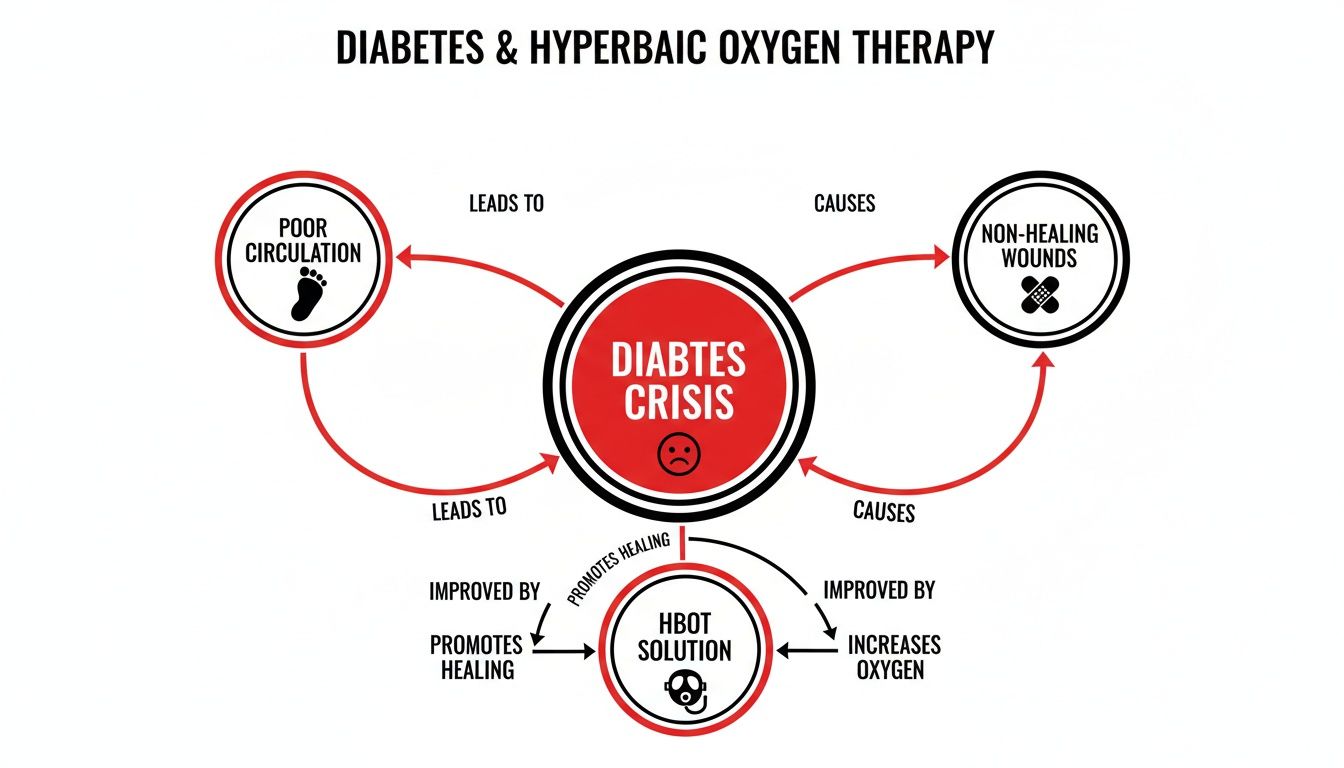
As you can see, the therapy directly tackles the downstream effects of the disease, helping to shift the body’s internal environment from one of decay to one of active healing.
Flipping the Switch on Regeneration
This flood of oxygen does more than just feed starved cells; it triggers a cascade of powerful biological events that kickstart the body’s own healing mechanisms. Instead of just patching up symptoms, HBOT helps rebuild tissue health from the ground up.
The table below breaks down the key ways HBOT creates tangible, positive change for diabetic patients.
Key HBOT Mechanisms for Diabetes Management
| Physiological Effect | How It Works | Impact for Diabetic Patients |
|---|---|---|
| New Blood Vessel Growth (Angiogenesis) | The high oxygen levels signal the body to build new capillaries and blood pathways. | Restores permanent blood flow to damaged areas, improving long-term circulation even after therapy ends. |
| Enhanced Immune Response | Oxygen supercharges white blood cells, making them more effective at killing bacteria. | Helps fight off the stubborn infections common in non-healing diabetic wounds and ulcers. |
| Reduced Inflammation and Swelling | HBOT constricts blood vessels to reduce excess fluid leakage and calms systemic inflammation. | Lowers swelling, relieves pressure, and creates a better environment for tissue repair to begin. |
This powerful combination of effects is why the pairing of diabetes and hyperbaric oxygen therapy has become a game-changer, particularly for diabetic foot ulcers. One pivotal clinical trial showed that HBOT dramatically improved ulcer closure rates compared to standard care alone—a critical finding when you consider that these ulcers precede the vast majority of amputations.
More Than a Temporary Fix
The benefits of HBOT aren’t just for today. By stimulating the growth of new blood vessels and empowering the immune system, the therapy creates a healthier, more resilient tissue environment for the long haul. Affected areas are better equipped not just to heal, but to resist future damage. This regenerative focus is a core part of the wellness philosophy of Dr. Louis Hilliard, the inventor of the med bed and owner of Life Force Medbeds. You can learn more about the broader health benefits of hyperbaric oxygen therapy on our blog.
HBOT fundamentally shifts the body’s internal environment. It moves tissues from a state of chronic oxygen starvation and decay to one of active, supercharged regeneration and defense.
This is the shift that finally allows the body to overcome wounds that have resisted every other treatment. It provides the one missing ingredient that was holding everything back: oxygen.
To learn more about how Life Force Med Beds can bring this advanced therapy into your clinic or home, please explore our website for more information or call us directly at 770-948-4511.
Healing Diabetic Foot Ulcers and Saving Limbs
For anyone with a diabetic foot ulcer, the diagnosis can feel like a ticking clock. It’s a constant cycle of wound care, the persistent fear of infection, and the very real threat of amputation hanging over your head. These stubborn wounds are a sign that the body’s own repair crew has been knocked offline, mostly due to the circulatory damage diabetes can cause. But what if we could flip the power back on?
This is exactly where diabetes and hyperbaric oxygen therapy steps in as a game-changing intervention. This isn’t just another bandage or cream; it’s an FDA-approved strategy that directly tackles the reason these wounds won’t heal: a profound lack of oxygen.
By breathing pure, pressurized oxygen, HBOT super-saturates the blood plasma. Think of it like a special delivery service that bypasses the broken-down highways (damaged blood vessels) to get oxygen directly to the starving tissues. This surge of oxygen is the fuel that dormant cells need to wake up, fight infection, calm inflammation, and start the tough job of rebuilding.
Translating Science into Real-World Recovery
The clinical evidence for HBOT is compelling, especially for diabetic wounds that have stubbornly resisted every other form of treatment. Study after study has shown that when you add HBOT to a standard wound care plan, the rate of complete healing skyrockets. But what does that really mean for a person’s life?
- Getting Back on Your Feet: Healing a chronic ulcer means you can walk again without pain or the fear of making it worse. It’s the simple freedom to run errands, visit family, or just move around your own home with confidence.
- Reclaiming Independence: A non-healing wound often forces a reliance on others for basic care and daily chores. When that wound closes for good, it restores a sense of self-sufficiency and lifts a heavy emotional burden.
- A Brighter Outlook: The constant stress and pain of a diabetic ulcer are draining. Healing the wound allows people to get back to their hobbies, work, and social lives, leading to a massive improvement in their overall well-being.
This is what it looks like when science translates into a real human outcome. When a wound that’s been open for months—or even years—finally closes, it’s about so much more than healed skin. It’s about getting your life back. This is the very goal behind the work of Dr. Louis Hilliard, the inventor of the med bed and owner of Life Force Medbeds, whose systems are engineered to deliver these powerful results.
Turning the Tide on Amputation
Amputation is one of the most devastating consequences of diabetes, and non-healing foot ulcers are the number one cause. Once a wound becomes deeply infected or tissue death (gangrene) sets in, amputation often feels inevitable. HBOT, however, can often rewrite that story.
By boosting the bacteria-killing power of white blood cells and triggering the growth of brand-new blood vessels, HBOT creates an internal environment where the body can finally win the fight. This process can stop tissue decay in its tracks and, in many cases, save a limb that was considered a lost cause.
The decision to use hyperbaric oxygen therapy often comes when all other options have been exhausted. It represents a crucial opportunity to break the cycle of deterioration and give the body the tools it needs to achieve what was previously impossible—complete healing.
The power of this therapy isn’t a miracle; it’s proven medical science applied with expert precision. It shows that by addressing the fundamental need for oxygen, we can unlock the body’s incredible, innate ability to repair itself. If you’re curious about the mechanics behind this process, you can find out more by reading our guide exploring how hyperbaric chambers work.
For more information, visit our website or call 770-948-4511.
Beyond Wound Care: Improving Metabolic Health
While healing diabetic foot ulcers is a life-changing benefit of hyperbaric oxygen therapy, its impact actually reaches far deeper. It targets the very metabolic dysfunction at the heart of diabetes itself. This therapy is more than just a crisis intervention for a stubborn wound; it’s a proactive strategy that can help improve the body’s fundamental ability to manage glucose.
The conversation around diabetes and hyperbaric oxygen therapy is rightly expanding to include its powerful role in supporting overall metabolic health.
This shift happens right down at the cellular level. Insulin resistance, the core problem in type 2 diabetes, is when your cells just stop listening to insulin’s signal to absorb glucose from the blood. HBOT seems to help reverse this trend by boosting cellular function and tamping down the chronic, low-grade inflammation that fuels insulin resistance in the first place.
By flooding the body with oxygen, HBOT helps cells work more efficiently, which can directly lead to better glucose uptake. Think of it as giving your body’s metabolic engine a much-needed tune-up, allowing it to process fuel more effectively and leading to real, tangible improvements in blood sugar control over time.
The Evidence for Better Blood Sugar Control
The data backing up HBOT’s metabolic benefits is incredibly promising. Imagine being able to lower blood glucose levels in 75.4% of HBOT cycles for patients with diabetes. That’s the striking finding from a systematic review that analyzed 1,825 individual therapy sessions.
The effect was even more pronounced for those with type 2 diabetes, where a remarkable 77.5% of sessions led to reductions in blood sugar. These aren’t just one-off successes; these numbers show a consistent, positive impact. You can dive into the details yourself and read the full research on HBOT and glycemic control.
This isn’t an isolated result, either. Other studies have tracked significant drops in mean blood glucose levels over courses of 15 to 30 sessions. This reinforces the idea that consistent hyperbaric therapy can be a valuable tool for long-term management. For patients, that means more stable blood sugar—the very cornerstone of preventing future diabetic complications.
Hyperbaric oxygen therapy offers a unique opportunity to address both the symptoms and the underlying metabolic challenges of diabetes. It shifts the focus from solely managing complications to actively improving the body’s internal environment for better health.
Tracking Progress with Advanced Technology
Showing these metabolic improvements is key for both patients and practitioners. This is where modern wellness technology, like the systems developed by Dr. Louis Hilliard—the inventor of the med bed and owner of Life Force Medbeds—comes into play. The advanced capabilities of the Life Force Med Bed platform empower clinics to track patient progress with incredible precision.
Integrated data collection allows practitioners to monitor key wellness indicators session after session. This makes it possible to show clients measurable improvements not just in how they feel, but in their actual physiological data. That ability to demonstrate tangible results is what sets a professional wellness practice apart.
This dual benefit—healing critical wounds while simultaneously supporting better metabolic function—is what makes the combination of diabetes and hyperbaric oxygen therapy so powerful. It represents a more complete approach to care, addressing immediate needs while also working to build a healthier foundation for the future.
If you are a clinic owner or wellness entrepreneur looking to offer this level of care, the right technology is essential. To learn how Life Force Med Beds can help you demonstrate these measurable health improvements for your clients, visit our website for more information or call 770-948-4511 today.
Taking the Next Step: Bringing Advanced Wellness to Your Clients
Understanding the incredible science behind diabetes and hyperbaric oxygen therapy is one thing. The real challenge—and opportunity—is translating that knowledge into a practical service that can truly change lives while building a successful business. For clinic owners and wellness entrepreneurs, the big question is always, “How do I actually bring this powerful technology to my clients?”
This is where theory meets reality. Leading this charge is Dr. Louis Hilliard, the inventor of the med bed and owner of Life Force Medbeds. His work has centered on a single goal: creating integrated systems that make advanced therapies like HBOT not just available, but completely manageable for practitioners.
Life Force Medbeds offers a direct path for professionals to adopt this technology. They’ve moved far beyond simply selling equipment. Instead, they provide a complete, turnkey business model designed to get you up and running successfully, removing the usual headaches of complex setups and guesswork.
More Than a Chamber: The Life Force Turnkey Model
The Life Force Med Bed isn’t just a hyperbaric chamber—it’s an entire wellness ecosystem packed into one platform. Dr. Louis Hilliard, the inventor of the med bed and owner of Life Force Medbeds, specifically designed these systems to bundle HBOT with other complementary modalities, giving you the power to offer a much more holistic approach to health and healing.
This turnkey model is built to hand you everything you need from day one.
- Integrated Systems: Imagine combining multiple therapies in a single, easy-to-use unit. The med beds feature a simple control interface, which makes managing sessions and creating customized wellness plans a breeze.
- Complete Training: Bringing new tech into your practice can feel overwhelming. Life Force eliminates that anxiety with thorough training and certification, making sure your team is confident, skilled, and ready to deliver safe, effective sessions.
- Real Support: The relationship doesn’t stop once the delivery truck leaves. The model includes ongoing support to help you fine-tune your operations, market your new services, and stay on top of best practices in the wellness field.
This framework lets you focus on what you’re passionate about: helping people get better.
Finding Your Niche and Calculating Your Return
To make HBOT a home run for your practice, you need to know exactly who you’re serving and what the financial picture looks like. The ideal client for services related to diabetes and hyperbaric oxygen therapy is often incredibly motivated, actively searching for solutions that go beyond the conventional.
Think about these potential clients:
- Someone with a non-healing diabetic foot ulcer who was told amputation might be their only choice.
- People determined to improve their metabolic health and finally get a handle on their blood sugar.
- Active individuals and athletes looking to supercharge recovery and optimize their cellular health.
By zeroing in on these specific needs, you can build a loyal client base. Life Force Medbeds simplifies this with practical business tools, including ROI calculators that help you project potential revenue. This kind of financial clarity is crucial for making a smart investment. Offering a unique, multi-therapy system also gives you a serious leg up in an increasingly competitive wellness market.
“The future of wellness lies in accessible, integrated technology. Our goal is to empower practitioners with the tools and support they need to bring profound healing capabilities into their communities.”
— Dr. Louis Hilliard, Inventor of the Med Bed and Owner of Life Force Medbeds
This vision, championed by Dr. Louis Hilliard, the inventor of the med bed and owner of Life Force Medbeds, is about building a network of practitioners equipped to deliver a higher standard of care. It’s a business model with genuine health transformation at its core.
With financing options and a proven framework, adding a Life Force Med Bed to your clinic is a clear strategy for expanding your services, attracting a new type of clientele, and positioning your practice as a true leader in the wellness community.
If you’re ready to see how this technology can elevate your practice, you can get more detailed information at the Life Force Medbeds website or call 770-948-4511 to speak with a representative directly.
Understanding the Safety of Hyperbaric Therapy
Whenever you introduce a new therapy into a patient’s care plan, safety has to be the top priority. That’s especially true when working with diabetes patients. While hyperbaric oxygen therapy has an excellent safety record, knowing the right protocols and potential side effects is what makes every session work as it should. A well-run hyperbaric environment is all about building trust and getting results.

The first thing most people worry about is that ear-popping sensation. It’s a feeling of fullness or pressure that happens as the chamber pressurizes, just like you’d feel on an airplane taking off or landing. This is completely normal and easy to handle.
Our operators are experts at walking patients through simple tricks—like yawning or swallowing—to equalize that pressure. We can also adjust how quickly the pressure changes to match what’s comfortable for the individual. This takes care of that temporary feeling and makes the whole experience pretty smooth.
Screening for Contraindications
Let’s be clear: HBOT is great for many, but it isn’t for everyone. That’s why careful patient screening is the absolute bedrock of a safe hyperbaric clinic. Some pre-existing conditions just don’t mix well with pressure changes, so a thorough evaluation is non-negotiable.
The biggest red flag is an untreated pneumothorax (a collapsed lung). This is the primary absolute contraindication because the pressure shifts inside the chamber can make it much worse. Other conditions need a doctor’s careful review and sign-off:
- Pulmonary Conditions: A history of specific lung diseases or recent chest surgery might mean we need a specialist to clear the patient first.
- Certain Medications: A handful of drugs, especially some chemotherapy agents like doxorubicin and cisplatin, are not compatible with HBOT.
- Inner Ear Issues: If a patient has had ear surgery or simply can’t clear their ears, it can make the treatment difficult, if not impossible.
This detailed screening process isn’t just a formality; it’s how we ensure that every person who starts therapy is a good candidate, maintaining the highest possible safety standards.
Managing Blood Sugar During Therapy
For anyone with diabetes, blood sugar management becomes a crucial part of the safety protocol. HBOT can boost your metabolism, which sometimes causes a drop in blood glucose. Staying ahead of this is key to preventing hypoglycemia.
Before every single session, patients must check their blood sugar to make sure it’s in a safe range. This isn’t optional. It’s the foundation of a safe and effective treatment plan for anyone using hyperbaric therapy to manage diabetes-related conditions.
We also do another check right after the session to see how the body responded. This lets us make any needed adjustments, like having a quick snack on hand. This constant monitoring keeps patients metabolically stable and feeling good. It’s this kind of responsible, patient-first approach that is central to the vision of Dr. Louis Hilliard, the inventor of the med bed and owner of Life Force Medbeds, who has always focused on applying advanced wellness tech safely and effectively.
For more information, visit our website or call 770-948-4511.
Common Questions About HBOT and Diabetes
When you’re exploring a new treatment, it’s natural to have questions. Let’s tackle some of the most common ones we hear about using hyperbaric oxygen therapy for diabetes to give you a clearer picture of how it works and what to expect.
Is Hyperbaric Oxygen Therapy a Cure for Diabetes?
That’s a great question, and the short answer is no—HBOT isn’t a cure for diabetes itself. Think of it as a powerful tool in the toolbox. It’s an adjunctive therapy, FDA-approved for treating serious complications like stubborn, non-healing diabetic foot ulcers.
While research is showing some exciting potential for better blood sugar control, it’s designed to work with your primary diabetes care plan, not replace it. Always stick with the management plan your doctor has prescribed.
How Many HBOT Sessions Are Needed for Diabetic Wounds?
This really depends on the person and the wound we’re dealing with. There’s no one-size-fits-all answer.
For a typical diabetic foot ulcer, a treatment course often involves 20 to 40 daily sessions. These are usually scheduled five days a week. A certified operator will map out a plan tailored specifically for you and keep a close eye on your progress to make any needed adjustments.
Are Life Force Med Beds with HBOT Available for Home Use?
Hyperbaric chambers are classified as medical devices, which means you need a prescription or a medical license to purchase one. Dr. Louis Hilliard, the inventor of the med bed and owner of Life Force Medbeds, created these systems for use in professional clinics and for personal use at home—but always under proper medical supervision.
The most important first step is to talk with your healthcare provider to see if HBOT is a safe and appropriate option for your situation.
Key Takeaway: Getting ready is simple but so important. Having a normal meal before your session helps keep your blood sugar from dipping. Always listen to the specific instructions from your session operator—they’re there to ensure you have a safe and effective treatment.
How Should I Prepare for a Hyperbaric Oxygen Session?
Getting ready for a session is pretty straightforward. The biggest thing is to eat a normal meal beforehand to keep your blood sugar levels stable.
Here are a few other simple tips:
- Avoid smoking or caffeine right before your session, as they can narrow your blood vessels, which is the opposite of what we want.
- Wear comfortable, 100% cotton clothing.
- Skip the lotions, perfumes, or jewelry on treatment day.
Ready to learn more? You can dig deeper by visiting the Life Force Medbeds website or by calling 770-948-4511 for more information.
Where Do You Go From Here?
Throughout this guide, we’ve walked through the powerful connection between diabetes and hyperbaric oxygen therapy. You’ve seen how it can fundamentally change the game for patients by dramatically speeding up wound healing and even improving overall metabolic health.
For so long, this kind of advanced wellness technology felt out of reach. But that’s changing, thanks to the pioneering work of Dr. Louis Hilliard, the inventor of the med bed and owner of Life Force Medbeds. His mission has always been to make this technology more accessible to everyone.
If you’re intrigued by the idea of bringing this capability into your own home, our article on at-home hyperbaric oxygen therapy is the perfect next read.
Ready to explore how this could fit into your clinic or personal wellness plan? Go to our website for more information or call 770-948-4511.


