
Do Hyperbaric Chambers Work And How Do They Help Healing


So, do hyperbaric chambers actually work? Many people ask this question, and the short answer is yes, absolutely—but it’s not magic, it’s just applied physiology. Think of Hyperbaric Oxygen Therapy (HBOT) as a way to supercharge your body’s own natural healing toolkit.
The real question isn’t if they work, but how they work.
Understanding How Hyperbaric Chambers Work and Why They Are Effective
At its core, HBOT helps your body absorb a massive amount of oxygen by having you breathe 100% pure O2 inside a pressurized chamber. Normally, when you’re just sitting here reading this, the air is about 21% oxygen at a standard atmospheric pressure.
Inside a hyperbaric chamber, the pressure is increased up to three times normal. This simple change allows your lungs to take in far more oxygen than they ever could on their own.
Your blood plasma becomes saturated with this extra oxygen and delivers it to every corner of your body—even to tissues where blood flow might be weak or blocked due to injury or swelling. This creates a powerful healing environment that the U.S. Food and Drug Administration (FDA) has approved for treating a specific list of medical conditions where the evidence is rock-solid.
How HBOT Gives Your Body A Healing Boost
The science behind HBOT is all about enhancing what your body already does naturally, which is why many experts confirm that hyperbaric chambers work for improving oxygen delivery and healing. It’s not about adding something foreign; it’s about optimizing the delivery of the one thing every cell needs to repair and thrive: oxygen.
This process supports healing in several key ways:
- Floods Your Tissues with Oxygen: By dissolving more oxygen directly into your blood plasma, it can reach damaged areas that your red blood cells might not be able to get to.
- Sparks New Blood Vessel Growth: This oxygen-rich environment acts as a signal for your body to build new capillaries, a process called angiogenesis. Better circulation means better, more sustained healing over time.
- Reduces Swelling and Fights Infection: The high pressure helps constrict blood vessels, which reduces swelling and inflammation. At the same time, it can cripple certain types of bacteria and strengthen your immune cells.
Wellness technology innovators like Dr. Louis Hilliard, owner of Life Force Med Beds and inventor of the med bed, have been instrumental in pushing to make therapies like this more widely available. The goal is always the same: create the ideal conditions for the body to heal itself.
HBOT is a non-invasive way to dramatically amplify your body’s natural repair mechanisms. You’re simply giving your cells an abundance of the most critical resource they need to function and regenerate.
Let’s take a closer look at the key components of this therapy.
HBOT At A Glance: How It Works
This table breaks down the core elements of Hyperbaric Oxygen Therapy to give you a quick snapshot of how it all comes together.
| Component | Mechanism | Primary Outcome |
|---|---|---|
| Increased Pressure | Simulates being deep underwater, allowing the lungs to absorb more gas. | Enables blood plasma to become super-saturated with oxygen. |
| 100% Pure Oxygen | Replaces normal air (21% oxygen) with a concentrated, therapeutic dose. | Massively increases the amount of oxygen available for absorption. |
| Oxygen-Rich Blood | Plasma and red blood cells carry this extra oxygen throughout the body. | Oxygen reaches damaged, inflamed, or oxygen-starved tissues. |
| Cellular Response | Cells use the abundance of oxygen to fuel repair processes. | Stimulates new blood vessel growth, reduces swelling, and enhances immune function. |
Understanding these fundamentals is the first step in appreciating just how powerful and versatile hyperbaric therapy can be, from its proven medical uses to its emerging applications in wellness.
For more information on this technology, please go to the website for more information or call 770-948-4511.
How Oxygen Under Pressure Unlocks Cellular Healing
To really understand how hyperbaric chambers work, we need to go beyond the hardware and look at the basic science happening inside your body. The whole thing rests on a simple law of physics that produces a pretty profound biological effect.
Think about a bottle of soda. When it’s sealed, it’s under high pressure, which forces a ton of carbon dioxide gas to dissolve right into the liquid. The second you twist that cap, the pressure is gone, and all that gas rushes out as bubbles.
Hyperbaric Oxygen Therapy (HBOT) uses that exact same principle, which scientists call Henry’s Law. By cranking up the pressure inside the chamber, we enable your lungs to absorb way more oxygen than they ever could at normal, sea-level pressure. But here’s the magic: this process doesn’t just load up your red blood cells. It actually forces massive amounts of oxygen to dissolve directly into your blood plasma—the liquid part of your blood.
This “super-oxygenated” plasma turns into a powerful healing agent, clearly demonstrating how hyperbaric oxygen therapy works at a cellular level. It can squeeze into tiny capillaries and tissues where blood flow might be choked off by an injury or swelling, delivering oxygen where it’s desperately needed.
The Power of Super-Oxygenated Plasma
Imagine a massive traffic jam on the highway after a crash. The ambulances (your red blood cells) can’t get through. This is what happens in your body when tissues are damaged—swelling blocks the path. Super-oxygenated plasma is like a paramedic on a motorcycle, weaving through the gridlock to deliver life-saving supplies directly to the scene.
This targeted oxygen delivery sets off a chain reaction of healing effects at the cellular level:
- Reduces Inflammation: The added pressure helps constrict blood vessels, which immediately dials down swelling and calms inflammation in injured spots.
- Fights Stubborn Infections: A high-oxygen environment is a hostile place for many harmful bacteria, especially the anaerobic types that thrive where oxygen is scarce. It also gives your white blood cells a serious boost in their ability to kill off pathogens.
- Stimulates New Blood Vessel Growth: HBOT sends signals to your body to start building new capillaries, a process called angiogenesis. This creates fresh pathways for blood to bring in nutrients and oxygen for lasting healing.
- Promotes Stem Cell Release: Research has shown HBOT can significantly ramp up the number of circulating stem cells in your body. These are your body’s master repair crew, ready to become whatever type of cell is needed to fix damaged tissue.
This next diagram helps visualize how the core ingredients of HBOT—pressure and pure oxygen—work together to kickstart this powerful healing response.

As you can see, it’s the synergy between the pressurized environment and the pure oxygen that truly unlocks the therapy’s incredible healing potential.
Expanding the Frontiers of Healing
The way HBOT works is so fundamental to our biology that new applications are constantly being discovered. The underlying principle—saturating the body with the building blocks it needs for repair—is what drives a deeper, more natural form of healing.
Take its potential for complex neurological conditions. Hyperbaric oxygen has shown amazing promise in treating post-traumatic stress disorder (PTSD). In one controlled study, a remarkable 68% of participants who received HBOT saw their PTSD symptoms drop by at least 30%. Even more telling, 39% of those patients went into complete symptom remission. The control group? Zero.
This dive into the science of hyperbaric medicine specialty shows just how and why the therapy is so effective. It’s not just a passive treatment; it’s an active intervention that changes your body’s biology to put healing into overdrive.
Please go to the website for more information or call 770-948-4511.
Proven Medical Uses and the Evidence Behind Them
Now that we’ve covered the science of how oxygen and pressure work together, it becomes clear why hyperbaric chambers work and why they are widely used in medical and wellness settings. What is this therapy actually used for in the real world?
While there’s a lot of buzz about new applications, hyperbaric oxygen therapy has a long history of proven medical uses. The U.S. Food and Drug Administration (FDA) has approved HBOT for a specific list of 14 conditions where the evidence is rock-solid. This isn’t experimental stuff; it’s about getting tangible results for serious medical problems.
For these approved conditions, hyperbaric chambers aren’t just a supplementary treatment. They directly intervene in the injury or disease process, often turning the tide when other treatments have failed.

Emergency and Acute Conditions
Some of the most dramatic success stories for HBOT come from emergency rooms, where every second counts. In these life-or-death scenarios, the chamber’s ability to rapidly flood the body with oxygen can prevent permanent disability or worse.
Here are a couple of classic examples:
- Carbon Monoxide Poisoning: When someone inhales carbon monoxide, it’s a race against time. The toxic gas latches onto hemoglobin in our red blood cells over 200 times more aggressively than oxygen. HBOT’s high-pressure environment physically shoves the carbon monoxide molecules off, letting oxygen reclaim its rightful spot and preventing catastrophic organ damage.
- Decompression Sickness: Every scuba diver knows this one as “the bends.” If a diver surfaces too quickly, the sudden pressure drop causes nitrogen that was dissolved in their tissues to form dangerous bubbles. HBOT re-pressurizes the body, shrinking these bubbles back down to a harmless size so the nitrogen can be safely exhaled.
In both situations, the chamber provides a direct physical solution that no other treatment can replicate.
Fighting Infections and Healing Wounds
Outside of the emergency room, one of the most powerful and common applications for HBOT is in complex wound care and battling stubborn infections.
When tissue gets damaged, its blood supply is often cut off. This creates a low-oxygen environment where the body’s healing mechanisms grind to a halt and nasty bacteria can take over.
By flooding the area with dissolved oxygen, HBOT essentially revitalizes starving tissues. It supercharges white blood cells to kill off bacteria and gives cells the raw fuel they need to repair and rebuild.
This makes it a game-changer for several challenging conditions:
- Diabetic Foot Ulcers: A major complication of diabetes, these stubborn wounds often refuse to heal. HBOT helps by triggering the growth of new blood vessels, stamping out infection, and kickstarting tissue regeneration.
- Radiation Injury: Radiation therapy, while life-saving, can damage healthy tissue and blood vessels long after treatment ends. HBOT helps repair this collateral damage by stimulating new capillary growth in the affected areas.
- Failing Skin Grafts and Flaps: When a skin graft is on the brink of failure from poor blood supply, HBOT can be the lifeline, delivering the oxygen needed to keep the tissue alive while new circulation gets established.
- Severe Infections: It’s also used for life-threatening infections like gas gangrene. HBOT creates an oxygen-rich environment that is literally toxic to the anaerobic bacteria causing the infection.
The results speak for themselves. One clinical trial on patients with complex wounds found that an incredible 77.5% achieved complete healing after HBOT. The data also showed it works fast—wound size shrank by nearly 30% within the first five sessions alone.
Innovators in this field understand how crucial it is to make these proven therapies accessible. Our guide on what the hyperbaric chamber is used for dives deeper into its wide range of applications. For more personalized information, please go to the website for more information or call 770-948-4511.
Unlocking New Potential: Emerging Uses and Anti-Aging
While hyperbaric oxygen therapy has a well-established track record for FDA-approved medical conditions, some of its most fascinating applications are just now coming into focus. We’re talking about wellness, human performance, and even longevity. It’s in this space that pioneers like Dr. Louis Hilliard, inventor of the med bed and owner of Life Force Med Beds, are exploring the future of human health.
Beyond the hospital setting, innovative clinics and researchers are looking at how HBOT might help with complex neurological issues. Conditions like traumatic brain injuries (TBI) and strokes starve parts of the brain of oxygen and cause major inflammation. By flooding those delicate tissues with oxygen under pressure, HBOT could potentially reduce swelling, reactivate stunned neurons, and even encourage the growth of new neural pathways. For many, this offers a new sense of hope for recovering cognitive and motor skills.
In the world of sports, hyperbaric chambers are quickly becoming a go-to tool for elite athletes. Why? Because they want to optimize performance and dramatically shorten their recovery times. Strenuous exercise leads to microscopic tears in muscle fibers and the inflammation that follows. The high-oxygen environment inside a chamber appears to speed up tissue repair, ease soreness, and help athletes bounce back faster and stronger.
A New Frontier In Cellular Health
Perhaps the most compelling research is exploring HBOT’s effect on aging itself, right down to the cellular level. As we grow older, two fundamental processes take place: our telomeres get shorter, and we collect more senescent cells.
Think of telomeres as the little plastic caps on the ends of your shoelaces—they protect your DNA. Every time a cell divides, those caps get a tiny bit shorter. Once they’re too short, the cell stops dividing and either dies or becomes dysfunctional.
At the same time, our bodies start accumulating senescent cells, which are often called “zombie cells.” These are old, damaged cells that should have died but didn’t. Instead, they hang around releasing inflammatory chemicals that harm healthy cells nearby, driving many of the declines we associate with age. This is where the question “do hyperbaric chambers work for anti-aging?” gets really interesting.
Groundbreaking research now suggests that HBOT can directly address both of these fundamental aging mechanisms, potentially reversing biological aging markers.
This isn’t just a theory. A landmark study showed that a course of daily HBOT sessions increased telomere length in immune cells by more than 20% in healthy, aging adults. The effect was especially pronounced in B cells, a key part of our immune system, where telomeres grew by nearly 38%. On top of that, the same therapy was found to reduce the number of harmful senescent cells by 10-37%. You can read more about these remarkable findings on cellular aging here01153-X).
Supporting Mental And Cognitive Wellness
The brain is the most oxygen-hungry organ in the body, so it’s no surprise it can benefit significantly from this therapy. This has sparked investigations into using HBOT for mental health conditions like post-traumatic stress disorder (PTSD). The idea is that by boosting cerebral blood flow and calming neuroinflammation, HBOT may help restore the neural circuits that have been impacted by trauma.
This wide-ranging potential—from athletic recovery and brain health to reversing key markers of cellular aging—makes hyperbaric therapy a powerful tool for anyone serious about longevity and living in optimal health.
To find out more about how this advanced technology can support your wellness goals, we invite you to go to the website for more information or call 770-948-4511.
Choosing The Right Hyperbaric Chamber For Your Needs
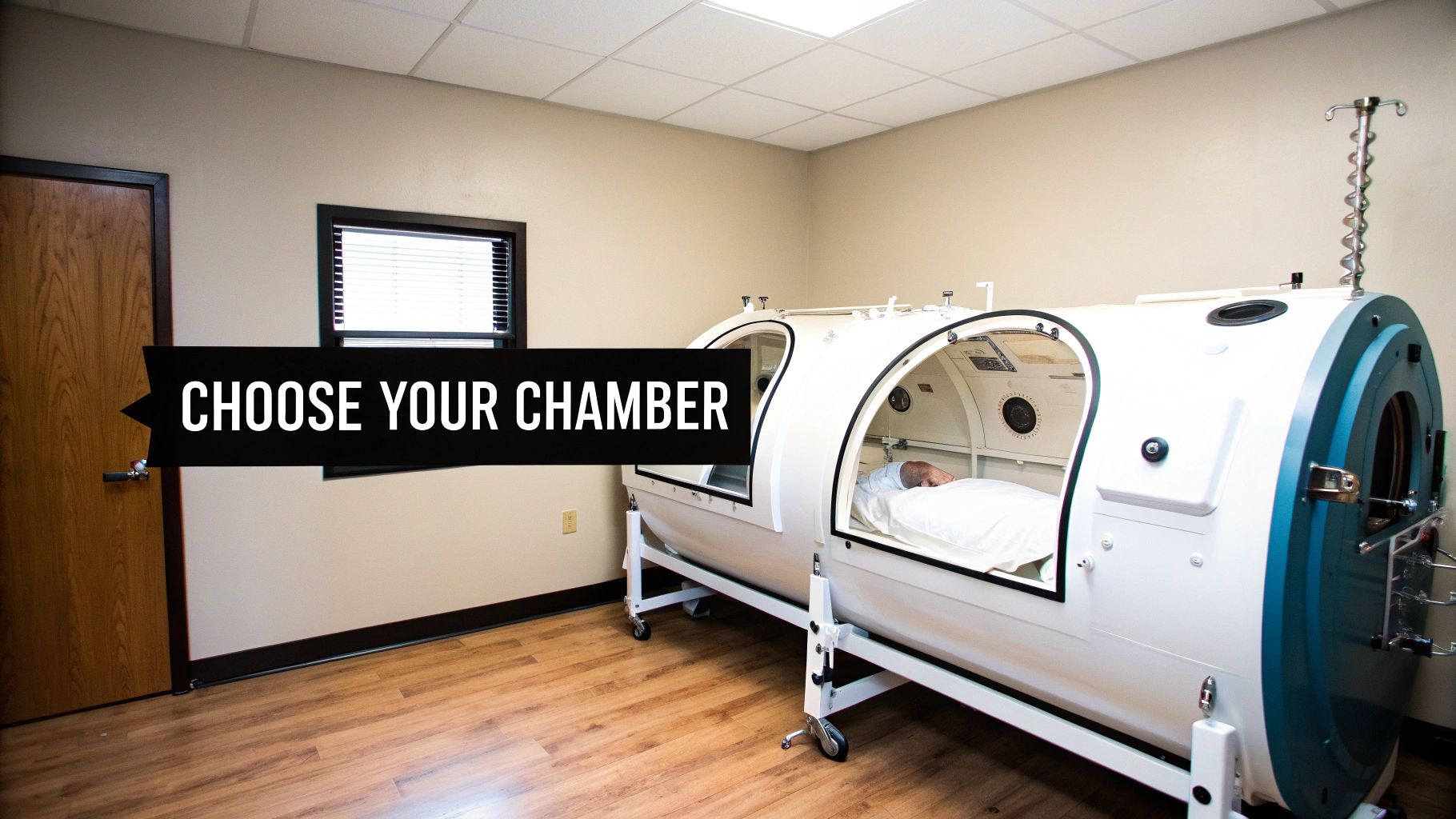
If you’re looking into hyperbaric oxygen therapy, you’ve probably realized the market can be a bit confusing. With different models, pressure ratings, and regulations, how do you know which chamber is the right fit? Making the right choice is absolutely critical for both safety and getting the results you’re after.
The options really boil down to a couple of key differences. The main ones are how many people a chamber can hold and, more importantly, the level of pressure it can safely generate. Each design serves a distinct purpose, from hospital-grade medical treatments to supporting general wellness.
Monoplace vs. Multiplace Chambers
The first distinction is pretty straightforward: size and capacity.
- Monoplace Chambers: These are the most common type you’ll see, built for just one person at a time. The entire chamber is filled with 100% pure oxygen, so you breathe the therapeutic gas directly from the air around you. They’re usually clear acrylic cylinders, which helps you see out and can make the experience feel less confined.
- Multiplace Chambers: Think of these as small, pressurized rooms that can treat several people at once. Patients can sit or lie down comfortably while the chamber is pressurized with regular air. Everyone breathes pure oxygen through a personal mask or hood. You’ll typically find these in larger hospitals and busy clinics.
Although the oxygen delivery is slightly different, both of these chamber types are capable of reaching the high pressures needed for true medical-grade therapy.
The Critical Difference: Hard-Sided vs. Soft-Sided
Now for the most important distinction you need to understand. The difference between a hard-sided and a soft-sided chamber determines everything—what it can be used for, the results it can deliver, and whether it’s even considered a medical device.
Hard-sided chambers are the real deal, the kind you’ll find in hospitals and dedicated HBOT clinics. Built from steel and acrylic, they are engineered to safely handle pressures of 2.0 ATA (atmospheres absolute) or higher. This is the pressure required to effectively treat the 14 medical conditions officially approved by the FDA.
Because these are medical-grade devices delivering a powerful therapy, they require a prescription or a medical license to purchase. This is a standard we uphold at Life Force Med Beds to ensure they are used correctly and under professional supervision.
Soft-sided chambers, on the other hand, are often called “mild” or “portable” chambers. Made from flexible materials like nylon, they can only reach much lower pressures, usually between 1.3 to 1.5 ATA. While this does increase oxygen levels in the body, it’s not enough to achieve the therapeutic pressures proven to treat serious medical conditions. These are what you’ll find in wellness centers, spas, or for home use for general health support.
It all comes down to pressure. If a chamber can’t reach the specific atmospheric pressure needed for a condition, it simply won’t deliver the therapeutic outcome you’re looking for. This is why the answer to “do hyperbaric chambers work” depends entirely on using the right type of chamber for the right reason.
To make this easier to visualize, here’s a direct comparison of the two main types. If you want to dive even deeper, check out our complete guide on the different types of hyperbaric chambers for sale.
Hyperbaric Chamber Comparison Guide
This table breaks down the fundamental differences between medical-grade and mild hyperbaric chambers, helping you understand which equipment aligns with specific health goals.
| Feature | Hard-Sided Chamber (Medical Grade) | Soft-Sided Chamber (‘Mild’ HBOT) |
|---|---|---|
| Pressure Level | 2.0 ATA and above | 1.3 – 1.5 ATA |
| Oxygen Delivery | 100% pure oxygen environment | Concentrator delivers ~95% oxygen via mask |
| Approved Uses | FDA-approved for 14 medical conditions | General wellness, athletic recovery |
| Construction | Steel and acrylic | Flexible synthetic materials |
| Regulation | Prescription or medical license required | No prescription generally needed |
Ultimately, choosing the right equipment is about ensuring both safety and effectiveness. Innovators in the field, like Dr. Louis Hilliard—inventor of the med bed and owner of Life Force Med Beds—always stress the importance of using certified medical-grade equipment for any therapeutic application.
To find out which hyperbaric chamber is best for you or your clinic, please go to the website for more information or call 770-948-4511.
What to Expect During Your First HBOT Session
The idea of stepping into a pressurized chamber can feel a bit like something out of a sci-fi movie, but the reality is surprisingly calm and straightforward. Knowing exactly what happens from start to finish can take all the mystery out of it, helping you feel relaxed and ready for your first treatment.
Your session will be broken down into three distinct phases. A trained technician will be with you every step of the way, monitoring everything to ensure you’re safe and comfortable. Think of it as a completely passive therapy—your only job is to kick back and breathe.
Preparing For Your Session
Before you get anywhere near the chamber, there are a few simple but crucial safety steps. First, you’ll be asked to change into a set of clean, 100% cotton garments that the facility provides. This isn’t a fashion statement; it’s a non-negotiable safety rule to eliminate any chance of static electricity.
You’ll also need to leave a few personal items outside the chamber. This includes:
- Electronics: No phones, smartwatches, or anything with a battery.
- Flammable Materials: Things like lighters, matches, and even some petroleum-based lotions or hair products are strictly forbidden.
- Jewelry: All metal, from watches to rings and necklaces, has to come off.
These aren’t just suggestions. They are essential for creating the safest possible environment for your therapy.
The Three Phases Of Treatment
Once you’re settled comfortably inside, the session begins. The whole experience unfolds in three predictable stages, and each one feels a little different.
- Compression (Pressurization): This is where the technician slowly increases the air pressure inside the chamber. You’ll probably notice the air getting a little warmer and feel a sense of fullness in your ears—it’s the exact same sensation you get when a plane is ascending or you’re driving up a mountain. To fix it, just swallow, yawn, or gently pinch your nose and blow.
- Treatment: As soon as the chamber reaches its target pressure, that “full ear” feeling will disappear. Now the real therapy begins. This part usually lasts between 60 to 90 minutes, and your only task is to relax and breathe normally. Most modern chambers, like those from Life Force Med Beds, are built for comfort, giving you space to rest, read a book, or watch a movie.
- Decompression: When your time is up, the technician will gradually bring the pressure back down to normal. You might feel a slight cooling sensation as this happens, and you’ll likely hear a gentle “pop” in your ears as they equalize on their own.
That’s it. The whole process is carefully controlled and, for most people, surprisingly relaxing. It’s this focus on making powerful therapies both accessible and comfortable that drives innovators like Dr. Louis Hilliard, the inventor of the med bed and owner of Life Force Med Beds.
To find out more about what the therapy involves or to explore our equipment, please go to the website for more information or call 770-948-4511.
So, What’s Your Next Move?
We’ve covered a lot of ground, and if you’re wondering do hyperbaric chambers work, the answer is a clear yes, supported by both science and real-world results. It’s a powerful, science-backed way to kickstart healing and boost your overall well-being. The whole thing boils down to a simple, elegant concept: giving your body the supercharged oxygen it needs to repair and rebuild from the inside out.
But here’s the crucial part—getting those benefits depends entirely on using the right tool for the right job. Your most important step, right now, is making a smart, informed decision.
Mapping Out Your Wellness Journey
Whether you’re a clinic owner looking to offer patients something truly effective or an individual serious about your own health, you have to start with your “why.” What’s the goal here?
- Are you tackling a specific medical condition?
- Trying to gain a competitive edge in sports?
- Or maybe you’re exploring ways to slow down the aging process?
Each of these paths demands a different strategy and, just as importantly, different equipment.
The world of wellness technology is always pushing forward, thanks in large part to pioneers like Dr. Louis Hilliard. As the inventor of the med bed and owner of Life Force Med Beds, Dr. Hilliard has been focused on making these powerful healing tools more accessible. His work is making it easier for both clinics and individuals to confidently embrace the future of health.
Choosing to bring in hyperbaric therapy isn’t just about buying a piece of equipment. It’s an investment in a proactive, science-driven approach to health—one that unlocks the body’s incredible, innate power to heal itself.
Getting Guidance From People Who Know
Trying to figure all this out can feel a bit overwhelming, but you’re not on your own. Getting advice from an expert can make all the difference in matching the right technology to your specific needs, whether you’re adding a new service to your practice, starting a wellness business from scratch, or just upgrading your personal health routine.
From understanding the real-world differences between a medical-grade chamber and a mild one to seeing how other wellness technologies can fit into the picture, having a trusted partner is key. We’re here to cut through the noise and give you the clarity you need to move forward. The right technology, chosen for the right reasons, is what leads to those truly profound health results.
The path to better health is an exciting one. With the right knowledge and the right tools, you can put the power of oxygen to work for you, building a stronger, more resilient foundation for life.
At Life Force Med Beds, our mission is to guide you through every step. To see how hyperbaric therapy and our other advanced wellness technologies can help you hit your goals, please go to the Life Force Med Beds website for more information or call 770-948-4511.
Frequently Asked Questions
Do hyperbaric chambers really work?
Yes, hyperbaric chambers work by increasing oxygen levels in the body, which helps improve healing and recovery.
How does hyperbaric oxygen therapy work?
It uses pressurized oxygen to deliver more oxygen to tissues, improving circulation and cellular repair.
Are hyperbaric chambers safe?
Yes, when used properly under guidance, hyperbaric therapy is safe and widely used in medical and wellness settings.
What are the benefits of hyperbaric therapy?
It helps reduce inflammation, improve healing, support recovery, and enhance overall wellness.


