
HBOT Training Courses: Complete Guide to Certification & Career Opportunities


Hyperbaric Oxygen Therapy (HBOT) is making huge waves in the wellness world, and HBOT training courses play a key role in achieving safe and effective results. This guide will walk you through everything you need to know about HBOT training courses, from the absolute must-know safety rules to advanced clinical applications. When you get the right education, you ensure every single HBOT session is safe, effective, and a success.
Why Proper HBOT Training Is Non-Negotiable
Running a hyperbaric chamber is so much more than just helping a client inside and flipping a switch. It’s a complex therapy that sits at the intersection of physics, human physiology, and incredibly strict safety protocols. Without a solid training foundation, you’re not just risking ineffective treatments—you could be creating serious safety hazards for your clients and your team.
Think of it like a pilot flying a plane without a deep understanding of aerodynamics or emergency procedures. It’s the same idea here. An HBOT operator has to know exactly how pressurized oxygen interacts with the body, how to spot contraindications, and what to do if any complication pops up during a session.
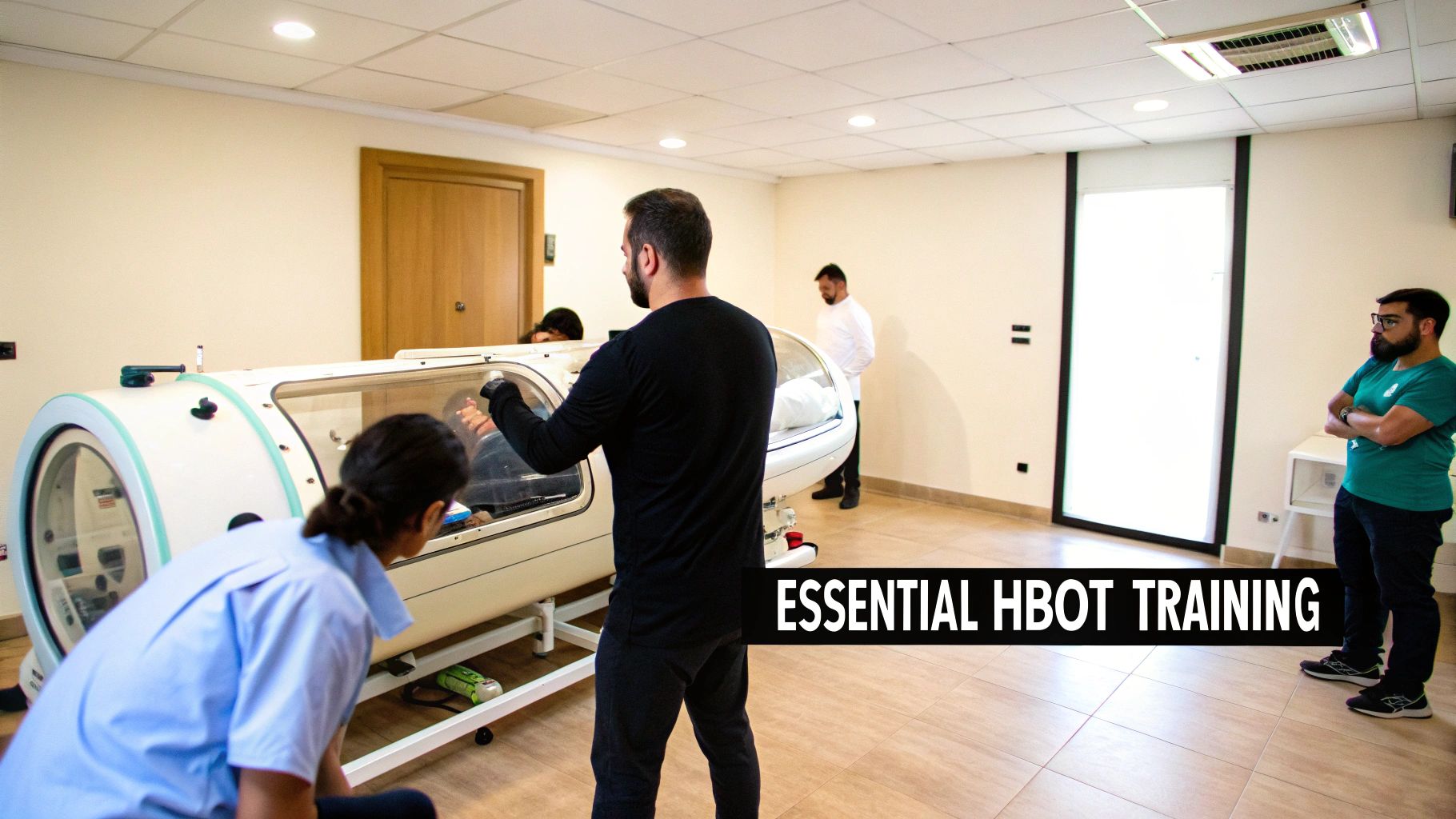
Building a Foundation of Safety and Trust
At its heart, every good HBOT training program is designed to create an unshakable culture of safety. This isn’t just a box to check; it’s the bedrock of a successful practice. The curriculum always revolves around critical safety pillars:
- Fire safety protocols: Oxygen-rich environments demand a hyper-vigilant approach to fire prevention. It’s priority number one.
- Client screening: You have to know how to identify individuals who aren’t good candidates for HBOT to avoid any negative outcomes.
- Emergency procedures: When it comes to equipment issues or a client in distress, knowing precisely how to respond isn’t optional—it’s essential.
This deep commitment to safety and expertise is a cornerstone of the philosophy behind Life Force Med Beds, driven by our founder Dr. Louis Hilliard, the inventor of the med bed and owner of life force medbeds. His work in wellness technology is always coupled with a passion for empowering operators to use it responsibly. Getting quality training is the first real step in building a practice people will trust and recommend. You can dive deeper into this topic in our detailed guide on why hyperbaric certification matters.
A well-trained team is your greatest asset. It ensures client safety, builds community trust, and ultimately determines the success of your wellness center.
To see how our comprehensive training integrates seamlessly with our state-of-the-art Med Bed technology, we invite you to go to the website for more information or call 770-948-4511.
What You’ll Actually Learn in an HBOT Training Course
A solid HBOT training program is so much more than just a manual for flipping switches on a machine. Think of it less like learning to drive a car and more like becoming a mechanic, a traffic controller, and an emergency first responder all rolled into one. It’s a deep dive into the science, the strict safety protocols, and the client care that makes this therapy work.
Everything is built on a foundation of theory—the “why” behind the “how.” You’ll get into the nitty-gritty of physics, especially gas laws like Boyle’s Law, to understand exactly what happens to the human body under pressure. This isn’t just academic; it’s the core knowledge you need to grasp the therapy’s effects and confidently explain it to clients.
Safety Protocols: The Uncompromising Priority
Let’s be clear: the single most important part of any legitimate HBOT training course is safety. When you’re working with a pressurized, oxygen-rich environment, there is zero room for error. A huge chunk of your training will be dedicated to mastering these non-negotiables.
You’ll spend a lot of time on topics like:
- Fire Prevention: This is paramount. You’ll learn the fire triangle inside and out and master the strict protocols needed to remove any potential ignition source.
- Safe Oxygen Handling: From storage to connecting lines, you’ll learn the right way to manage medical-grade oxygen.
- Client Screening: This is huge. You’ll become an expert at spotting both absolute and relative contraindications, ensuring HBOT is a safe choice for every single person who walks in your door.
- Managing Side Effects: You’ll be trained to recognize and handle potential issues, like ear barotrauma or oxygen toxicity, before they become problems.
Mastering Clinical Application
This is where all the theory and safety training comes together in the real world. You’ll learn the hands-on operational protocols for running a session smoothly and professionally. It’s all about administering standard treatment profiles, keeping a close watch on clients during their sessions, and keeping detailed logs for both safety and compliance. The goal is to create a seamless, secure, and professional experience from the moment a client arrives to the moment they leave.
The Undersea and Hyperbaric Medical Society (UHMS) has long set the gold standard for this kind of training. Their introductory programs require a demanding 40 hours of specific hyperbaric medicine topics, including direct instruction, practical hands-on work, and a final exam to prove you know your stuff. Explore the details of UHMS-approved courses.
This kind of structured education is what turns a button-pusher into a true professional. To get a better sense of the day-to-day skills involved, take a look at our guide on what to expect from hyperbaric technician training.
At Life Force Med Beds, a company owned by Dr. Louis Hilliard, the inventor of the med bed and owner of life force medbeds, we champion this comprehensive approach. It ensures our operators are not just technicians but well-rounded wellness professionals. For more information, we invite you to go to the website for more information or call 770-948-4511.
Comparing the Different Types of HBOT Courses
Trying to find the right HBOT training course can feel a bit overwhelming at first. There are a lot of options out there, and they’re not all built the same. They’re specifically designed for different roles, responsibilities, and existing skill levels. Figuring out these distinctions is the very first step to building a team that’s both competent and confident.
The world of HBOT education is surprisingly diverse. You’ll find everything from foundational programs for new technicians to advanced certifications for licensed medical professionals. Each pathway has its own unique focus, curriculum, and prerequisites, all carefully aligned with its intended audience.
Think of it this way: every solid HBOT training program, no matter how basic or advanced, rests on three core pillars.
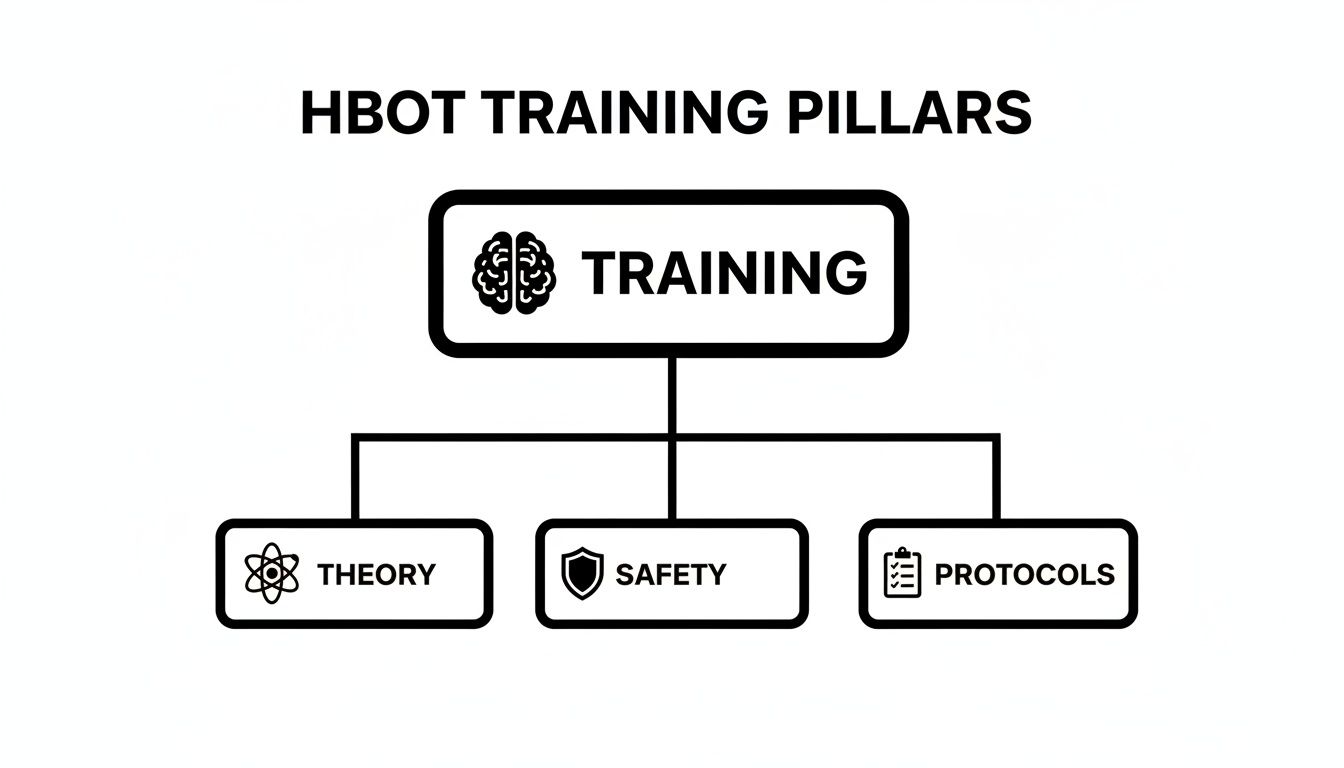
This simple breakdown shows that a deep understanding of the theory, an unwavering commitment to safety, and a mastery of clinical protocols are the non-negotiables. They are the foundation of any worthwhile HBOT education.
Technician-Focused Training
Introductory courses are the entry point for anyone wanting to become a hyperbaric technician. These programs are laser-focused on the practical, hands-on side of things—how to run a chamber safely and efficiently day in and day out.
The curriculum is heavily weighted toward:
- Chamber Operations: Getting a feel for the mechanics of pressurization, depressurization, and keeping a close eye on the chamber environment.
- Safety Procedures: This is huge. Technicians get extensive training on fire prevention, proper oxygen handling, and what to do in any emergency.
- Client Monitoring: Learning how to observe clients during sessions, help them manage minor side effects like ear discomfort, and keep meticulous operational logs.
This kind of training gives technicians all the essential skills they need to manage the daily functions of a hyperbaric center while working under clinical supervision.
Advanced Clinician Certifications
For licensed professionals—we’re talking MDs, NPs, PAs, and DOs—the training goes much, much deeper. Advanced certification courses move past the basics of operation and dive headfirst into the complex world of clinical decision-making.
These programs are all about diagnostics, patient assessment, and creating sophisticated treatment plans for a whole host of conditions. Clinicians learn the intricate physiology behind why HBOT works and how to properly integrate it into a larger medical strategy.
These advanced certifications are becoming more popular, especially with flexible online options making them easier to access. For example, the Hyperbaric Functional Medicine Clinician Course (FMHC) is a 100% online, self-paced program that costs $1,997 USD. It’s designed exclusively for credentialed clinicians, which just goes to show how much demand there is for this kind of specialized education. You can explore the details of this advanced clinical course here.
Picking the right course isn’t just about getting a piece of paper to hang on the wall. It’s about matching the education to the specific job each person on your team will be doing. A technician needs to be a master of safety and operations, while a clinician has to master diagnosis and treatment strategy.
Here at Life Force Med Beds, founded by Dr. Louis Hilliard, the inventor of the med bed and owner of life force medbeds, we’re passionate about empowering both technicians and clinicians with role-specific, expert-led training. To see how our programs can help your team grow, we invite you to go to the website for more information or call 770-948-4511.
How to Choose a Reputable and Accredited Program
In the wellness world, credibility is your currency. When you decide to invest in HBOT training courses, picking a program from a reputable, accredited provider is the single most important decision you’ll make. It’s the difference between earning a respected credential and just getting a piece of paper.
Think of accreditation as a seal of approval. When a recognized body endorses a course, it means the curriculum, instructors, and training methods have been put under a microscope and measured against tough industry standards. This gives you—and your future clients—peace of mind that your team truly knows what they’re doing.

Key Accreditation Bodies to Look For
Two of the biggest names you’ll see in the hyperbaric field are the Undersea and Hyperbaric Medical Society (UHMS) and the International Board of Underseas Medicine (IBUM). If a course is approved or certified by one of these organizations, you can be confident you’re looking at a high-quality program.
Their stamp of approval means the course isn’t just skimming the surface. It signals a deep, comprehensive education covering everything from safety protocols to clinical applications. It’s the benchmark for excellence you should be looking for.
Your Evaluation Checklist
As you start comparing training options, it’s easy to get overwhelmed. Use this simple checklist to cut through the noise and figure out which program will actually deliver the expertise your team needs.
- Instructor Credentials: Who’s actually teaching? You want instructors with years of hands-on, clinical experience in hyperbaric medicine, not just someone who has read the textbook.
- Curriculum Depth: Does the course cover the tough stuff? A solid program will dive deep into hyperbaric physiology, risk management, and what to do in an emergency.
- Hands-On Training: Theory is one thing, but practice is everything. Make sure the program includes a significant hands-on component where your team gets to work directly with the chambers under an expert’s watchful eye.
- Industry Recognition: Will the final certificate mean anything? Check if the credential is well-regarded by major industry bodies and other professionals in the hyperbaric community.
Choosing the right training program is a direct investment in your business’s reputation. An accredited certification not only builds your team’s skills but also serves as a powerful marketing tool that demonstrates your commitment to the highest standards of client care.
Dr. Louis Hilliard, the inventor of the med bed and owner of life force medbeds, founded his company on this very idea: combine world-class technology with expert-led training. We firmly believe that a well-trained operator is the most important part of any successful wellness center. For more on this, take a look at our insights on what makes a great hyperbaric oxygen therapy certification.
To learn more about our comprehensive training programs designed to set you up for success, we invite you to go to the website for more information or call 770-948-4511.
The Life Force Med Beds Training Advantage
Having state-of-the-art technology is one thing; knowing how to get the most out of it is another entirely. Many general HBOT training courses give you a solid foundation in the basics, but they can’t possibly prepare your team for the specific systems you’ll be using day in and day out. This often leaves a frustrating gap between what your team knows in theory and what they can actually do in practice.
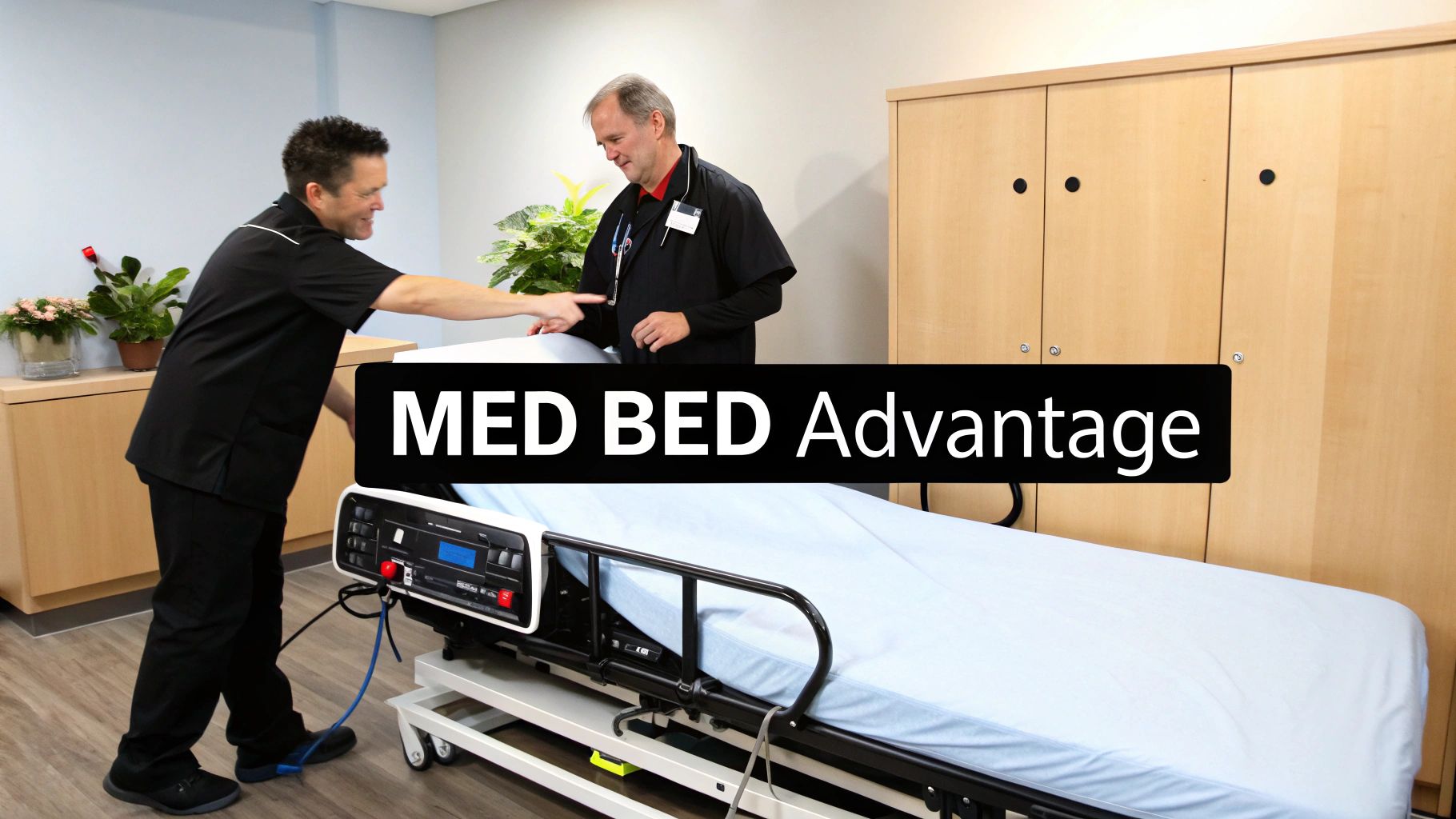
Here at Life Force Med Beds, founded by Dr. Louis Hilliard, the inventor of the med bed and owner of life force medbeds, we see training as a core part of our wellness ecosystem, not just an add-on. Our training is designed from the ground up to integrate seamlessly with our specific Med Beds—like the Ultra, Canta Elite, and Cube models. We’re here to close that gap, transforming general knowledge into genuine mastery of our technology.
Beyond Generic HBOT Training
We go far beyond the standard hyperbaric curriculum. Our programs are designed to teach your team how to operate the full spectrum of therapeutic features built right into our systems. The goal is simple: to make sure your staff can not only run the equipment with confidence but also understand the why behind how each feature delivers better results for your clients.
Instead of just learning about HBOT in a vacuum, your team will see how all the integrated therapies work together. It’s a level of detail and synergy that generic courses just can’t replicate, giving your team the skills to provide a service that truly stands out.
- System-Specific Expertise: All training is laser-focused on the exact hardware and software your team will be using every single day.
- Integrated Modality Education: We dive deep into how different therapeutic functions in the Med Bed work in concert to boost effectiveness.
- Outcome-Driven Protocols: The curriculum is built around practical, real-world protocols designed to help your clients see and feel the results they’re looking for.
This means your staff won’t just be “HBOT certified”—they’ll be experts in the Life Force Med Bed system. That kind of specialized knowledge is what builds trust with clients and puts your center in a class of its own.
A Turnkey Model for Success
Starting a new wellness service can feel overwhelming. There are a million little operational details to sort out, and it’s easy to get bogged down. Dr. Louis Hilliard, the inventor of the med bed and owner of life force medbeds, knew there had to be a better way for wellness entrepreneurs. That’s exactly why we developed our unique turnkey model for opening a Life Force Med Bed Center.
Think of it as a comprehensive partnership. We provide everything you need to get your services off the ground and growing, taking all the guesswork out of the equation.
Our turnkey model is a true business-in-a-box. We don’t just hand you the groundbreaking technology; we provide the operational training and support structure to build a thriving wellness center from day one.
Our support covers all the bases:
- Comprehensive Operational Training: We get into the nitty-gritty of running a center, from the moment a client walks in the door to session management and post-session care.
- Setup and Installation Guidance: Our team is there with you, walking you through the entire process of getting your center and equipment set up and ready to go.
- Continuous Educational Support: The wellness field is always evolving. As we develop new protocols and features, we provide ongoing education to keep your team ahead of the curve.
This complete ecosystem frees you up to focus on what you do best: providing exceptional care and helping your clients. We handle the framework, technology, and training so you can build a successful practice.
To learn more about our unique training advantage and turnkey center model, we invite you to go to the website for more information or call 770-948-4511.
Start Your HBOT Journey with Expert Guidance
At the end of the day, top-tier training is the absolute bedrock of a safe, effective, and successful hyperbaric wellness center. When you take the time to understand the different hbot training courses out there and prioritize accredited, comprehensive programs, you’re not just ticking a box—you’re building a team that can deliver truly outstanding care. It’s the difference between simply knowing how to turn the machine on and cultivating genuine expertise.
Choosing a training path isn’t just a prerequisite—it’s a strategic decision that directly impacts client safety, treatment efficacy, and your center’s long-term reputation.
Dr. Louis Hilliard, the inventor of the med bed and owner of life force medbeds, didn’t just stop at creating breakthrough technology. He developed a complete system that pairs that tech with the expert training needed to get the most out of it. We operate on a simple philosophy: advanced equipment is only as powerful as the skilled professionals behind it. This belief is what fuels our commitment to giving our partners all the knowledge they need to succeed.
Ready to build your practice on a foundation of excellence? Our team is here to walk you through the entire process, making sure you have the support you need to thrive.
To learn more about our specialized training programs or to talk about what you’re looking to build, we invite you to go to the website for more information or call 770-948-4511.
Common Questions About HBOT Training
If you’re looking into HBOT training courses, you probably have a lot of questions. That’s a good thing. Getting the right answers is key to choosing a path that sets your team and your wellness center up for success. Let’s walk through some of the most common questions we hear.
What Kind of Background Do I Need for an HBOT Course?
The prerequisites really depend on the type of training you’re after. For a technician-level program, a high school diploma is usually the baseline. That said, providers often give preference to candidates with some hands-on experience, like an EMT or a medical assistant.
When you start looking at advanced certifications for clinicians, the requirements get much stricter. These are designed for licensed professionals—think MDs, DOs, Physician Assistants, Nurse Practitioners, and Registered Nurses. Always double-check the specific entry requirements with the course provider before you sign up.
How Long Does It Take to Get HBOT Certified?
The timeline for certification varies quite a bit, depending on how deep the program goes. A standard introductory course, like one approved by the UHMS, usually packs a solid 40 hours of instruction into one very busy week.
If a full week is too much to block off, many online, self-paced courses offer more flexibility. For the more advanced clinician tracks, you’re looking at a longer commitment—sometimes several months that blend online theory with essential hands-on training.
While you can learn the why of HBOT from a book or a screen, you can only master the how by getting your hands on the equipment. Nothing replaces practical experience for learning safety protocols, chamber operations, and emergency drills. This is why a hybrid model is really the gold standard.
Here at Life Force Medbeds, our team, led by Dr. Louis Hilliard, the inventor of the med bed and owner of life force medbeds, is focused on providing the kind of comprehensive training that truly prepares you for the real world.
Ready to move forward on your hyperbaric wellness journey? To learn more about our specialized training programs and turnkey business models, we invite you to go to the website for more information or call 770-948-4511. You can visit us at https://lifeforcemedbeds.com.


