
Your Guide to Home Hyperbaric Chamber Price and Value


So, you’re looking into buying a hyperbaric chamber for your home, and the big question on your mind is: what’s this actually going to cost me? Let’s get straight to it.
You’re looking at a wide range. The home hyperbaric chamber price can start around $5,000 for a soft-shell model and climb past $60,000 for a clinical-grade hard-shell unit. Ultimately, what you pay depends on the chamber’s pressure capability, the materials used, and any extra features included.
What Is the Real price of a Home Hyperbaric Chamber
When you start digging into hyperbaric therapy for home use, that price tag is usually the first hurdle. Instead, view this as more than a purchase. It becomes a real investment in your long-term health and vitality. Getting a handle on why the prices vary so much is the key to choosing a chamber that fits both your budget and your wellness goals.
Today, this is no longer a niche market. The demand for personal hyperbaric oxygen chambers is booming, with a projected growth rate of 9.2% CAGR through 2030. This trend shows growing demand for powerful health solutions. Previously, only clinics offered these therapies. Now, people want them in their own homes. You can learn more about this expanding market and its projected growth.
Soft-Shell vs. Hard-Shell Price Points
The biggest single factor that drives the price is the type of chamber you choose. There are two main categories out there, each built for different purposes and price points.
- Soft-Shell Chambers: You’ll often hear these called “mild” hyperbaric chambers. Manufacturers build these chambers from durable, flexible materials. As a result, they remain portable and operate at lower pressures. Think of them as the entry point for home hyperbaric therapy.
- Hard-Shell Chambers: These are the heavy hitters. Manufacturers build these chambers with steel and acrylic. Therefore, they reach higher atmospheric pressures (ATA), similar to clinical systems. Naturally, they come with a more significant price tag.
To give you a clearer picture, here’s a simple breakdown of what you can expect to pay for each type.
Typical Home Hyperbaric Chamber Price Ranges
| Chamber Type | Typical Price Range (USD) | Common Use Case |
|---|---|---|
| Soft-Shell (Mild) | $5,000 – $10,000 | General wellness, athletic recovery, entry-level home use |
| Hard-Shell (High-Pressure) | $30,000 – $60,000+ | More intensive protocols, in-home clinical-level therapy |
This table shows the stark difference in investment. Advanced engineering and higher pressure capability place hard-shell models in a completely different cost bracket.
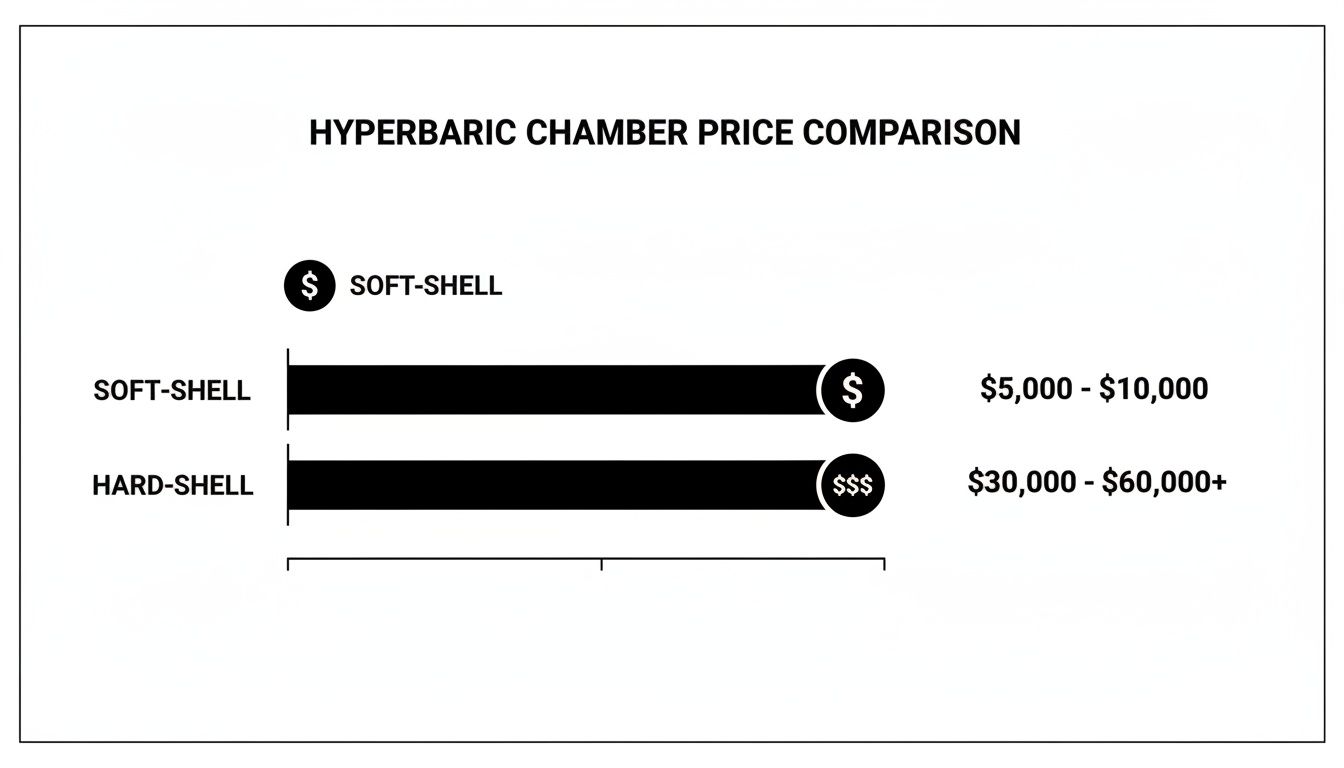
As you can see, a hard-shell chamber is a much larger upfront investment, but it’s built for a higher level of performance.
Dr. Louis Hilliard, the inventor of the med bed and owner of Life Force Medbeds, always encourages people to reframe this from an “expense” to a strategic investment in their body’s own incredible capacity to heal.
For more information, go to our website or call 770-948-4511.
What’s Behind the Price Tag? Decoding the Cost of a Chamber
Ever wonder why one home hyperbaric chamber has a price tag that’s thousands of dollars higher than another? It’s not random. Just like the engine, materials, and safety features determine the price of a car, several key factors drive the final cost of a chamber. Getting a handle on these elements is the first step to making a smart investment.
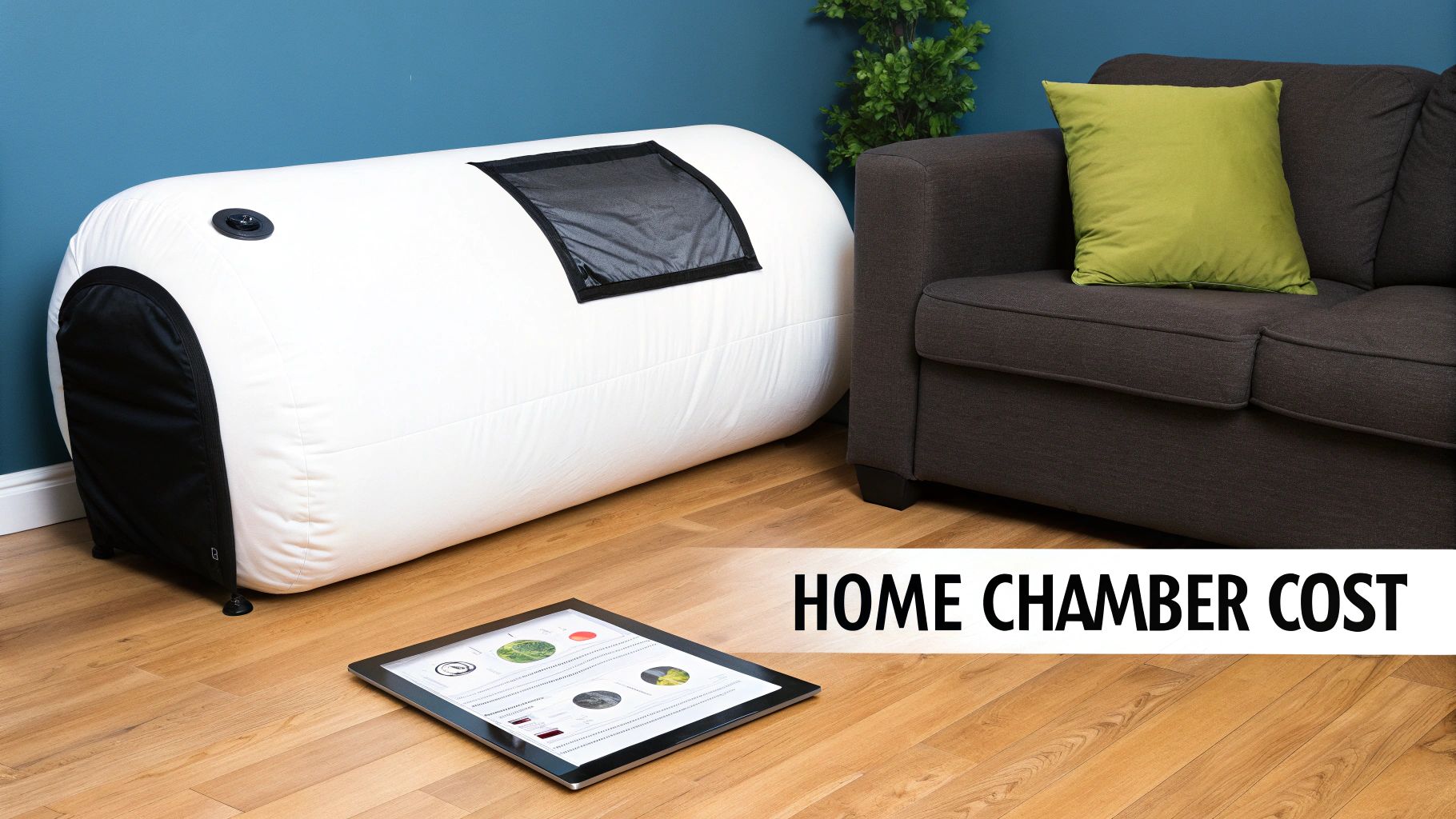
The biggest cost driver comes down to the fundamental design. You have soft-shell models, often called mild hyperbaric chambers, which are built from durable, flexible materials and operate at lower pressures. Then you have hard-shell chambers, constructed from heavy-duty materials like steel and acrylic, which allows them to safely reach much higher atmospheric pressures. That difference in engineering and material strength is directly reflected in their price.
Pressure Ratings and Construction Quality
A chamber’s pressure capability, measured in atmospheres absolute (ATA), is one of the most significant cost factors. A unit rated for 1.3 ATA is going to be far less expensive than one built to handle 2.0 ATA or more. Why? Because higher pressures demand more robust engineering, stronger materials, and more sophisticated safety systems to operate reliably.
Think of it this way: a family sedan and a high-performance sports car both get you from point A to B. But the sports car’s powerful engine, specialized brakes, and reinforced chassis are built for a completely different level of performance—and its price reflects that. It’s the same principle here. Higher ATA capabilities simply require a more complex and costly build.
The materials themselves—from the chamber body to the zippers and viewports—also play a huge role. Medical-grade components and superior construction don’t just ensure a longer lifespan; they contribute to the overall safety and effectiveness of the therapy. It’s a crucial part of the investment.
The market for these devices is really taking off, projected to grow from USD 4.58 billion in 2025 to USD 5.01 billion in 2026. While clinical-grade monoplace chambers still dominate the market, portable and home-based units are a fast-growing segment. Innovation is driving this growth, making chambers more comfortable and effective for personal use. You can dive deeper into this market trend and the tech behind it in this detailed industry report.
Size and Included Technology
Beyond the core construction, a few other features will move the needle on the home hyperbaric chamber price:
- Chamber Size: It’s simple, really. A larger chamber that can comfortably fit a taller person or allow for more movement costs more to build than a smaller, compact model. More materials, more manufacturing.
- Oxygen Concentrator: This is a vital piece of the puzzle, supplying the purified air for your session. The quality, flow rate, and purity level of the included concentrator can significantly impact the total package price.
- Additional Features: Modern chambers often include extras for comfort and convenience, like internal communication systems, mounts for entertainment devices, and upgraded air filtration systems. Each of these add-ons contributes to the final cost.
As Dr. Louis Hilliard, the inventor of the med bed and owner of Life Force Medbeds, often points out, understanding these components helps you look past the price tag. You start to see the real value and capability of the system you’re investing in.
For more information, go to our website or call 770-948-4511.
Making Your Investment More Accessible with Financing
Let’s be honest: a high-quality hyperbaric chamber is a significant investment. At first, the home hyperbaric chamber price—especially for hard-shell models—may feel daunting. But it helps to think of it less like a simple purchase and more like other major investments you might make for your family, like a new car or a major home upgrade.

Most people don’t buy those things with cash upfront, and the same logic applies here. Reputable providers get this and offer financing options that break down the total cost into predictable monthly payments. This is a really practical way to bring a powerful health tool into your home without draining your savings all at once.
Breaking Down the Monthly Payments
So, what does that actually look like in terms of your monthly budget? While the final numbers will always depend on the chamber’s price, your credit, and the loan term you select, we can look at some common scenarios to give you a solid idea.
A longer loan term usually means a lower monthly payment, which can put even the most advanced systems within reach.
Here’s a table to help you visualize what your monthly investment could be at a few different price points.
Example Monthly Payment Scenarios
| Chamber Price (USD) | Loan Term (Months) | Estimated Monthly Payment (USD) |
|---|---|---|
| $7,000 | 36 Months | ~$220 |
| $15,000 | 60 Months | ~$300 |
| $40,000 | 72 Months | ~$685 |
*Please note: These are estimates for illustrative purposes. Your actual rates and payments will vary based on your specific situation.
As you can see, a seemingly large one-time expense can be transformed into a manageable monthly figure, often in the same ballpark as a car payment or other typical household bills. It really shifts the perspective from a big purchase to a sustainable, ongoing investment in your well-being.
Your Path to Ownership
At Life Force Medbeds, our goal is to make this technology accessible. Dr. Louis Hilliard, the inventor of the med bed and owner of Life Force Medbeds, is passionate about getting these powerful health tools into the hands of individuals and families who can benefit from them.
That’s why we offer clear, straightforward financing options. We work with you to find a payment plan that fits your budget, allowing you to start experiencing the benefits of hyperbaric therapy much sooner.
For more information, go to our website or call 770-948-4511.
Budgeting for Long-Term Ownership and Maintenance
The sticker price of a home hyperbaric chamber is just the beginning of the story. To get the full picture, you have to think like a long-term owner. It’s a lot like buying a car—the initial purchase is the big hurdle, but you also have gas, oil changes, and tune-ups to consider down the road. Planning for these ongoing costs from the start ensures your chamber remains a seamless part of your wellness routine, with no financial surprises.

The good news? For a well-made home unit, these expenses are surprisingly low. The main cost you’ll see regularly is the electricity needed to power the compressor and oxygen concentrator. Thankfully, modern systems are built to be efficient, often drawing about the same amount of power as a common household appliance.
Anticipating Routine Maintenance
Beyond your power bill, you’ll need to account for a few replaceable parts. Think of it as the basic upkeep that keeps your investment in peak condition, just like changing the filters in your home’s HVAC system.
Here’s a look at the typical maintenance tasks for a home hyperbaric chamber:
- Air Filters: These are your first line of defense for air quality and need to be swapped out regularly to keep the air inside the chamber pure.
- Seals and Gaskets: The seals around zippers and viewing windows are crucial for maintaining pressure. Over years of use, they can wear out and will need to be replaced to ensure a perfect, airtight seal.
- Oxygen Concentrator Servicing: Your oxygen concentrator works hard during every session. It may require periodic filter changes or professional servicing to keep its oxygen purity levels right where they need to be.
These are all simple, predictable tasks that protect your chamber and ensure it performs safely for years to come. If you want to dive deeper into the specifics, check out our complete guide to hyperbaric chamber maintenance.
Investing in a well-engineered chamber from the start is the best way to minimize these long-term costs. Superior materials and construction mean less frequent replacements and a longer operational lifespan for your entire system.
Dr. Louis Hilliard, the inventor of the med bed and owner of Life Force Medbeds, specifically designed our systems for durability and low-maintenance ownership. When you choose quality upfront, you’re not just getting a better therapeutic experience—you’re also securing a more predictable and lower total cost over the life of the chamber.
For more information, go to our website or call 770-948-4511.
Getting a Prescription and Why It Matters
So, you’ve figured out the cost of a home hyperbaric chamber, but there’s another crucial piece of the puzzle: the prescription. In the United States, the FDA classifies these chambers as Class II medical devices, and that’s not just red tape—it’s all about your safety.
This means you’ll need a doctor’s sign-off to buy one. While it might sound like an extra hoop to jump through, this step is your best friend. It ensures a medical professional has looked at your health history and agrees that hyperbaric therapy is a safe and appropriate choice for you.
A Prescription Isn’t a Hurdle, It’s a Guardrail
Think of the prescription as less of a barrier and more of a built-in safety check. It’s there to protect you from hopping into a powerful therapeutic device without the right guidance on pressure levels and session times. Any reputable company will insist on it.
This commitment to safety is a big reason why North America is the global leader in hyperbaric oxygen therapy. The entire industry is built on a foundation of proven protocols and regulatory oversight that keeps users safe and ensures the therapy works as it should. You can dig into the data and see how safety regulations support industry growth.
When a provider asks for a prescription, it’s a huge green flag. It tells you they care more about your well-being than just making a sale and that they operate with integrity.
Here at Life Force Medbeds, we don’t just follow these rules—we champion them. Our company was founded by Dr. Louis Hilliard, the inventor of the med bed and owner of Life Force Medbeds, on the principles of safety and real-world results. We’ll walk you through the prescription process and make it as straightforward as possible. We firmly believe that when you’re dealing with this level of wellness technology, doing things the right way is the only way.
If you want to learn more about the therapy itself, our guide on home hyperbaric oxygen therapy is a great place to start.
For more information, go to our website or call 770-948-4511.
Making a Confident Leap Into Wellness
Hopefully, you now have a much clearer picture of what goes into the price of a home hyperbaric chamber. It’s not just a number on a tag; it’s a reflection of the technology, safety, and long-term value you’re bringing into your home. We’ve walked through everything from the core cost drivers to the realities of owning one, so you can make a decision you feel genuinely good about.
This is a big step, no question about it. But it’s an investment in something that truly matters: your long-term health and vitality. When you understand the nuances between different models, why certain safety features are non-negotiable, and what to expect for maintenance, you’re not just buying a piece of equipment. You’re choosing a partner for your wellness journey.
We’re Here to Help You Navigate It All
At Life Force Medbeds, we do more than just sell equipment. Our mission, driven by our founder, Dr. Louis Hilliard, the inventor of the med bed and owner of Life Force Medbeds, is to make this incredible technology both accessible and easy to understand. We operate on a foundation of total transparency and a genuine commitment to supporting you.
We believe the path to better health shouldn’t be confusing. Our job is to guide you, answer your questions honestly, and make sure you have the peace of mind to invest in yourself with confidence.
We know everyone’s situation is different. Maybe you’re an athlete looking to speed up recovery, or perhaps you’re focused on overall wellness for you and your family. Whatever your goal, we’re here to help you find the right chamber that fits both your needs and your budget.
When you’re ready, the next step is simple. For more information, go to our website or call 770-948-4511.
Frequently Asked Questions About Home Chambers
Diving into the world of home hyperbaric chambers naturally brings up a few questions. I get these all the time from people trying to figure out if this is the right move for them. Let’s walk through some of the most common ones to give you a clearer picture.
What Kind of Setup Is Needed For a Home Chamber?
You’d be surprised how simple it is to get a home chamber up and running. Most of the soft-sided models are designed for easy, tool-free assembly.
All you really need is a clean, dedicated spot in a spare room or home gym—just enough space for the chamber to inflate with a little breathing room for the compressor and oxygen concentrator. A standard wall outlet is all the power you’ll need. It’s really that straightforward.
Is a Soft-Shell Chamber as Good as a Hard-Shell One?
This is probably the most common question I hear, and the honest answer is: it completely depends on what you’re trying to achieve. One isn’t automatically “better” than the other; they’re just built for different jobs.
- Soft-Shell Chambers: These are your go-to for general wellness. They operate at lower pressures, usually up to 1.5 ATA, which is perfect for boosting athletic recovery, reducing inflammation, and supporting your body’s natural healing functions.
- Hard-Shell Chambers: These are the heavy-hitters, capable of reaching pressures of 2.0 ATA and higher, just like what you’d find in a clinical setting. They’re designed for more serious, medically supervised protocols.
Think of it like this: a soft-shell chamber is like having a high-quality treadmill at home for daily fitness, while a hard-shell chamber is like the specialized equipment a physical therapist uses for intensive rehabilitation. Both are excellent tools, but you have to pick the right one for your specific goals.
Can I Use a Home Chamber for Any Health Issue?
This is non-negotiable: you absolutely must talk to your doctor before using a hyperbaric chamber for a specific health concern. While the wellness benefits are broad, hyperbaric oxygen therapy is not a cure-all, and it isn’t right for everyone.
Your doctor is the only person who can tell you if it’s a safe and appropriate option for your health situation. They’ll also be the one to guide you on the right pressure levels and session times to get the results you’re looking for safely.
What Warranty Can I Expect with My Chamber?
A strong warranty clearly shows the manufacturer’s confidence in the product. Don’t just glance at it—look for comprehensive coverage that protects the chamber itself and the essential components, like the compressor and concentrator.
A solid warranty isn’t just a piece of paper; it’s your peace of mind. It ensures your investment is safe and that you’ll have support if something goes wrong.
Dr. Louis Hilliard, the inventor of the med bed and owner of Life Force Medbeds, often says that a quality product is always backed by equally strong customer support.
For more information, go to our website at Life Force Med Beds website or call 770-948-4511.


