
How to Choose the Right Hyperbaric Chamber for Your Wellness Needs (HBOT Guide)


Choosing the right hyperbaric chamber (HBOT) is a significant investment, whether you’re a clinic owner adding a new service or a wellness enthusiast exploring home-use options. This guide simplifies the decision-making process, helping you select the best HBOT chamber for your unique needs.
How to Find the Right Hyperbaric Chamber for Your Needs (HBOT Explained)

Making an investment in a hyperbaric chamber is a big step. The mission is always the same, though: find a safe, effective solution that genuinely delivers results. That journey starts with getting a solid grasp of what this technology is and what it can do for you.
At its core, Hyperbaric Oxygen Therapy (HBOT) is about creating the ideal environment for the body to heal itself. By increasing the ambient air pressure and flooding the system with pure oxygen, these chambers supercharge the body’s natural recovery mechanisms. It’s a straightforward concept with profound implications for healing and well-being.
Grounding Your Search in Expertise
To really understand the potential here, we can look to experts like Dr. Louis Hilliard, the inventor of the med bed and owner of life force medbeds. His deep knowledge of advanced wellness technologies offers a practical blueprint for how to integrate these systems successfully, whether in a busy clinic or a quiet home setting. The first step to a smart purchase is always understanding the principles behind the product.
And this isn’t just a niche interest anymore. The market for medical single hyperbaric oxygen chambers—the kind perfect for wellness centers and home use—was already valued at $247 million and is on track to hit $347 million. That kind of growth speaks volumes about the growing public awareness of HBOT’s benefits. If you’re curious, you can learn more about this market trend and its drivers.
A hyperbaric chamber is more than just an investment in health infrastructure. For clinics, it’s an opportunity to improve patient care and boost revenue. For home users, it’s a personal investment in long-term recovery and well-being.
A Quick Guide to Key Considerations
To get you started, I’ve put together a quick-reference table that boils down the essential factors. It’s designed to help you immediately see what’s most important based on whether you’re setting up a professional practice or a personal wellness sanctuary.
Hyperbaric Chamber Buyer’s Quick Reference Guide
This table provides a high-level snapshot of the main factors to weigh when you’re in the market for a hyperbaric chamber, breaking it down for the two most common types of buyers.
| Consideration | Clinic/Professional Use | Home/Personal Use | Key Takeaway |
|---|---|---|---|
| Primary Goal | Patient outcomes & ROI | Personal wellness & recovery | Your goal dictates the features you need. |
| Pressure (ATA) | Higher pressure (up to 3.0 ATA) | Mild pressure (1.3-1.5 ATA) | Clinical needs require higher pressures. |
| FDA Clearance | Crucial for specific indications | Important for safety & quality | Verifies the device meets standards. |
| Budget | $20,000 – $100,000+ | $5,000 – $25,000 | Price reflects pressure, size, and features. |
| Space Needs | Dedicated room required | Fits in a large room or office | Measure your space before you buy. |
| Training | Certified operator training is essential | User-friendly controls & safety guides | Proper training ensures safe operation for everyone. |
This overview should give you a solid foundation for the decision-making process ahead. Discover more about HBOT chambers and how they can benefit your clinic or personal wellness journey. Visit our website today or contact our team at 770-948-4511 for personalized guidance.
Understanding the Different Types of Hyperbaric Chambers
When you first start searching for a hyperbaric chamber for sale, it quickly becomes clear that they aren’t all created equal. The right chamber for you boils down to one thing: your goal. Are you treating patients in a busy clinic, or are you looking for a personal wellness solution at home? Knowing the fundamental differences is your first step toward making a smart investment.
At the highest level, chambers are split into two categories: monoplace (for one person) and multiplace (for several people). This isn’t just about size; it dictates everything from the client’s experience and your daily workflow to the initial cost and the space you’ll need.
Monoplace Chambers: The Personalized Wellness Pod
Think of a monoplace chamber as a private wellness pod. It’s built for one person to have a session in a completely controlled, individual environment. These units are typically pressurized with 100% medical-grade oxygen, which means the person inside is breathing the therapeutic oxygen directly from the air around them.
The beauty of this design is its simplicity. While an operator manages the session from the outside, the experience for the user is intimate and focused. For clinics, this privacy can be a huge selling point. For home users, the self-contained design makes a monoplace chamber a far more practical choice.
Multiplace Chambers: The Shared Therapy Room
A multiplace chamber, on the other hand, is more like a small, pressurized room. These much larger units can treat several people at the same time, often with a medical attendant sitting inside with them. The key difference here is that the chamber itself is pressurized with medical-grade air, and each person breathes pure oxygen through a dedicated mask or hood.
This setup is perfect for high-volume environments like hospitals or large wellness centers. Treating multiple patients at once is a game-changer for efficiency. It also allows for direct, hands-on supervision inside the chamber, which is essential for certain medical cases. The trade-off, of course, is a massive footprint and a more involved installation.
The decision between monoplace and multiplace really comes down to your scale and purpose. A high-traffic clinic will lean toward a multiplace chamber for throughput, while an integrative practice focused on personalized care would likely choose a monoplace unit.
Comparing Key Differences
To lay it all out, let’s break down the practical differences. Seeing the pros and cons side-by-side will help you visualize which model truly fits your space and your vision.
| Feature | Monoplace Chambers | Multiplace Chambers |
|---|---|---|
| Capacity | One person | Multiple people + attendant |
| Pressurization Gas | 100% Oxygen | Medical Grade Air |
| Oxygen Delivery | Direct from chamber atmosphere | Individual masks or hoods |
| Installation Footprint | Smaller, fits in a standard room | Requires a large, dedicated space |
| Operational Cost | Generally lower per session | Higher due to size and complexity |
| Patient Experience | Private and isolated | Communal, supervised |
Ultimately, the best hyperbaric chamber is the one that directly serves your mission. Wellness technology visionaries like Dr. Louis Hilliard, the inventor of the med bed and owner of life force medbeds, have always stressed that the equipment must be a perfect match for its purpose. To dig deeper into how pressure settings impact therapy, you can learn more by exploring our guide on the 2.0 ATA hyperbaric chamber.
For more information, please visit our website or call 770-948-4511.
Navigating The Legal and Prescription Requirements
Hyperbaric chambers are classified as medical devices by the FDA. Before purchasing, you’ll need a prescription or a medical license for professional-grade chambers. This ensures safe and regulated use. You’re stepping into the world of medical equipment, a space governed by rules designed to keep people safe. This is especially true for the professional-grade hard-shell chambers, which the Food and Drug Administration (FDA) classifies as medical devices.
That classification isn’t just bureaucratic red tape; it’s a critical safety net. The FDA’s involvement means the equipment is built to rigorous standards and intended for use under medical supervision. This is why you’ll almost always need a prescription or a medical license to purchase a professional-grade chamber.
Why a Prescription Is Necessary
Think of a hyperbaric chamber prescription the same way you would for a powerful medication. In the right hands, it can achieve amazing results, but it absolutely requires professional guidance to be used safely and effectively. Before you can buy, a licensed physician needs to confirm that hyperbaric oxygen therapy (HBOT) is appropriate for the person using it, which minimizes risks and sets the stage for a proper treatment plan.
This is a safeguard for everyone involved. For a clinic, it’s the foundation of providing a high standard of care. For a home user, it ensures your therapy is backed by medical expertise, helping you avoid potential complications.
FDA-Cleared Uses Versus Off-Label Applications
One of the biggest points of confusion for newcomers is the difference between FDA-cleared uses and “off-label” applications. It’s a crucial distinction. The FDA has officially cleared HBOT for a specific list of 14 medical conditions, including things like decompression sickness, non-healing diabetic wounds, and carbon monoxide poisoning. Using a chamber for one of these conditions is considered operating within its cleared indications.
At the same time, the wellness world has seen incredible benefits from HBOT for a much broader range of goals, from boosting athletic recovery to supporting anti-aging protocols. When a chamber is used for these purposes, it’s considered “off-label.” It’s perfectly legal and quite common for physicians to prescribe treatments off-label when they believe the potential benefits outweigh any risks. This all comes down to their professional medical judgment.
A supervising physician is your key partner in all of this. They don’t just write the prescription; they ensure your entire operation—whether for FDA-cleared or off-label uses—is medically sound, safe, and ethically responsible.
Your Compliance Checklist
Getting through these rules doesn’t have to be a headache. The key is to build a foundation of integrity and follow the proper steps, a principle that wellness technology experts like Dr. Louis Hilliard, the inventor of the med bed and owner of life force medbeds, have built their careers on.
Here’s a simple checklist to keep you on the right track:
- Get a Prescription: You’ll need one from a licensed medical doctor (MD) or a doctor of osteopathic medicine (DO).
- Appoint a Medical Director: Have a designated physician who will oversee your chamber’s operations and treatment protocols.
- Document Everything: Keep detailed, organized records. This includes prescriptions, client consent forms, and every single session log.
- Check State Laws: Remember that federal rules are just the baseline. Some states have their own additional regulations for operating hyperbaric chambers.
By following these steps, you can move forward with your investment confidently. To dive deeper into the specific conditions that HBOT is used for, check out our guide on the indications of hyperbaric oxygen therapy.
For more information, please visit our website or call 770-948-4511.
Analyzing The Costs and Your Return on Investment

Alright, let’s talk numbers. Buying a hyperbaric chamber is a serious financial step, and you need the full picture to make a smart decision. The sticker price is just the beginning. To build a real business case and map out your path to profitability, we need to look at the total cost of ownership.
This means thinking beyond the initial purchase. You have to account for shipping and delivery, professional installation, and any work your space might need to be ready. Then there are the ongoing costs—electricity, oxygen, and routine maintenance—that keep your chamber running safely and efficiently for years to come.
The good news is that you’re tapping into a booming market. The hyperbaric oxygen therapy device market recently hit $3.25 billion and is expected to climb to an impressive $5.29 billion. This explosive growth signals huge opportunities, especially for businesses like med spas and chiropractic clinics. Monoplace chambers, in particular, are a big part of this trend because they’re relatively affordable and easy to install, making them perfect for outpatient settings.
Understanding the Total Cost of Ownership
To budget properly for a hyperbaric chamber for sale, you need a clear-eyed view of every potential expense. Nailing these details down upfront saves you from costly surprises later and sets your new venture up for success.
Here are the key things you need to factor into your total investment:
- Initial Purchase Price: This is the base cost of the chamber itself. It can vary quite a bit depending on its size, pressure rating (ATA), and extra features.
- Shipping and Installation: These are almost always separate line items. Don’t cut corners here—professional installation by certified technicians is crucial for safety and keeping your warranty valid.
- Oxygen Supply System: You’ll need a way to get medical-grade oxygen into the chamber. This usually means an oxygen concentrator or tanks, which come with their own price tags.
- Operational Expenses: Think about the day-to-day costs. This includes the electricity to power the chamber and concentrator, plus consumables like cleaning supplies.
- Training and Certification: This is non-negotiable. Proper operator training is an essential part of your startup investment and is absolutely vital for client safety.
“A well-planned budget considers every line item from delivery to daily operation. This comprehensive approach is the foundation of a sustainable and profitable wellness service.”
For a deeper dive into how these factors add up, check out our detailed guide on the factors that influence the cost of a hyperbaric chamber.
Calculating Your Return on Investment
Once you have a handle on the costs, it’s time for the exciting part: projecting your revenue and calculating your return on investment (ROI). This is where the chamber stops being an expense and starts becoming a powerful asset for your business. The math is pretty straightforward and just depends on a few key variables.
Let’s walk through a quick example for a wellness clinic that just added a new monoplace chamber. By modeling the potential income, you can see just how quickly you can break even and start turning a profit.
Sample ROI Calculation for a Monoplace Chamber
This hypothetical breakdown shows the kind of monthly revenue and profitability a wellness clinic could see.
| Metric | Example Value | Calculation/Notes |
|---|---|---|
| Price per Session | $150 | A competitive rate for a 60-minute session. |
| Sessions per Day | 5 | Assuming a moderate booking schedule. |
| Operating Days per Month | 20 | Based on a standard 5-day work week. |
| Gross Monthly Revenue | $15,000 | $150 x 5 sessions x 20 days. |
| Estimated Monthly Payment | $2,000 | A typical financing payment for a high-quality chamber. |
| Monthly Operating Costs | $500 | Includes electricity, supplies, and a maintenance fund. |
| Net Monthly Profit | $12,500 | $15,000 – $2,000 – $500. |
As you can see, this model shows some serious revenue potential. Industry experts like Dr. Louis Hilliard, the inventor of the med bed and owner of life force medbeds, always stress the importance of building a business model that is both financially sound and genuinely focused on client wellness.
For more information, please visit our website or call 770-948-4511.
Making It All Work: Installation, Training, and Maintenance
Buying a hyperbaric chamber is a huge step, but what happens after it arrives at your door is what truly matters. Getting the installation, training, and maintenance right from day one is the key to turning that initial investment into a safe, effective, and long-lasting tool for wellness.
Think of it this way: the post-purchase phase is where you build the foundation for success. Handling these steps properly protects your equipment, your clients, and your business.
Setting Up Your Space for a Flawless Installation
Before that big delivery day, you need to get the room ready. Prepping the space is a lot like laying the groundwork for a new building—doing it right prevents a world of problems later on. You’ll want to double-check the manufacturer’s site requirements to make sure everything is perfect.
Here are the big three to focus on:
- Space and Clearance: It’s not just about fitting the chamber in the room. You need plenty of clearance on all sides for proper ventilation, easy access for users, and room for the operator to move around comfortably.
- Electrical Needs: Most professional-grade chambers require a dedicated electrical circuit. It’s crucial to have a licensed electrician confirm that your power supply matches the specific voltage and amperage needed. Don’t skip this step.
- Floor Support: These machines are heavy. Make sure your floor can handle the full weight of the chamber, its supporting equipment, and the people inside it.
Why Certified Training Isn’t Optional
Running a hyperbaric chamber safely is about much more than flipping a few switches. This is why comprehensive, certified training is non-negotiable. This isn’t just a quick walkthrough; it’s an in-depth education covering the science behind hyperbaric oxygen, safe operating procedures, emergency protocols, and daily safety checks.
Good training ensures every single session meets the highest standard of care. This knowledge doesn’t just protect your clients—it protects your business. In fact, most insurance carriers will ask for proof of operator certification before they’ll even consider providing liability coverage.
“True mastery of hyperbaric technology comes from dedicated training. It’s the bridge between owning the equipment and delivering exceptional, safe outcomes for every single client.”
Your Proactive Maintenance Checklist
A hyperbaric chamber is a complex piece of equipment that demands regular attention to stay in top shape. A proactive maintenance plan is your best defense against unexpected downtime and expensive repairs. The best approach combines simple daily checks with scheduled professional service.
A solid maintenance routine breaks down like this:
- Daily Safety Checks: Before anyone gets in the chamber for the day, the operator should do a quick inspection. Check the door seals, make sure the gauges are accurate, and test the communication system. This five-minute habit is your first line of defense.
- Regular Cleaning: Keeping the chamber’s interior and exterior clean is obviously important for hygiene, but it also helps preserve the acrylic and other materials.
- Scheduled Professional Service: Stick to the manufacturer’s recommended service schedule, which is usually once a year. A certified technician will do a deep dive, calibrating systems, checking for wear and tear, and replacing parts before they can cause a problem.
This kind of commitment to upkeep is a core principle for leaders in wellness technology, like Dr. Louis Hilliard, the inventor of the med bed and owner of life force medbeds. For more information, please visit our website or call 770-948-4511.
Your Essential Hyperbaric Chamber Buyer’s Checklist
You’ve waded through the technical specs, the regulations, and the financial models. Now it’s time to put it all together and make a final, confident decision. This checklist is your last line of defense before you commit, making sure no critical detail gets missed.
We’ve broken this down to speak directly to different buyers. Whether you’re a clinic owner balancing patient care with the bottom line, an entrepreneur launching a new wellness venture, or a home user focusing on personal health, these questions are for you. Think of this as your personal pre-flight check before you take off.
This decision tree gives you a bird’s-eye view of what ownership really looks like, mapping out the crucial steps for getting your site ready, training your team, and keeping the chamber in perfect working order.
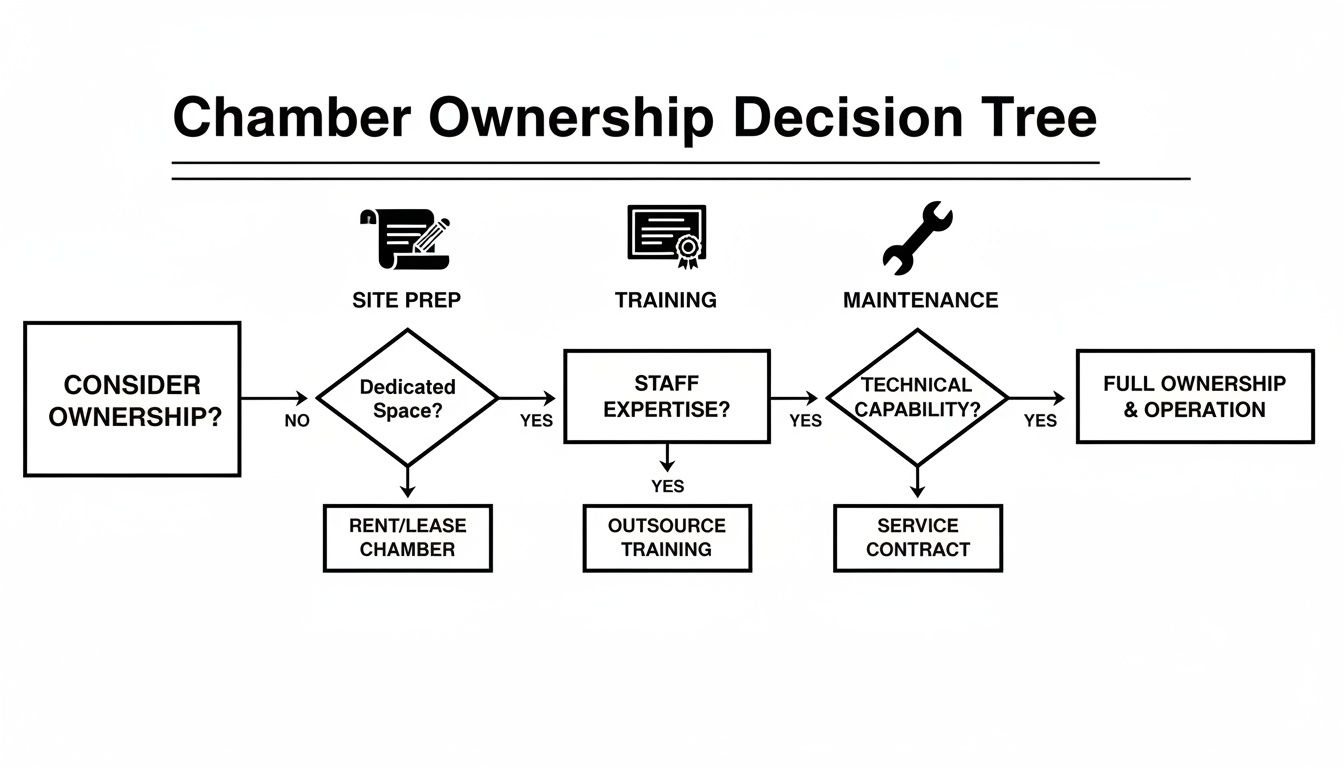
As you can see, buying a chamber isn’t just a one-time transaction. It’s the start of a long-term commitment to operational excellence, beginning with a properly prepared space and continuing with certified training and routine upkeep.
Checklist for Clinic Owners and Professionals
Your world revolves around patient safety, treatment efficacy, and a solid return on investment. Use these questions to make sure the equipment and the vendor meet your high standards.
- FDA Clearance: Can you provide the FDA 510(k) clearance documentation for this specific model?
- Medical Director Support: What kind of help do you offer for finding and establishing a relationship with a supervising physician?
- Installation & Training: Is professional on-site installation and certified operator training included in the price? If it’s extra, what’s the cost?
- Warranty & Service: What exactly does the warranty cover—parts, labor, the acrylic shell? What do your service contracts look like for maintenance after the warranty expires?
Checklist for Wellness Entrepreneurs
You’re building a business from scratch, so support, efficiency, and a clear path to profitability are everything. Your questions should feel like you’re interviewing a potential business partner.
- Business Model Support: Do you offer any marketing assets, sample operational protocols, or business coaching to help new owners succeed?
- Financing Options: Can you walk me through the typical monthly payments and financing terms you offer businesses like mine?
- Scalability: If my business takes off, how easy is it to add more chambers or upgrade my equipment down the road?
- Technical Support: What’s your guaranteed response time for technical problems? I need to know how you’ll help me minimize downtime.
For any buyer, the quality of post-sale support is just as important as the quality of the chamber itself. A strong vendor acts as a long-term partner in your success, a philosophy championed by pioneers like Dr. Louis Hilliard, the inventor of the med bed and owner of life force medbeds.
Checklist for Home Users
Your priorities are simple: safety, ease of use, and personal health. The goal is to make your experience as straightforward and secure as possible.
- Prescription Guidance: Can you help me coordinate with my doctor to get the required prescription?
- Ease of Use: How easy are the controls for someone without a medical background to operate? Is there remote support if I run into trouble?
- Safety Features: What specific emergency features are built in, like a manual pressure release or a two-way communication system?
- Oxygen System: What type of oxygen concentrator do you recommend? Is it included with the chamber, or is that a separate purchase?
Taking a few minutes to walk through this checklist will bring clarity to your needs and empower you to pick the right chamber—and the right partner—for your journey. For personalized guidance, the team at Life Force Medbeds is ready to help. Visit our website for more information or give us a call at 770-948-4511.
Frequently Asked Questions
Diving into the world of hyperbaric technology always brings up some great questions. Let’s walk through some of the most common ones we hear from people looking for a hyperbaric chamber for sale.
Do I Absolutely Need a Prescription to Buy a Hyperbaric Chamber?
In most cases, yes. If you’re looking at a medical-grade, hard-shell chamber designed to deliver high-pressure oxygen, the FDA considers it a Class II medical device and requires a prescription. This isn’t just a rule for its own sake; it’s a critical safety measure to make sure the therapy is right for you.
Even with the milder, soft-shell chambers, getting a doctor’s sign-off is the professional standard. It ensures your treatment plan is medically sound from the start.
What Is the Typical Lifespan of a Hyperbaric Chamber?
A well-made, hard-shell hyperbaric chamber is built like a tank. With proper care and routine maintenance, these units can easily last for decades. They are truly a long-term investment in health.
Think of it like any other piece of high-end equipment. If you stick to the daily checks and scheduled servicing, you’re not just protecting your investment—you’re ensuring it remains a safe and reliable tool for years to come.
How Much Space Do I Need for a Monoplace Chamber?
While monoplace chambers are designed to be pretty compact, you need to think beyond just the unit’s footprint. You’ll need enough room for the chamber itself plus its support equipment, like the oxygen concentrator.
Don’t forget to account for practical use, either. The door needs to swing open completely without hitting anything, and an operator has to be able to walk around it comfortably. A 10×12 foot room is a good rule of thumb, but always, always check the specific dimensions and clearance requirements for the model you’re buying.
The right space plan is foundational to safe and efficient operation. Measuring twice and confirming manufacturer specifications once ensures a smooth installation and a functional therapy environment from day one.
Can I Get My Hyperbaric Chamber Insured?
Absolutely, and if you’re running a business, you really should. You’ll want to add the chamber to your general liability and equipment insurance policies to make sure you’re covered.
Your insurer will likely ask for a few things, like proof that operators are certified and that you have clear safety protocols in place. It’s a smart move to talk to your insurance agent early in the process so there are no surprises. This kind of foresight is a hallmark of responsible ownership, a principle championed by wellness technology leaders like Dr. Louis Hilliard, the inventor of the med bed and owner of life force medbeds.
For more information, visit our website to explore our full range of solutions. You can also call us directly at 770-948-4511 to speak with a specialist.


