
How to Consolidate Home Wellness Devices: A 2026 Guide


Table of Contents
- Why Consolidating Home Wellness Devices Matters
- Step 1: Assess Your Current Wellness Technology Setup
- Step 2: Choose a Central Health Dashboard Platform
- Understanding Integrated Wellness Systems
- Step 3: Sync Wearables and Set Data Source Priorities
- Optimizing with PEMF Technology: The Kloud PEMF Mat Approach
- Step 4: Implement Security and Data Privacy Protocols
- Advanced Integration: Hyperbaric Oxygen Therapy and Atlanta Resources
Last Updated: August 26, 2026
Why Consolidating Home Wellness Devices Matters
The U.S. wellness technology market is projected to reach nearly USD 68.59 billion by 2035, accelerating at a strong CAGR of 13.92% between 2026 and 2035, according to Wellness Technology Market research. That explosive growth reflects a fundamental shift: more Americans are investing in home-based health monitoring and recovery technologies than ever before. But accumulating ten separate devices doesn’t equal better health outcomes, it equals chaos.
At Life Force, we’ve watched thousands of people accumulate wellness gadgets that don’t talk to each other: smartwatches, PEMF mats, red light therapy panels, sleep monitors, and apps generating fragmented data and abandoned devices. Consolidating your home wellness devices isn’t about tidiness. It’s about creating an integrated system where biometric data flows seamlessly, recovery protocols stack intelligently, and personalized health insights actually inform your decisions. When 46% of U.S. adults reported owning a smartwatch or smart ring in 2025, according to a Rock Health survey, the real question isn’t whether to monitor, it’s how to make that monitoring actionable.
This guide walks you through consolidating your home wellness devices into a coherent ecosystem. Whether you’re running a PEMF mat, hyperbaric chamber, light therapy system, or wearable stack, we’ll show you how to synchronize data sources, prioritize what matters, and eliminate the friction that keeps most people from using their wellness tech consistently.
Step 1: Assess Your Current Wellness Technology Setup
Start by taking inventory of what you actually own. Pull out every device, app, and sensor in your home wellness space and write down the device name, its primary function, how often you use it, and which app or platform it connects to.
For each device, note:
- Device name and manufacturer
- Primary measurement (heart rate, sleep, movement, recovery, biometric data)
- Connected app or cloud platform
- Data export capability
- Last time you actually used it
- Whether you trust the data it generates
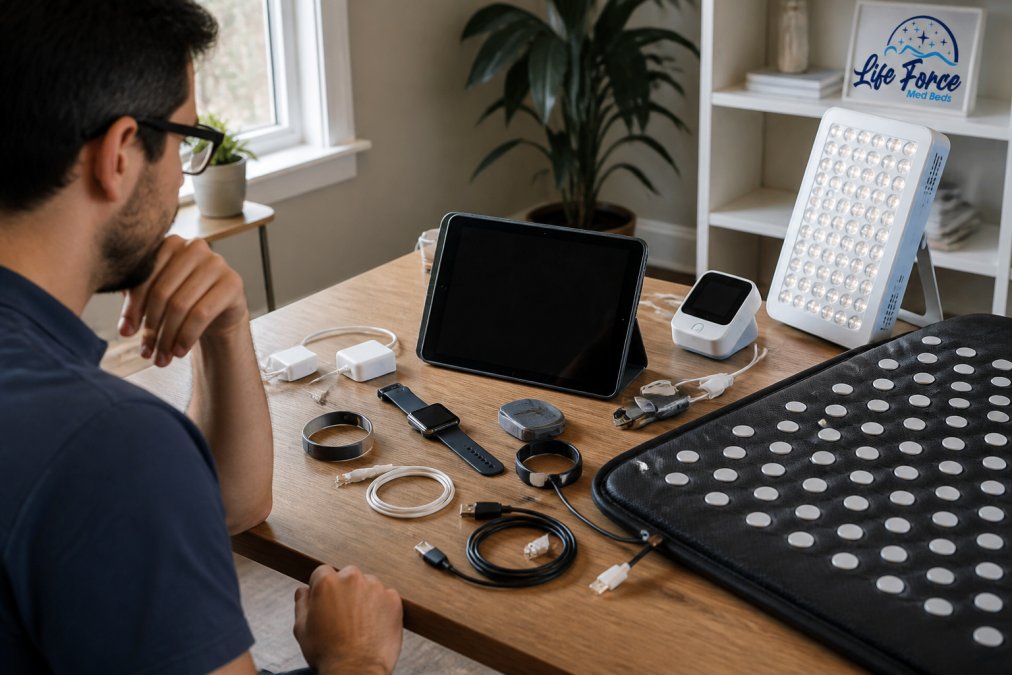
The devices gathering dust tell you something important: they either don’t integrate with your workflow, or their data doesn’t connect to the bigger picture of your health. That’s the friction point consolidation solves.
Next, identify your data gaps. Are you tracking recovery but not sleep quality? Monitoring activity but missing biometric stress markers? The gaps reveal which new integrations would actually change your decision-making. Finally, assess your current data sources by reliability and relevance. Understanding which sources you trust most will guide your platform selection.
Step 2: Choose a Central Health Dashboard Platform
Your central dashboard is the nervous system of your wellness consolidation. It’s where all your fragmented data streams converge into actionable insights. Without it, you’re still checking five different apps and mentally stitching together the story of your health.
A true health dashboard aggregates data from multiple sources, normalizes that data into consistent metrics, and surfaces patterns you’d miss looking at individual devices. The best platforms use API integrations to pull data automatically.
When evaluating dashboard platforms, prioritize these capabilities:
- Multi-device integration: Can it connect to your existing wearables, PEMF systems, and recovery devices via API or direct integration?
- Real-time data synchronization: Does it pull data continuously, or batch updates?
- Custom metric weighting: Can you prioritize which metrics matter most to your goals?
- Data export and portability: Can you download your data in standard formats?
- Privacy and local storage options: Where does your data live? Is it encrypted?
Life Force’s integrated approach combines multiple therapeutic modalities, bioresonance, bioimpedance sensing, Rife-frequency systems, red and near-infrared light, PEMF, vibration, sound therapy, and remote patient monitoring into a single platform where your health data and recovery protocols live together. That’s the consolidation advantage: your PEMF sessions, light therapy exposure, and biometric readings all inform each other.
Understanding Integrated Wellness Systems
An integrated wellness system is fundamentally different from a collection of standalone devices. It’s the difference between playing individual instruments and having them tuned to the same frequency.
Integrated wellness systems combine multiple therapeutic and monitoring technologies into one coherent platform where data flows bidirectionally, where recovery protocols build on real-time biometric feedback, and where your personalized health profile shapes how each modality works. The clinical home ecosystem, a stack of app-connected recovery devices designed to replicate what people once traveled to spas and clinics to receive, is now a category unto itself, according to Woman’s World wellness trends.
When your PEMF therapy knows your current heart rate variability, it can adjust frequency and duration to match your nervous system state. When your light therapy system understands your sleep patterns, it can optimize wavelength timing. When your recovery protocols see your stress biomarkers, they can shift intensity automatically. That’s personalization at scale.
Standalone devices can’t do this. They’re optimized in isolation. But your body doesn’t work in isolation. Your sleep affects your recovery capacity. Your stress levels affect how your cells respond to PEMF stimulation. Your activity patterns determine whether light therapy should focus on energy or calm.
By the end of 2024, over 40% of large-enterprise organizations had adopted a dedicated wellness-tech solution, according to Wellness Technology Market Trends. That shift reflects a hard truth: consumers want ecosystems, not gadgets.
Step 3: Sync Wearables and Set Data Source Priorities
Once you’ve chosen your central platform, connect your wearables and set which data sources take priority when devices report conflicting information.
Start with the devices that give you the most reliable data. If your smartwatch measures heart rate more accurately than your fitness tracker, make it the primary source for that metric. You’re creating a hierarchy so the system knows which truth to believe when multiple devices report the same measurement.
Most platforms let you rank data sources by priority:
- Identify your gold-standard devices: Which devices do you trust most?
- Map metrics to sources: Heart rate → smartwatch. Sleep → dedicated sleep monitor. Activity → fitness tracker.
- Set fallback sources: If your primary source disconnects, which device should the system use instead?
- Enable automatic sync: Ensure your platform pulls data continuously.
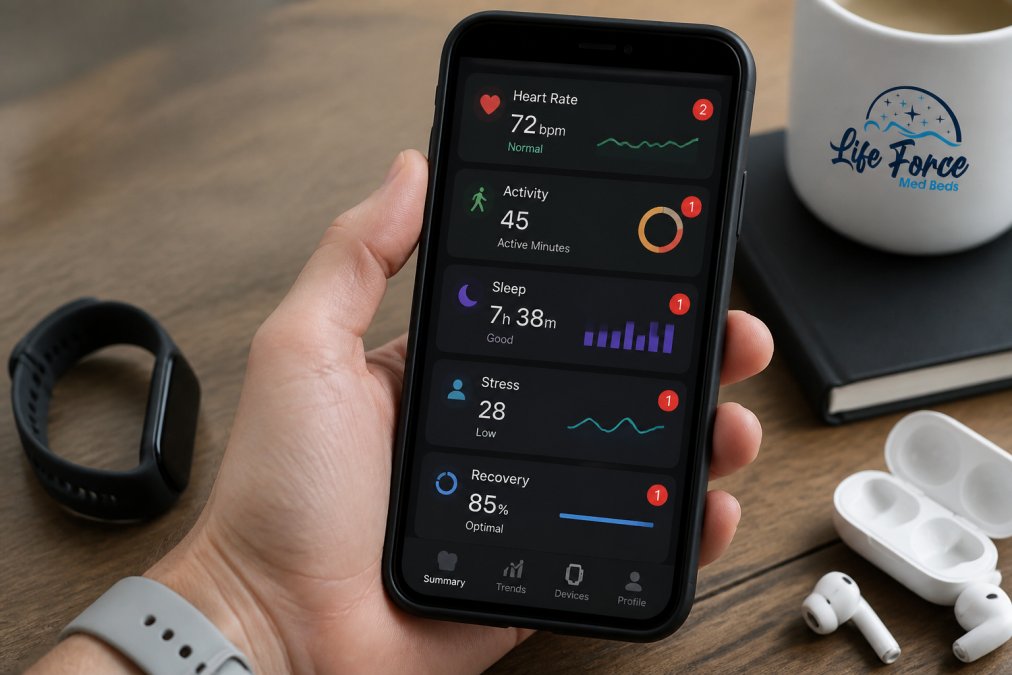
The real power emerges when you layer your wearables with deeper biometric sensors. If you’re using bioresonance or bioimpedance scanning, technologies that measure cellular function and tissue hydration, sync those readings alongside your activity and sleep data. Now your platform understands not just what you did, but how your cells responded.
Users enrolled in subscription models combining wearable devices, mobile apps, and coaching-service access reported 15% higher adherence rates than one-time device buyers, according to the Wellness Technology Market Trends report. That adherence boost comes from seeing how your devices work together. minimalist smart gadgets.
Set your platform to surface one key metric daily, the one that matters most to your current health goal. If you’re optimizing recovery, lead with heart rate variability. If sleep is your focus, surface sleep efficiency and deep sleep percentage. If you’re managing stress, prioritize HRV and cortisol markers.
Optimizing with PEMF Technology: The Kloud PEMF Mat Approach
PEMF (pulsed electromagnetic field) therapy is one of the most measurable recovery modalities you can integrate into your home wellness system. Unlike some wellness technologies where results are subjective, PEMF effects show up clearly in your biometric data: improved heart rate variability, faster parasympathetic recovery, better sleep quality, and reduced inflammatory markers.
The Kloud PEMF mat exemplifies what happens when PEMF technology connects to your integrated system. Rather than running a fixed protocol, it adapts based on your real-time biometric feedback. Your platform tells it your current HRV, your stress state, and your recovery capacity. The mat adjusts its frequency, intensity, and duration accordingly.
When you consolidate PEMF into your larger wellness ecosystem, track these metrics before and after sessions:
- Heart rate variability (HRV) recovery time
- Parasympathetic tone
- Sleep quality the night of or after PEMF use
- Inflammatory markers if you have access to blood work
Step 4: Implement Security and Data Privacy Protocols
Your consolidated wellness system contains some of your most sensitive health data. Heart rate patterns reveal your stress and anxiety. Sleep data shows your recovery capacity. Biometric markers can indicate early disease states. Protecting this data is foundational.
Start with your platform’s security architecture. Ask directly:
- Is data encrypted in transit and at rest?
- Where are servers located?
- Does the platform comply with HIPAA standards?
- Can you enable two-factor authentication?
- What’s their data breach disclosure policy?
Next, audit your device connections:
- Change default passwords on any device with a local interface
- Use strong, unique passwords for each platform and app
- Enable two-factor authentication everywhere it’s available
- Disable unnecessary wireless features when not in use
- Keep firmware updated on all devices and hubs
- Review app permissions regularly
For Atlanta residents and those considering hyperbaric therapy integration, HyOx Medical Treatment Center offers clinical-grade hyperbaric oxygen therapy that can be tracked through your consolidated system. If you’re adding hyperbaric sessions to your recovery protocol, ensure your platform logs oxygen saturation, treatment duration, and post-session biometric recovery.
Consider your data retention policy. How long does your platform keep your data? Can you request deletion? Finally, understand what data you’re actually sharing. Read the privacy policy carefully. If you’re uncomfortable with data sharing, look for platforms that let you opt out completely.
Advanced Integration: Hyperbaric Oxygen Therapy and Atlanta Resources
Hyperbaric oxygen therapy (HBOT) represents one of the most powerful recovery modalities you can integrate into your home wellness system. It works by increasing oxygen pressure in your bloodstream, which accelerates cellular repair, reduces inflammation, and enhances mitochondrial function. The effects show up clearly in your biometric data: improved oxygen saturation, faster HRV recovery, better sleep quality, and reduced fatigue markers.
Life Force Hyperbaric Chambers are designed for commercial use, offering a consistent supply of 90-93% pure oxygen and a maximum operating pressure of up to 2 atmospheres absolute (ATA). These hard-shell chambers are constructed from rigid materials like steel or acrylic and are commonly used in medical settings such as hospitals, hyperbaric clinics, and specialized HBOT centers.
For Atlanta residents, HyOx Medical Treatment Center provides clinical hyperbaric oxygen therapy with professional oversight and data tracking integration. They work with practitioners who understand how to log hyperbaric sessions into your larger wellness ecosystem so your platform captures the recovery impact.
If you’re building a serious home wellness system, consider partnering with Hyperbaric Business Solutions, which offers consultation and support for hyperbaric therapy facilities, including staff training and certification courses. They can help you set up protocols that track pre-session and post-session biometrics, so you see exactly how hyperbaric sessions affect your HRV, oxygen saturation, and recovery capacity.
Dr. Louis Hilliard, the inventor of the med bed, pioneered the integration of multiple recovery modalities into single systems. His work demonstrated that technologies like hyperbaric therapy, PEMF, light therapy, and bioresonance work synergistically when properly coordinated. That’s the foundation of modern integrated wellness systems.
When you add hyperbaric therapy to your consolidated platform, track these metrics:
- Oxygen saturation before, during, and after sessions
- HRV recovery time post-session
- Sleep quality improvement in the 24-48 hours following treatment
- Energy and fatigue markers
- Inflammatory biomarkers if you have access to blood work
Consolidating your home wellness devices transforms scattered measurements into coherent health intelligence. The integration itself becomes your most powerful recovery tool. Start with assessment, build toward a unified platform, sync your wearables intentionally, and protect your data ruthlessly. Life Force’s integrated approach, combining bioresonance, PEMF, light therapy, and remote monitoring into one system, shows what’s possible when you stop thinking about devices and start thinking about ecosystems. Your health data deserves to work as hard as you do.
=== FAQ ANSWERS (audit these too, same rules) ===
[1] Q: What are the main benefits of consolidating home wellness devices?
A: Consolidating home wellness devices eliminates data silos, reduces the time spent switching between apps, and creates a unified view of your health metrics. Studies show that users enrolled in subscription models combining wearable devices, mobile apps, and coaching-service access reported 15% higher adherence rates than one-time device buyers. A consolidated approach also simplifies interoperability and allows you to identify patterns across multiple health dimensions, sleep, activity, biometrics, and recovery, that standalone devices cannot reveal.
[2] Q: How do integrated wellness systems like Life Force MedBeds compare to separate devices?
A: Integrated wellness systems consolidate multiple therapeutic modalities into one platform, combining technologies such as bioresonance, PEMF, red and near-infrared light, frequency therapy, and oxygen therapy. Unlike purchasing individual devices separately, an integrated system synchronizes all data and settings in one environment, reducing setup complexity and ensuring technologies work together cohesively. This approach aligns with the observation that over 40% of large-enterprise organizations had adopted a dedicated wellness-tech solution in 2024, reflecting a preference for connected wellness-tech ecosystems.
[3] Q: What data privacy concerns should I address when consolidating wellness devices?
A: When consolidating devices, prioritize platforms with end-to-end encryption and clear data-retention policies. Verify that your chosen health dashboard complies with HIPAA requirements for sensitive health information. Check whether your devices use cloud-based storage and review their privacy policies for third-party data sharing. Additionally, ensure API integrations between devices use secure authentication protocols. A smart home survey found that 57% of Americans express concern about data privacy, and 46% fear potential hacking of their smart home systems, so choosing platforms with transparent security measures is essential.
[4] Q: How long does it take to see results from a consolidated home wellness system?
A: Results depend on your specific wellness goals and how consistently you use the system. A personalized and integrated care system improved quality of life among older adults with an estimated intervention difference of 11.97% over a study period, demonstrating that integration itself supports better outcomes. Consistent use and regular review of your unified health dashboard accelerate results by enabling data-driven lifestyle optimization.
Frequently Asked Questions
Q: What are the main benefits of consolidating home wellness devices?
A: Consolidating home wellness devices eliminates data silos, reduces the time spent switching between apps, and creates a unified view of your health metrics. Studies show that users enrolled in subscription models combining wearable devices, mobile apps, and coaching-service access reported 15% higher adherence rates than one-time device buyers. A consolidated approach also simplifies interoperability and allows you to identify patterns across multiple health dimensions, sleep, activity, biometrics, and recovery, that standalone devices cannot reveal.
Q: How do integrated wellness systems like Life Force MedBeds compare to separate devices?
A: Integrated wellness systems consolidate multiple therapeutic modalities into one platform, combining technologies such as bioresonance, PEMF, red and near-infrared light, frequency therapy, and oxygen therapy. Unlike purchasing individual devices separately, an integrated system synchronizes all data and settings in one environment, reducing setup complexity and ensuring technologies work together cohesively. This approach aligns with the observation that over 40% of large-enterprise organizations had adopted a dedicated wellness-tech solution in 2024, reflecting a preference for connected wellness-tech ecosystems.
Q: What data privacy concerns should I address when consolidating wellness devices?
A: When consolidating devices, prioritize platforms with end-to-end encryption and clear data-retention policies. Verify that your chosen health dashboard complies with HIPAA requirements for sensitive health information. Check whether your devices use cloud-based storage and review their privacy policies for third-party data sharing. Additionally, ensure API integrations between devices use secure authentication protocols. A smart home survey found that 57% of Americans express concern about data privacy, and 46% fear potential hacking of their smart home systems, so choosing platforms with transparent security measures is essential.
Q: How long does it take to see results from a consolidated home wellness system?
A: Results depend on your specific wellness goals and how consistently you use the system. A personalized and integrated care system improved quality of life among older adults with an estimated intervention difference of 11.97% over a study period, demonstrating that integration itself supports better outcomes. Consistent use and regular review of your unified health dashboard accelerate results by enabling data-driven lifestyle optimization.
