
How to Open a Medical Spa: A Complete Startup Guide


Opening a medical spa is about more than just offering the latest treatments; it's about crafting an experience. You're blending the world of clinical precision with the feel of a luxury wellness retreat, and that requires a solid plan from day one. I've seen too many talented practitioners jump in without a proper foundation, only to struggle later. Your success hinges on getting the groundwork right—validating your market, building a rock-solid business plan, and truly understanding the clients you want to serve.
Your Blueprint for a Thriving Medical Spa
Getting into the med spa business is an exciting journey, but it’s one that demands careful, strategic planning. Think of it like building a house: a weak foundation will bring the whole thing down, no matter how beautiful the design. Your foundational pillars are proving your concept, doing a deep dive into the market, and creating a business plan that doesn't just list goals but actually convinces investors.
It all starts with one critical question: does your local market genuinely need what you're offering? It's a common mistake to think that because the industry is booming, any new spa will automatically succeed. The reality is much more complicated. You have to find an underserved niche or a unique angle that will make your spa the go-to choice.
This isn't about a gut feeling. It’s about real research. You need to answer a few key questions:
- Who is your perfect client? Are you targeting millennials who want preventative treatments, or an older crowd focused on anti-aging?
- What’s the competition look like? Scope out other local med spas. What are they offering? What are their prices? How do they market themselves?
- What services will you specialize in? Are you going to be the expert in injectables, laser treatments, or maybe something totally new and different?
Charting Your Course from Concept to Grand Opening
The path from a simple idea to a fully-functioning medical spa is a marathon, not a sprint. Each step builds on the last, so it's helpful to see the whole journey laid out. Having these milestones in mind can keep you focused and manage your expectations along the way.
This is a high-level look at how your idea progresses from a concept to the day you finally open your doors.
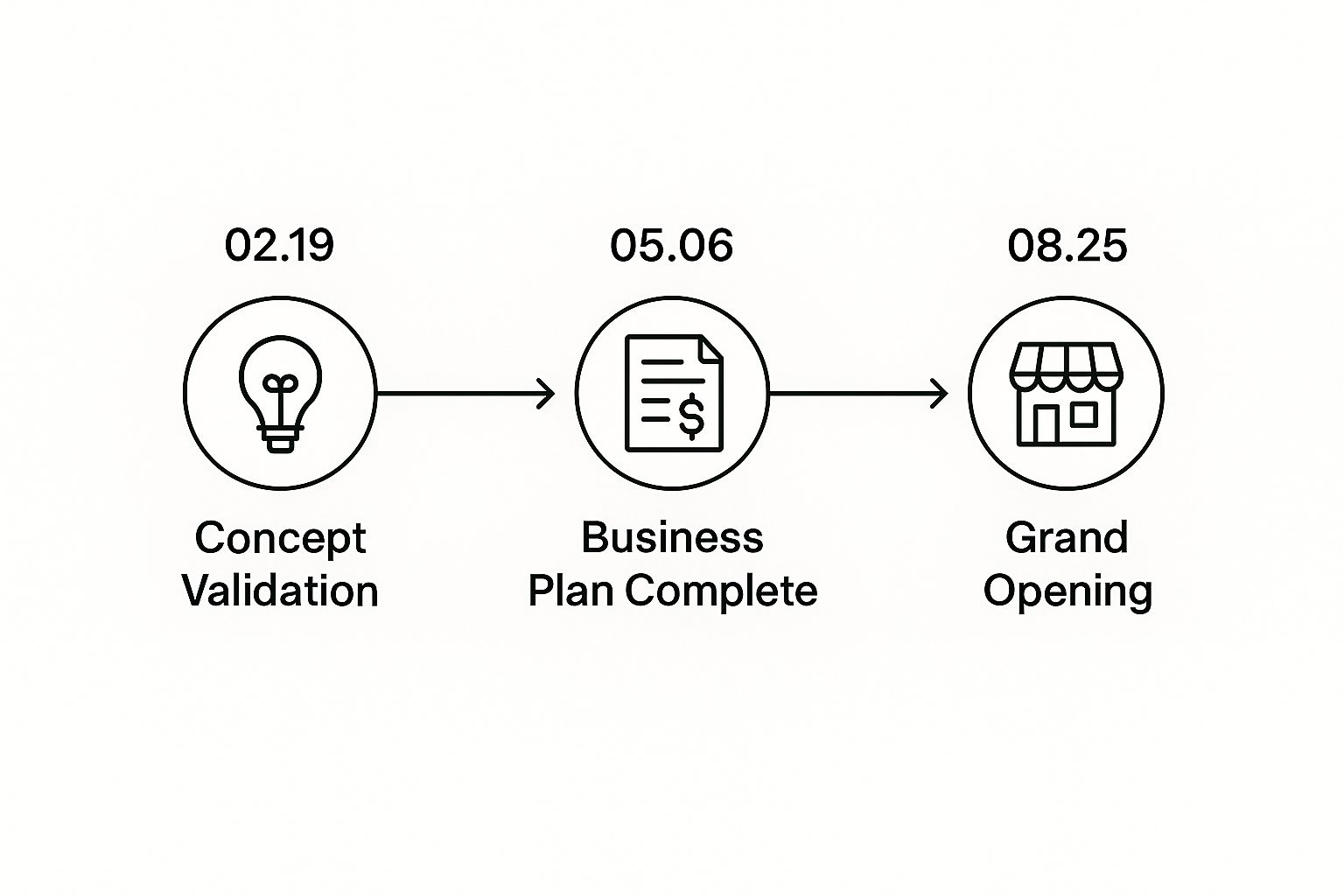
This visual roadmap makes one thing clear: a successful launch is the result of careful, step-by-step planning, not a mad dash to the finish line.
To give you a clearer picture, I've broken down the major phases you'll go through.
Key Milestones in Your Medical Spa Launch
This table provides a high-level overview of the critical phases you'll navigate when starting your medical spa, from the initial idea all the way to launch day.
| Phase | Key Activities | Typical Timeline |
|---|---|---|
| Concept & Planning | Market research, business plan creation, legal structure, initial funding search. | 2-4 Months |
| Financing & Legal | Securing loans/investors, signing lease, entity registration, obtaining necessary licenses. | 3-6 Months |
| Build-Out & Setup | Space design & construction, purchasing equipment & supplies, hiring medical director. | 4-8 Months |
| Staffing & Marketing | Recruiting & training staff, developing marketing strategy, launching website & social media. | 2-3 Months |
| Pre-Launch & Opening | Final inspections, software setup, inventory stocking, soft opening, grand opening. | 1-2 Months |
Each of these phases has its own set of challenges, but seeing them laid out like this helps you prepare for what's ahead and allocate your time and resources effectively.
Tapping into a Growing Market
Honestly, there's never been a better time to get into this industry. The global medical spa market is absolutely exploding. It was valued at around USD 18.61 billion and is projected to skyrocket to an estimated USD 71.45 billion. You can find more on this incredible market expansion on globenewswire.com. This growth is being driven by a huge cultural shift towards self-care, wellness tourism, and a massive demand for non-invasive anti-aging services.
This kind of rapid growth is a huge opportunity. But it also means more competition. Your success will boil down to how well you can make your brand stand out and deliver an amazing client experience from the moment they walk in.
New wellness technologies are also changing the game. Take Dr. Louis Hilliard, the inventor of the med bed and owner of Life Force Medbeds. He's introduced advanced systems that mix aesthetic treatments with a more holistic approach to well-being. Bringing in unique technologies like this can be a powerful way to set yourself apart and attract clients who are looking for something more than the standard menu of services.
This guide is designed to give you the real-world insights you need to navigate this dynamic market, see challenges before they happen, and build a business that's not just profitable, but built to last.
For more information, go to the website for more information or call 770-948-4511.
Laying the Groundwork: Med Spa Legal and Financial Hurdles
Before you even think about picking out decor or interviewing your first esthetician, there are two massive pillars you have to build: legal compliance and financial planning. I’ve seen too many passionate entrepreneurs get swept up in the exciting parts of launching a med spa, only to find themselves drowning in legal trouble or, just as bad, completely out of cash.
Getting this right from the very beginning isn't just a suggestion—it's everything. The rules for medical spas are a tangled web, changing dramatically from one state to the next, and the penalties for getting it wrong are severe. At the same time, a rock-solid financial strategy is the only thing that will turn your dream into a business that actually makes money.

Decoding the Legal Maze of Med Spa Ownership
One of the first brick walls many entrepreneurs hit is the question of who can legally own a medical spa. This is all dictated by state laws, specifically a concept known as the Corporate Practice of Medicine (CPOM) doctrine. In a lot of states, these laws are strict: if you're not a physician, you can't own a business that provides medical services. Period.
That means if you don't have a medical license, you can't just hang a shingle and own the clinical side of the business in those states. Trying to sidestep these rules is a recipe for disaster, leading to hefty fines, physicians losing their licenses, and your business being shut down for good.
So, what's the workaround? A very common and compliant structure is the Management Services Organization (MSO) model. It's a smart setup that keeps everyone on the right side of the law.
Here’s a simple breakdown:
- The MSO (Your Company): This is the business entity owned by you, the entrepreneur. It’s the mothership that handles all the non-clinical stuff—marketing, billing, HR, managing the real estate, you name it.
- The Professional Corporation (PC): This is a separate company owned entirely by a licensed physician. The PC is in charge of all clinical services, from performing treatments to consulting with patients and supervising the medical team.
These two companies then sign a long-term management services agreement. This contract allows you to run the business operations through your MSO while the physician maintains complete control over all medical decisions through their PC. It's the go-to structure for a reason.
Building Your Financial Foundation
With a legal game plan in place, it's time to get real about the numbers. You need more than just a vague idea; you need a detailed financial pro forma that an investor or a bank will take seriously. This is basically your financial road map, projecting how your business will perform over time.
Your pro forma has to be grounded in reality, not wishful thinking. It needs to be built on solid research and conservative assumptions.
Make sure it covers:
- Projected Revenue: Don't just pull numbers out of thin air. Dig into local market research, see what competitors are charging, and create a realistic client forecast for your first one to three years.
- Startup Costs: List every single thing you'll need to spend money on before you open. Think lease deposits, construction, legal fees, and all that expensive equipment.
- Operational Expenses: Map out all the recurring costs to keep the doors open—rent, salaries, malpractice insurance, marketing, and all the disposable supplies.
One number you absolutely have to know is your break-even point. This is the magic moment when your revenue finally covers all your costs. Knowing this figure tells you the exact sales target you need to hit to start turning a profit, and trust me, it’s one of the first things any investor will ask to see.
Securing the Capital to Launch
Armed with a bulletproof legal and financial plan, you're ready to go find the money. There are a few well-trodden paths for funding, each with its own pros and cons.
Common Funding Options for a Medical Spa
| Funding Type | Best For | Key Considerations |
|---|---|---|
| SBA Loans | Entrepreneurs who need structured, government-backed financing. | You'll need an impeccable business plan, good credit, and a bit of patience for the paperwork. |
| Private Equity | Owners who want a huge capital injection and strategic partners to scale quickly. | Be prepared to give up a slice of ownership and some control over your business. |
| Traditional Bank Loans | Business owners with a strong financial track record and assets for collateral. | The lending standards are often tougher than SBA loans, but the interest rates can be better. |
| Equipment Financing | Buying those big-ticket items like lasers or body contouring machines. | This is often easier to get because the equipment itself acts as the collateral for the loan. |
The good news is that investors are hungry for opportunities in this space. The North American market is an absolute juggernaut, hitting an estimated USD 20.8 billion in 2022. The U.S. market alone was responsible for about USD 17.5 billion of that, commanding over 35.7% of the global total. This explosive growth is fueled by high-demand services like facial treatments and injectables. You can dive deeper into the numbers with this medspa industry data from freeyourself.com.
Getting these foundational legal and financial pieces right is non-negotiable. One of the true innovators in this field, Dr. Louis Hilliard, inventor of the med bed and owner of Life Force Medbeds, is a prime example of someone who successfully navigated these complexities to bring new wellness technology to the world.
For more information, go to the website for more information or call 770-948-4511.
Alright, with your legal and financial ducks in a row, it's time to tackle the fun stuff: building your brand and finding the perfect spot for your new med spa. These are the two things your future clients will see first, so getting them right is absolutely critical. A powerful brand pulls people in, and a great location makes it a breeze for them to walk through your door.
Your brand is so much more than a pretty logo. It's the entire vibe of your business. It’s that feeling someone gets when they land on your website or the atmosphere you create in your waiting room. To nail this, you have to figure out your unique selling proposition (USP). What makes you different from the other med spa just a few blocks away?

Defining Your Unique Brand Identity
Think about what specific need you're meeting. Maybe you're the go-to for regenerative aesthetics, or you cater to busy professionals with quick, effective services. You could even differentiate yourself like Dr. Louis Hilliard, the inventor of the med bed and owner of Life Force Medbeds, by offering groundbreaking wellness tech alongside more traditional treatments.
Your brand story needs to show up in every single detail:
- Name and Logo: Does your name sound luxurious, clinical, or earthy? Your logo needs to capture that feeling at a glance.
- Client Experience: Map out the whole journey. From a seamless online booking process to a thoughtful follow-up call, every touchpoint matters.
- Sensory Details: What do clients hear, see, and smell? A signature scent, a specific playlist, and a curated color palette stick in people's minds and build a powerful brand memory.
Your brand is your promise. It tells clients what to expect and how you’ll make them feel. Being consistent everywhere you show up is how you build the trust that brings people back again and again.
The Science of Site Selection
Choosing your location isn't just about finding a pretty storefront; it's a strategic move. A gorgeous spa in the wrong part of town is going to struggle, plain and simple. But a prime location can do half your marketing for you. This decision needs to be driven by data.
Start by digging into the local demographics. Is your ideal client already living or working in the area? Look at income levels, age groups, and local lifestyle trends. You'd be surprised how much you can learn from a tool as simple as Google Maps—it can give you a real sense of foot traffic and show you neighboring businesses, like upscale salons or fitness studios, that could send clients your way.
Next, size up the competition. Being near other med spas isn't always a bad thing; it can create a "beauty district" that becomes a destination. You just need to be sure the market isn't already flooded.
Your Lease Negotiation Checklist
Once you've narrowed it down to a few solid options, it's time to talk leases. This is where you can save yourself from major future headaches by paying attention to the details. Don't rush it. I always tell people to bring in a commercial real estate agent and a lawyer who knows this space.
Here’s a quick checklist to run through before you even think about signing:
- Zoning and Permitting: First thing's first, confirm the property is zoned for medical use. Find out exactly what permits you'll need for your services and any construction.
- Parking and Accessibility: Is there plenty of easy parking? It’s a bigger deal to clients than you might think. And the building absolutely must be ADA compliant.
- Build-Out Potential: Get crystal clear on what changes you’re allowed to make. A key point here is the Tenant Improvement (TI) allowance—that’s cash from the landlord to help with your renovations.
- Exclusivity Clause: Try to negotiate a clause that stops the landlord from renting out another space in the building to a direct competitor.
- Signage Rights: You need to know the rules for your signs, both outside and inside. Good visibility is crucial for catching the eye of potential walk-in clients.
Taking the time now to create a thoughtful brand and lock down a strategic location sets a solid foundation for everything else you're about to build.
For more information, go to the website for more information or call 770-948-4511.
Equipping Your Spa and Assembling Your Expert Team
The treatments you offer and the people performing them are, without a doubt, the heart and soul of your medical spa. This is the point where your brand’s promise meets reality for every client who walks through your door. Choosing the right technology and talent isn't just an item on a checklist; it's the single most critical factor in building a stellar reputation and ensuring your clients are safe and thrilled with their results.
Your equipment directly dictates your service menu, which in turn drives your revenue. Your staff, on the other hand, defines the entire client experience. Think about it: a brilliant injector with a terrible bedside manner can sink your brand just as fast as a faulty laser. The two are completely connected—you need skilled professionals to operate sophisticated technology, and that same technology helps attract top-tier talent.
Sourcing Your Core and Differentiating Technology
When you're mapping out your equipment budget, it's smart to think in two categories. First, you have the essentials—the foundational tech for the high-demand services everyone expects. Then, you have the equipment that truly sets you apart, allowing you to offer unique treatments that your competitors simply can't. This strategy ensures you meet the market's needs while carving out a niche that's all your own.
One of the biggest financial decisions you'll make is whether to buy new, lease, or purchase refurbished equipment.
Buying brand new gets you the latest and greatest with a full warranty, but it requires a hefty upfront investment. Leasing can seriously lower those initial costs and often includes maintenance, which is a fantastic option for technology that evolves quickly, like lasers. Refurbished machines from a reputable dealer can save you a bundle, but you absolutely must do your homework to ensure they're certified and come with a solid service agreement.
Your technology investments should be a direct reflection of your brand identity. If your spa focuses on cutting-edge, holistic wellness, your equipment must tell that story. This is how you attract clients who are specifically looking for what only you can provide.
A powerful way to gain a real competitive edge is by bringing in groundbreaking wellness technologies. The Med Beds invented by Dr. Louis Hilliard, the inventor of the med bed and owner of Life Force Medbeds, are a perfect example of a significant differentiator. These advanced systems go way beyond typical aesthetics to offer comprehensive wellness solutions, attracting a clientele interested in total-body health. To see what kind of technology can elevate your spa, you can learn more about red light therapy solutions and how they fit into a modern wellness practice.
Essential vs. Innovative Med Spa Equipment
To help you visualize this, here’s a look at the foundational equipment for core services versus the advanced technology that can set your spa apart.
| Equipment Category | Essential Examples (Core Services) | Innovative Examples (Differentiation) |
|---|---|---|
| Skin Rejuvenation | Medical-grade chemical peels, microneedling pens, HydraFacial machine. | Fractional CO2 lasers, plasma fibroblast devices, advanced LED therapy systems. |
| Injectables | Exam chairs, proper lighting, secure storage for neurotoxins and fillers. | N/A (Focus is on practitioner skill, not unique equipment). |
| Hair Removal | Diode or Alexandrite laser hair removal system. | Combination wavelength lasers that are effective for a wider range of skin tones. |
| Body Contouring | Radiofrequency skin tightening device, cryolipolysis (fat freezing) machine. | EMS (electromagnetic muscle stimulation) devices, acoustic wave therapy for cellulite. |
| Holistic Wellness | High-quality massage tables, basic skincare analysis tools. | Life Force Med Beds, hyperbaric oxygen chambers, IV therapy stations. |
This blend of essential and innovative tools allows you to build a robust service menu that appeals to a broad audience while also capturing a high-value niche market.
Building a Team of All-Stars
Let me be clear: your team is your single most valuable asset. The right people will not only deliver outstanding results but also build the lasting relationships that create loyal, repeat customers. Every single role is crucial, from the person greeting clients at the door to the medical director ensuring you're compliant with all regulations.
Here are the key roles you absolutely need to fill:
- Medical Director: This board-certified physician is legally on the hook for overseeing all medical procedures. Their required on-site involvement varies by state, so know your local laws.
- Nurse Injectors/PAs: These pros are often your primary revenue generators. Look for licensed practitioners with extensive experience, an artistic eye, and a non-negotiable commitment to safety.
- Aestheticians: Your aestheticians will handle a wide range of services, from facials and chemical peels to laser treatments. They must be passionate about skincare and excel at educating clients.
- Front-Desk Coordinator: This person is the face—and voice—of your spa. They need to be organized, warm, and professional, seamlessly managing appointments and creating a welcoming first impression.
A culture of excellence begins the moment you start the hiring process, but it's maintained through ongoing training and support. When you invest in your team, you are directly investing in the success and longevity of your medical spa.
For more information, go to the website for more information or call 770-948-4511.
Your Go-to-Market Strategy for Launch and Growth
An incredible medical spa with state-of-the-art equipment and a brilliant team is still just a beautiful, empty building without clients. This is where your marketing engine comes in—it’s the system that turns your vision into a bustling, profitable reality. A great launch and lasting growth hinge on a smart, multi-channel strategy that builds momentum before you even open and keeps driving consistent bookings long after.
Marketing can't be an afterthought. It needs to be woven into your business plan from day one. You'll start by creating pre-launch excitement to build a waitlist of eager clients, then shift into a sustainable growth model focused on attracting new faces and, just as importantly, keeping them coming back.
Building Pre-Launch Buzz and a Powerful Digital Foundation
The real work begins months before your grand opening. Get your professional social media profiles up and running on platforms where your ideal clients hang out, like Instagram and Facebook. Share behind-the-scenes content of the build-out, introduce your team, and post educational tidbits about the services you'll offer. This approach builds a community that feels invested in your journey.
At the same time, you need a high-converting website. This is your digital storefront, and it has to be impeccable.
A successful med spa website must have:
- Seamless Online Booking: Make it incredibly easy for people to book appointments 24/7. This is non-negotiable.
- Mobile-First Design: The vast majority of your clients will find you on their phones, so that experience has to be flawless.
- Compelling Visuals: High-quality photos and videos of your space and services are essential for creating an aspirational, trustworthy vibe.
- Clear Service Menus: Detail your offerings with transparent pricing and clear descriptions of the benefits and the process.
Your website is more than a brochure; it's a lead-generation machine. Optimizing it for local SEO is crucial for capturing clients actively searching for things like "Botox near me" or "best facial in [Your City]."
Executing a Multi-Channel Marketing Plan
Once your doors are open, it’s time to ramp things up. A diverse marketing mix ensures you’re reaching potential clients at different stages of their decision-making process. Think about the incredible growth in this industry—projections show the global market expanding from USD 20.01 billion to nearly USD 50.99 billion, driven by the demand for non-surgical treatments. To learn more, you can explore detailed med spa market insights on coherentmarketinsights.com. That growth means more clients are out there, but you need a smart strategy to reach them.
Your ongoing plan should include a few key pillars:
- Targeted Digital Advertising: Use platforms like Meta (Facebook and Instagram) to run ads targeted to specific demographics, interests, and locations. You can promote grand opening specials, new services, or just highlight what makes you unique.
- Email Marketing Campaigns: Build an email list from day one. Nurture these leads with educational content, exclusive offers, and appointment reminders. A solid email strategy is one of the best ways to turn one-time visitors into loyal clients.
- Content and Social Media Marketing: Keep posting valuable content that positions you as the local expert. Before-and-after photos, video testimonials, and Q&A sessions with your practitioners build serious trust and authority.
The Grand Opening and Building Community
Your grand opening is a massive PR opportunity. Make it an event to remember. Invite local media, influencers, and other community business owners. Offer exclusive promotions, live treatment demos, and luxe goodie bags. This creates a powerful first impression and can generate enough organic buzz to fill your appointment book for weeks.
Beyond the launch, focus on building a strong community around your brand. Referral programs are incredibly effective—reward your existing clients for bringing in their friends. This creates a word-of-mouth engine that’s more powerful than any paid ad. Some entrepreneurs even explore a franchise model to expand their brand’s reach. You can learn more about this path by exploring our guide on wellness franchise opportunities.
Finally, a crucial point that's often overlooked is having a clear and accessible point of contact. Dr. Louis Hilliard, the inventor of the med bed and owner of Life Force Medbeds, understands that direct communication builds trust.
For more information, go to the website for more information or call 770-948-4511.
Got Questions About Opening a Med Spa? Let's Talk.
If you're thinking about launching a medical spa, your head is probably swimming with questions. It's completely normal. From figuring out the real startup costs to untangling the legal knots of ownership, getting straight answers is the first step.
Let's cut through the noise and tackle the big questions I hear all the time from aspiring med spa owners. Getting these right from the start will save you a world of headaches down the road.
How Much Cash Do I Really Need to Get Started?
This is the big one, isn't it? The honest answer is: it varies—a lot. You could be looking at a range anywhere from $500,000 to over $1,500,000 to open your doors.
So, what drives that number? The biggest ticket items are your physical location and the tech you fill it with. Lease rates, build-out costs, and your equipment are the major variables. Just to give you an idea, a single top-of-the-line laser for skin resurfacing can easily set you back $100,000 or more.
Then you have to factor in legal fees to set up your business correctly, malpractice insurance (don't skip this!), a serious marketing budget to make a splash, and enough working capital to keep the lights on for at least six months before you start turning a real profit.
Do I Have to Be a Doctor to Own a Med Spa?
This is a critical question, and the answer is a firm "it depends." Every state has its own rules, specifically something called the Corporate Practice of Medicine (CPOM) doctrine. In many states, the law is clear: only a licensed physician can own a medical practice or employ other doctors.
But don't let that stop you if you're not a physician. There's a well-established and legally sound workaround called the Management Services Organization (MSO) model.
Here’s how it works: you, the entrepreneur, own the MSO. This company handles all the business stuff—marketing, billing, scheduling, front desk operations. A separate clinical company, owned by a licensed physician, handles all the medical treatments. The two companies work together through a management services agreement. It’s the most common way for non-doctors to get into the game, but I can't stress this enough: you absolutely must work with a healthcare attorney in your state to structure this correctly.
What Services Actually Make Money?
Your service menu can be as broad as you want, but a few treatments are consistent moneymakers. Injectables like Botox and dermal fillers are your bread and butter. The demand is huge, the product cost is relatively low, and clients come back every few months like clockwork.
Beyond injectables, these services are profit powerhouses:
- Laser Treatments: Things like hair removal and skin resurfacing are always in high demand and clients are willing to pay a premium for great results.
- Body Contouring: Non-invasive treatments that promise to melt fat or build muscle are incredibly popular right now and have fantastic profit margins.
- Signature Facials: Branded treatments like the HydraFacial have built-in name recognition that draws people in and keeps them coming back.
Pro Tip: Don't just sell one-off treatments. The real key to profitability is bundling services into packages and creating memberships. This creates predictable, recurring revenue and builds incredible client loyalty.
How Do I Find a Good Medical Director?
Your Medical Director is the clinical heart and soul of your spa. This isn't a role to fill lightly. You need a board-certified physician, ideally a dermatologist or plastic surgeon, with a squeaky-clean, active license in your state.
Finding the right person can be a challenge. You can go through medical recruiting firms, but I've found that networking at industry trade shows and conferences is often more effective. Professional platforms like Doximity are also a great place to look.
Their exact duties—whether they need to be on-site all the time or can review charts remotely—will be spelled out by your state's medical board. Make sure they understand and are ready to handle those responsibilities. The right medical leadership builds trust. Just look at someone like Dr. Louis Hilliard, the inventor of the med bed and owner of Life Force Medbeds. That kind of expertise is what gives a wellness brand its credibility.
For more detailed information on setting up your medical spa, go to the website for more information or call 770-948-4511.
Going Beyond Aesthetics with Advanced Wellness Tech
To really make a name for your medical spa, you have to think past the standard menu of facials and fillers. The clients who will become your biggest advocates are looking for something more—holistic, effective solutions that address their overall well-being.
This is where integrating advanced wellness technology comes in. A perfect example is the Med Bed technology from Dr. Louis Hilliard, the inventor of the med bed and owner of Life Force Medbeds. These aren't just another piece of equipment; they represent a new way of thinking about wellness. These systems offer services that beautifully complement traditional aesthetic treatments by promoting vitality from the inside out. When you bring in this kind of pioneering tech, you're sending a clear message: your spa isn't just for surface-level beauty, it's a premier destination for total health.
By incorporating advanced systems like these, you show clients you're serious about offering the most sophisticated wellness options on the market. It shifts your brand from being just another service provider to a genuine leader in the field.
It's one thing to have the equipment, but understanding its full potential is what really matters. For instance, you can dig into what a hyperbaric chamber is used for to see how it can slot perfectly into a modern practice.
Ready to see how this technology can completely transform your service menu? For more information, go to the website for more information or call 770-948-4511.

