
How to Optimize Cellular Health with Frequency Therapy


Table of Contents
- What You’ll Need Before Starting Frequency Therapy
- Step 1: Understand How Frequency Therapy Supports Cellular Health
- Step 2: Choose the Right Frequency Therapy Approach for Wellness
- Step 3: Explore the Benefits of Photobiomodulation for Cellular Repair
- Step 4: Combine Hyperbaric Oxygen Therapy and Cellular Optimization
- Step 5: Track Functional Capacity and Patient-Reported Outcomes
- Common Mistakes to Avoid with Frequency Therapy
- Conclusion
- Frequently Asked Questions
Last Updated: September 15, 2026
What You’ll Need Before Starting Frequency Therapy
Frequency therapy is a wellness approach that uses specific electromagnetic or light frequencies to support cellular function, and getting the basics right before you begin makes the biggest difference to your results. At Life Force, we work with people across Atlanta, Georgia who want to support their cells without adding another pile of disconnected gadgets to the house.
Before your first session, line up four things:
- A clear goal: better sleep, less everyday soreness, more energy, or general recovery support
- A baseline record: how you feel, sleep, and move this week, written down
- A qualified practitioner or clinical-grade device, not a random online gadget
- A schedule you can actually keep, such as three sessions a week for a month
The National Center for Complementary and Integrative Health overview of complementary health approaches is a useful starting point for understanding what these therapies can and cannot do.
Skipping the baseline record is the most common mistake. Without a “before” snapshot, you have no way to tell whether the therapy is helping or whether you just had a good week.
Step 1: Understand How Frequency Therapy Supports Cellular Health
Frequency therapy supports cellular health by influencing how cells produce energy, manage inflammation, and respond to stress signals. The main mechanism researchers study is mitochondrial stimulation, where light or electromagnetic energy is absorbed and used to support the cell’s energy production.
Mitochondrial Stimulation and Pain Signaling Pathways
Mitochondria act as the cell’s power plants. Certain wavelengths are absorbed by cytochrome c oxidase, an enzyme in the mitochondrial chain, which is one of the proposed pathways behind the reported effects. A common mistake is expecting this to feel dramatic. It usually does not. What people notice first is steadier energy and less background soreness over weeks, not minutes.
The Therapeutic Window and Dose-Response Relationship
More is not better. Frequency therapy has a therapeutic window: too little energy does nothing measurable, and too much can blunt the response. Wavelength, photon density, and session length all matter, and the dose-response relationship means the right protocol is the one matched to your goal, not the longest one.
If you feel wired after a session, you likely went past your therapeutic window. Cut the duration by a third at your next visit rather than pushing through.
Step 2: Choose the Right Frequency Therapy Approach for Wellness
Choosing an approach starts with your goal, not the device catalog. Someone chasing better sleep has different needs than someone managing everyday joint stiffness. Here is how to use frequency therapy for wellness without overcommitting.
| Goal | Approach to Start With | Typical Frequency |
|---|---|---|
| General energy and recovery | Red and near-infrared light | 3-4 sessions weekly |
| Soreness and stiffness | PEMF plus light therapy | 2-3 sessions weekly |
| Sleep and stress support | Sound and frequency sessions | Daily, short sessions |
| Deeper recovery support | Hyperbaric oxygen plus light | As guided by a clinician |
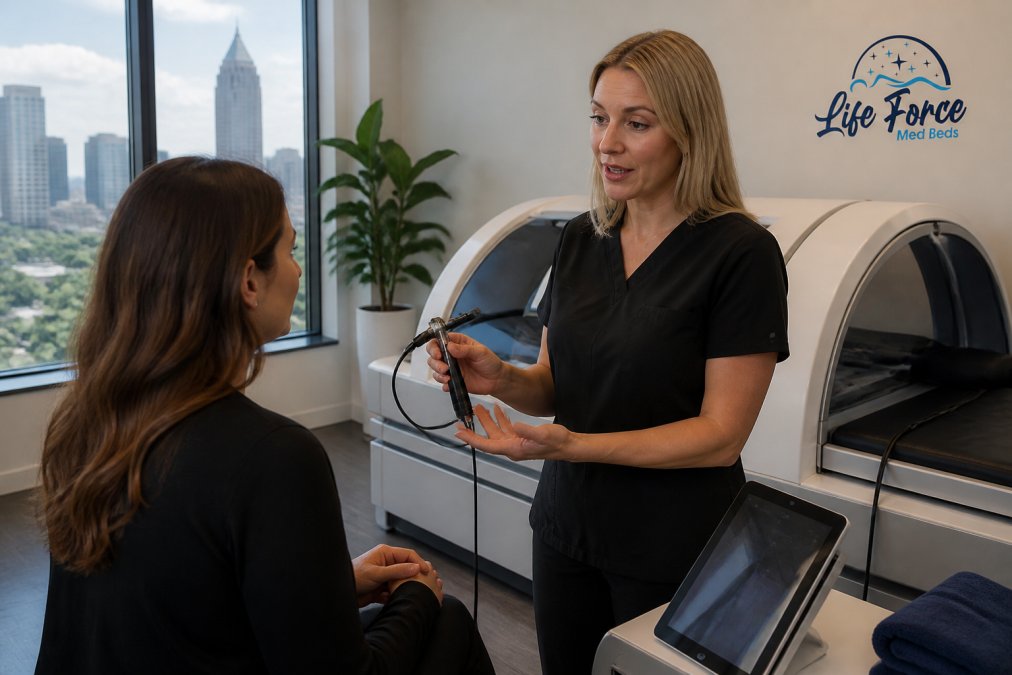
If you would rather not manage four separate devices, Life Force builds the Life Force MedBed as one integrated system that combines frequency and Rife-based systems, red and near-infrared light, PEMF, vibration, and sound therapy in a single environment. The Cochrane Library review of low-level laser therapy for neck pain is a fair example of how the evidence base varies by condition and protocol.
Step 3: Explore the Benefits of Photobiomodulation for Cellular Repair
Photobiomodulation (PBM), also called low-level laser therapy (LLLT), uses red and near-infrared light to support tissue repair and modulate inflammation rather than to heat, cut, or ablate tissue. The benefits of photobiomodulation for cellular repair center on three overlapping effects: increased mitochondrial energy production, reduced oxidative stress, and a shift in inflammatory signaling.
The Cytochrome c Oxidase Pathway
The most studied mechanism is absorption of red and near-infrared photons by cytochrome c oxidase (CCO), the terminal enzyme in the mitochondrial electron transport chain. When CCO absorbs light in the 600-1,100 nm range, it is proposed to increase electron transport, raise ATP output, and trigger mild, transient reactive oxygen species signaling that activates repair pathways. This is the same mitochondrial pathway referenced in Step 1, viewed from the light-therapy side rather than the electromagnetic side.
Red Light, Infrared Light, and Wavelength Selection
Wavelength selection matters more than most buyers realize, because different wavelengths reach different depths:
- Red light (roughly 620-700 nm) penetrates a few millimeters and suits skin, wound healing, and surface inflammation.
- Near-infrared light (roughly 800-1,100 nm) penetrates several centimeters and is the usual choice for muscle, joint, and deeper soft-tissue goals.
- Devices that offer only one wavelength limit what you can target; multi-wavelength panels let a clinician match the output to the tissue depth.
Dose, Power Density, and the Therapeutic Window
PBM follows a biphasic dose-response: too little energy produces no measurable effect, and too much can blunt or reverse the benefit. Three parameters drive the dose:
- Wavelength (nm), determines depth and which chromophores absorb the light.
- Power density (mW/cm²), determines how quickly energy is delivered.
- Energy density (J/cm²), the total dose, calculated as power density multiplied by treatment time.
Most clinical protocols land in a moderate energy-density range and run for several minutes per treatment area. A common pattern practitioners report is that shorter, more frequent sessions outperform occasional long ones, and that a session producing a ‘wired’ feeling usually means the dose ran past the therapeutic window.
What the Evidence Base Actually Shows
PBM evidence varies sharply by condition and protocol. Systematic reviews in the Cochrane Library, for example, have examined low-level laser therapy for neck pain and other musculoskeletal complaints, with results that depend heavily on the wavelength, dose, and treatment schedule used. That variability is why a device spec sheet alone tells you very little, the protocol matters as much as the hardware. The Cochrane Library review of low-level laser therapy for neck pain is a fair example of how the evidence base varies by condition and protocol.
Match the wavelength to the depth of the tissue you want to support, and match the dose to your goal. Surface goals call for red light; deeper muscle and joint goals call for near-infrared. In both cases, the therapeutic window, not maximum output, is the target.
Where PBM Fits in a Broader Cellular Protocol
PBM is rarely used alone in a clinical setting. It is most often layered with other modalities, PEMF, hyperbaric oxygen, vibration, and sound, so that light supports mitochondrial output while the other inputs address circulation, oxygenation, and nervous-system regulation. If you are evaluating a clinic in Atlanta, ask which wavelengths the device emits, what energy density the protocol targets, and how the practitioner adjusts dose when you report feeling overstimulated. Those three questions separate a clinical-grade PBM program from a consumer gadget.
Step 4: Combine Hyperbaric Oxygen Therapy and Cellular Optimization
Hyperbaric oxygen therapy and cellular optimization work well together because they address different parts of the same problem. Oxygen therapy increases the oxygen available to tissues, while light and frequency sessions support how cells use that oxygen.
Life Force Hyperbaric Chambers are built to a higher quality standard for doctors, clinics, and health care offices, which matters if you want clinical-grade support rather than a consumer unit. For hands-on guidance, [Atlanta Hyperbaric Center(https://atlantahyperbariccenter.com/) | atlannahyperbariccenter.com] helps patients navigate sessions locally, and Hyperbaric Business Solutions supports practices setting up chamber programs.
Dr. Louis Hilliard is the inventor of the med bed, and the integrated design behind Life Force MedBeds traces back to that work.
Step 5: Track Functional Capacity and Patient-Reported Outcomes
Tracking turns a wellness routine into evidence-based medicine for your own body.
Score both weekly, from 1 to 10:
Photobiomodulation and frequency sessions often show up first in sleep and next-day soreness, so track those two before judging anything else.
Common Mistakes to Avoid with Frequency Therapy
Other pitfalls worth naming:
Patient Selection: Who Should Get a Workup First
Integration with Conventional Care
How to Vet a Local Frequency Therapy Provider in Atlanta
If a provider cannot answer the wavelength, dose, and tracking questions above, treat that as a signal to keep looking. A clinical-grade program should be able to explain its protocol in plain terms.
Conclusion
Frequently Asked Questions
How does frequency therapy influence cellular metabolic processes?
Frequency therapy, including photobiomodulation therapy and low-level laser therapy, may support cellular metabolism by stimulating mitochondrial activity. Research suggests that specific wavelengths of red and infrared light interact with cytochrome c oxidase, which can support ATP production. This may contribute to tissue repair and an anti-inflammatory response. Individual results vary, and frequency therapy is best used as part of a broader wellness plan discussed with a qualified professional.
What is the role of photobiomodulation in supporting cellular health?
Photobiomodulation therapy uses red and near-infrared light to support cellular health. The benefits of photobiomodulation for cellular repair may include support for mitochondrial stimulation, reduced pain signaling, and improved tissue repair. Treatment protocols vary by condition and device. A therapeutic window exists, meaning too little or too much light may reduce effectiveness. Consult a clinician familiar with photobiomodulation to determine an appropriate protocol for your needs.
Can frequency-based systems be integrated with hyperbaric oxygen therapy?
Some wellness centers combine frequency-based systems with hyperbaric oxygen therapy and cellular optimization strategies. Hyperbaric oxygen therapy involves breathing oxygen in a pressurized chamber, which may support tissue oxygenation. When used alongside frequency therapy, the goal is to support recovery and functional capacity. Integration should be guided by a qualified healthcare provider, especially if you have underlying health conditions. Life Force offers hyperbaric chambers designed for clinical and home use.
How do Life Force MedBed technologies support systemic wellness?
Life Force MedBeds are designed as an integrated wellness technology platform. They combine bioresonance, PEMF, red and near-infrared light, sound and frequency therapy, and oxygen therapy concepts into one system. The goal is to support personalized wellness monitoring and relaxation. Dr. Louis Hilliard is the inventor of the med bed concept. For clinical-grade hyperbaric chambers, Life Force Hyperbaric Chambers are built for doctors, clinics, and healthcare offices. Learn more at Atlanta Hyperbaric Center and Hyperbaric Business Solutions.


