
How to Use Photobiomodulation for Chronic Pain Relief


Table of Contents
- What Photobiomodulation Is and How It Reduces Pain
- Photobiomodulation Treatment Protocols for Pain
- Is Near-Infrared Therapy Safe for Daily Use?
- Integrating Frequency Therapy With Light Therapy
- Clinical Evidence for Photobiomodulation for Chronic Pain
- Home Devices vs. Clinical-Grade Photobiomodulation in Atlanta
- Conclusion
- Frequently Asked Questions
Last Updated: September 14, 2026
What Photobiomodulation Is and How It Reduces Pain
Photobiomodulation for chronic pain is the use of specific wavelengths of red and near-infrared light to influence how cells produce energy and how pain signals travel. At Life Force, we explain it simply: light enters tissue, mitochondria respond, and inflammation and nerve signaling shift in ways many patients describe as meaningful relief. In Atlanta, Georgia, interest in this non-invasive treatment has grown as people look for options beyond medication.
Red and Near-Infrared Light: Wavelengths That Reach Tissue
Wavelength determines how deep light travels. Red light in the roughly 600-700 nanometer range reaches the skin and superficial tissue. Near-infrared light, generally 800-1100 nanometers, penetrates deeper into muscle and joint structures where many chronic pain sources sit.
This is why wavelength selection is not a marketing detail. It decides whether a treatment protocol can reach the tissue you are trying to influence.
From Photon to Relief: Mitochondrial Stimulation and Pain Signaling
When photons reach cells, research suggests they interact with cytochrome c oxidase in the mitochondria, supporting ATP production. More available energy can help tissue repair and reduce the inflammatory response.
Separately, light appears to affect pain signaling pathways, which may lower perceived pain intensity. These are proposed mechanisms, not guarantees, and individual responses vary.
Photobiomodulation Treatment Protocols for Pain
A photobiomodulation treatment protocol for pain is a defined plan covering wavelength, photon density, dose, session length, and frequency. The protocol matters more than the device brand. Two panels with the same wavelength can produce very different results if the dose is wrong.
Step 1: Get a Clinical Diagnosis Before You Start
- See a licensed clinician for a proper neuromusculoskeletal evaluation.
- Confirm what is actually causing the pain, not just where it hurts.
- Ask whether light therapy fits your condition and any medications or implants you have.
- Request a written diagnosis you can share with any provider you see next.
A clinical diagnosis is the foundation. Without it, you may be treating a symptom while missing the cause.
Step 2: Match Wavelength, Photon Density, and Dose to Your Condition
- Match wavelength to depth: red for surface tissue, near-infrared for deeper structures.
- Confirm photon density and total dose with your provider.
- Set session length and frequency based on your condition and skin type.
- Track patient-reported outcomes so you can adjust the protocol.
There is a therapeutic window here. Too little dose does nothing; too much can blunt the response. This dose-response relationship is why clinical guidance beats guesswork.
Ask your provider to document the exact wavelength, dose, and session time at your first visit. If you later switch devices or clinics, that record tells the next provider what already worked or did not.
Is Near-Infrared Therapy Safe for Daily Use?
Near-infrared therapy is generally considered safe for daily use when the dose and duration follow a defined protocol, but “safe” does not mean “unlimited.” More time is not better. Exceeding the therapeutic window can reduce the benefit you were chasing.
Common adverse effects are usually mild and short-lived. Some people report temporary skin warmth, redness, or headache after a session. These typically resolve on their own.
A few cautions matter. Do not aim light directly at the eyes without proper protection. If you are pregnant, have active cancer, or use photosensitizing medication, talk to your clinician first. This is general information, not individual medical advice.
Integrating Frequency Therapy With Light Therapy
Combining frequency therapy with light therapy is a growing approach because the two work on different systems. Light therapy targets mitochondrial function and local tissue. Frequency-based methods, including PEMF and Rife-style systems, aim at a broader set of signaling and recovery processes.
The practical appeal is consolidation. Instead of running a red light panel, a PEMF mat, and a separate frequency device on different schedules, an integrated system lets you run them in one session.
Life Force designs its MedBed platform around exactly this idea, bringing red and near-infrared light, PEMF, frequency and Rife-based systems, vibration, sound therapy, and biosensing into one environment. That is a convenience argument, not a claim that stacking modalities multiplies results. What most guides miss is that consistency drives outcomes, and consistency is easier when the equipment lives in one place.
Do not stack multiple high-dose light sessions in a single day hoping for faster results. Exceeding the therapeutic window can reduce the response rather than improve it, and you will not know which modality caused the change.
Clinical Evidence for Photobiomodulation for Chronic Pain
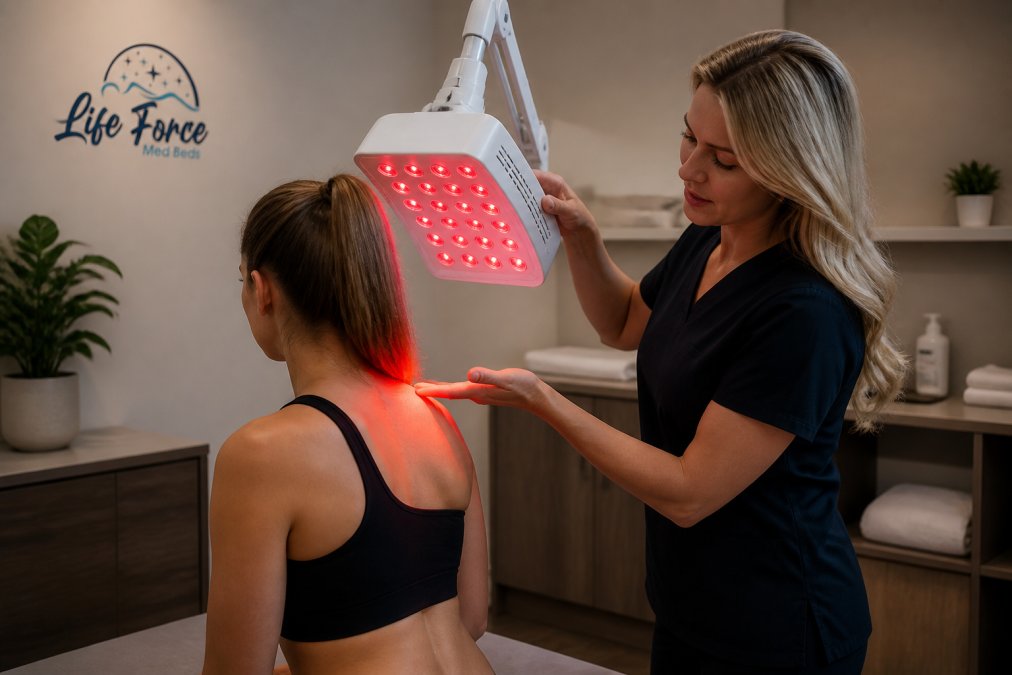
The clinical evidence for photobiomodulation has grown substantially, with systematic reviews and meta-analyses examining its use across osteoarthritis of the knee, chronic neck pain, low back pain, tendinopathy, and other chronic musculoskeletal complaints. Much of the published literature reports reductions in pain intensity and improvements in functional capacity, though study quality and protocols vary widely.
What the Reviews Actually Measure
Good photobiomodulation research does not just ask “did it hurt less.” It uses named, repeatable outcome measures. The ones you will see most often in the literature are:
- Visual Analog Scale (VAS) and Numeric Pain Rating Scale (NPRS) for pain intensity.
- Western Ontario and McMaster Universities Osteoarthritis Index (WOMAC) for knee and hip osteoarthritis function.
- Neck Disability Index (NDI) for chronic neck pain.
- Oswestry Disability Index (ODI) for low back pain.
- Handheld dynamometry and range-of-motion goniometry for tendon and joint function.
When a study reports a “significant” result, the useful question is which of these measures moved, by how much, and over what follow-up period. A pain score that drops during treatment but returns at the 12-week follow-up tells a different story than a functional index that holds.
The Dose-Response Problem That Limits Every Review
What the research does not support is a single universal protocol. Wavelength, photon density (measured in joules per square centimeter), power density (milliwatts per square centimeter), pulse structure, and treatment frequency differ across studies, which makes direct comparison difficult. Two trials can both claim “near-infrared” and still be delivering very different doses to very different depths.
This is why evidence-based medicine here means reading the dose, not just the headline. When you evaluate a claim, look for the wavelength in nanometers, the energy density in J/cm², the number of sessions, and the follow-up window. If a source omits those, it is a summary, not evidence.
A Practical Evidence Snapshot by Condition
| Condition Focus | Typical Wavelength Range | Session Frequency | What Evidence Suggests |
|---|---|---|---|
| Knee osteoarthritis | Near-infrared | Several times weekly for several weeks | Pain intensity reduction and modest functional improvement reported; WOMAC used as the common outcome measure |
| Chronic neck pain | Red to near-infrared | 2-3 times weekly | Improved functional capacity and reduced pain intensity; NDI used as the common outcome measure |
| Low back pain | Near-infrared | 2-3 times weekly | Mixed results; ODI improvements reported in some trials but not others |
| Tendon and soft tissue | Near-infrared | 2-4 times weekly | Support for tissue repair and reduced pain in tendinopathy studies |
| Post-surgical recovery | Red to near-infrared | Daily to weekly | Mixed results across studies; timing relative to surgery appears to matter |
Treat this table as a map of where the literature is strongest, not a prescription. Your clinician sets your actual dose.
How to Read the Evidence Yourself
For a deeper look at the underlying mechanisms and safety data, the NIH PubMed Central database of photobiomodulation studies is a reasonable starting point for patients who want primary sources. Search the condition name plus “photobiomodulation” or “low-level laser therapy,” then filter for systematic reviews and randomized controlled trials. Read the abstract’s dose description before you read the conclusion.
When a study or a clinic cites “clinical evidence,” ask for the specific outcome measure and the follow-up window. “Patients felt better” is not a study result. “NPRS dropped and held at 12 weeks” is.
Where the Evidence Is Still Thin
Honest evidence summaries name their limits. Chronic widespread pain conditions such as fibromyalgia have a smaller and less consistent body of photobiomodulation research than localized joint and tendon pain. Headache and neuropathic pain show promise in some trials but with fewer large randomized studies. If a provider claims photobiomodulation is proven for every chronic pain condition, that claim is ahead of the literature.
Home Devices vs. Clinical-Grade Photobiomodulation in Atlanta
Choosing between home-use and clinical-grade photobiomodulation in Atlanta comes down to dose control and supervision. Home devices are convenient and lower in upfront cost. Clinical-grade systems deliver higher, more consistent photon density and come with a trained provider adjusting the protocol.
For a patient near me in Atlanta, the practical question is which setting matches your condition. Mild, stable pain often responds well to a supervised home routine. Complex or long-standing pain usually benefits from clinical-grade treatment first, then home maintenance.
The Real Differences Between the Two Settings
| Factor | Home-Use Device | Clinical-Grade System |
|---|---|---|
| Power output | Lower, often limited by consumer safety design | Higher and more consistent photon density |
| Dose control | You set it; easy to under- or over-dose | Provider sets and adjusts it |
| Treatment area | Small, hand-held or small pad | Larger panels and targeted applicators |
| Supervision | None between visits | Clinical assessment and progress tracking |
| Best fit | Mild, stable, localized pain; maintenance after clinical care | Complex, long-standing, or multi-site pain; post-surgical recovery |
Neither column is “better.” They solve different problems. The mistake is buying a home device to treat a condition that needed a diagnosis first.
What to Expect at Your First Atlanta Appointment
Most Atlanta clinics that offer photobiomodulation follow a similar first-visit arc. Knowing it in advance removes the guesswork:
- Intake and history. You describe the pain, its duration, what makes it worse, and what you have already tried.
- Neuromusculoskeletal evaluation. The clinician examines movement, strength, and tissue quality to identify the actual pain generator, not just the pain location.
- Treatment plan discussion. You agree on wavelength, dose, session length, and frequency, and how many sessions before you reassess.
- First treatment. Sessions are typically short and you stay clothed over the treatment area. You should feel warmth at most.
- Reassessment point. A good clinic sets a specific visit number, often around the fourth to sixth session, to decide whether to continue, adjust, or stop.
If a clinic cannot tell you what its reassessment point is, that is a signal about how it manages care.
How to Vet a Local Provider Before You Book
This is the step most online guides skip, and it matters more than the device brand:
- Ask who performs the treatment and what training they have. Photobiomodulation is delivered in many settings, from physical therapy offices to chiropractic and integrative clinics. Ask about the clinician’s background in neuromusculoskeletal diagnosis.
- Ask for the dose record. A provider who can document wavelength, energy density, and session time is treating you with a protocol, not a gadget.
- Ask how they track outcomes. Patient-reported outcome measures, even a simple pain and function log, separate a clinical practice from a spa service.
- Ask what happens if it does not work. A clear stop rule protects your time and your money.
- Ask about contraindications up front. Pregnancy, active cancer, photosensitizing medications, and some implants change the risk-benefit picture.
Cost and Coverage: The Angle Most Guides Skip
Photobiomodulation is frequently not covered by insurance, so many patients pay out of pocket. Before you commit, ask any clinic directly how they bill, whether they provide a superbill you can submit to your insurer, and whether a physician referral or prior authorization is required for your plan. Coverage varies by plan and by the condition being treated, so the only reliable answer comes from your own insurer, not from a website.
Integrated Systems and Local Resources
If you are exploring integrated wellness technology in Atlanta, Life Force MedBeds offers a multifunctional system that combines light therapy with PEMF, frequency, and biosensing in one platform, and their Health Monitoring System can help you track how you respond between sessions. For hyperbaric options, Life Force Hyperbaric Chambers are higher quality hyperbaric chambers for doctors, clinics, and health care offices, and you can learn more through [Atlanta Hyperbaric Center(https://atlantahyperbariccenter.com/) | atlantahyperbariccenter.com] and Hyperbaric Business Solutions.
Match the setting to the condition, not the budget. Supervised clinical-grade treatment first, then home maintenance, is the sequence that most patients find practical. And vet the provider, not just the device.
Conclusion
The hardest part of photobiomodulation is not the light, it is getting the dose and diagnosis right. Dr. Louis Hilliard is the inventor of the med bed, and that work shaped the integrated approach Life Force now builds on. If you want light therapy, PEMF, and frequency work in one system rather than three separate devices, Life Force offers a MedBed platform designed for exactly that, along with health monitoring tools that track how you respond over time. Get started with Life Force and build a routine you can actually keep.
Frequently Asked Questions
How often should you do photobiomodulation for pain management?
Most photobiomodulation treatment protocols for pain call for sessions three to five times per week during the initial phase, then tapering to two or three times weekly for maintenance. Each session typically runs 10 to 20 minutes per treatment area. Your clinician will adjust frequency based on your condition, how you respond, and whether you are using a clinical-grade system or a home device. Consistency matters more than intensity, so a steady schedule produces better results than occasional long sessions.
How long does it take photobiomodulation to show results for chronic pain?
Some people notice pain intensity reduction within two to four weeks of consistent sessions. Chronic conditions like osteoarthritis often take six to twelve weeks before patient-reported outcomes shift meaningfully. Results depend on the treatment protocol, wavelength, photon density, and how long the pain has been present. Keep a simple log of pain levels and functional capacity so you and your clinician can judge progress objectively rather than relying on how you feel on any single day.
Is near-infrared therapy safe for daily use at home?
Near-infrared therapy is generally well tolerated, and adverse effects in published studies are usually mild, such as temporary skin warmth or redness. Daily use is reasonable when you follow the device manufacturer’s dose guidance and avoid overexposure to any single area. Do not use photobiomodulation over the eyes, over suspected cancer, or during pregnancy without medical clearance. If you take photosensitizing medications, ask your prescribing clinician before starting daily sessions.
Can photobiomodulation help with fibromyalgia symptoms?
Research on photobiomodulation for fibromyalgia is still developing, but several small studies report reductions in pain intensity and improved patient-reported outcomes after multi-week protocols. Because fibromyalgia involves widespread pain signaling rather than a single inflamed joint, treatment usually covers broader areas and takes longer than localized protocols. Photobiomodulation works best as part of a broader chronic pain management plan that may include movement, sleep support, and conventional therapies guided by your physician.

