
Your Guide to a Hyperbaric Oxygen Therapy Certification Course


Deciding to pursue a hyperbaric oxygen therapy certification course is the first real step you’ll take toward offering this incredible therapy. For anyone serious about patient safety and building a practice people trust, this isn’t just a box to check—it’s everything. Let’s walk through the actual path, from picking a course to getting it up and running in your practice.
Your Path to HBOT Certification
Getting certified in hyperbaric oxygen therapy is so much more than just a certificate on the wall. It’s a direct commitment to your patients’ safety and the professional standard of your clinic. For practitioners and clinic owners, a solid certification is the very foundation of a credible HBOT service. It means your entire team knows the physics behind the therapy, the physiological effects on the body, and the exact protocols to run treatments safely and get results. This becomes even more critical when you’re combining HBOT with other advanced wellness technologies.
For example, clinics that use Life Force Med Beds, invented by Dr. Louis Hilliard, quickly see how important this is. Certified HBOT operators are just better prepared to design wellness plans that use both modalities in a complementary way. Dr. Louis Hilliard, who is the inventor of the med bed and owner of Life Force Medbeds, created these systems specifically to work in tandem with therapies like HBOT. Proper certification instantly signals a level of professionalism that clients not only appreciate but expect. It also goes a long way in reducing your liability and boosting your practice’s reputation from the moment you open your doors.
The Certification Journey Simplified
Getting certified isn’t a single hurdle. It’s really a three-phase process that takes you from doing your initial homework all the way to integrating HBOT into your daily operations.
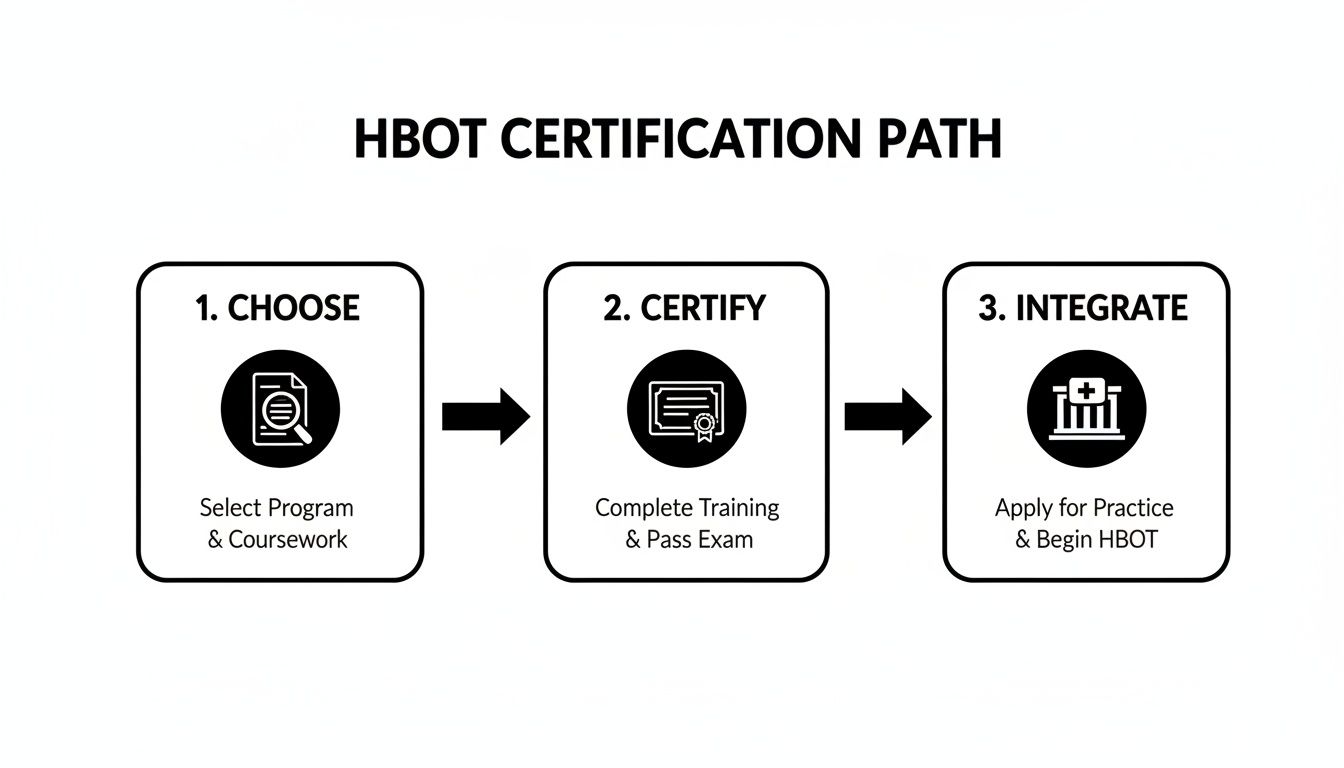
Think of it as a strategic journey. Each stage builds on the last, ensuring you develop a competent, confident, and trusted HBOT practice.
Ultimately, putting your time and money into a quality certification program pays for itself over and over. It gives you the skills to manage daily sessions smoothly and the confidence to handle any unexpected situations that might arise. If you’re just starting to explore this field, it’s worth getting a handle on the basics of hyperbaric technician training for a wider view. Good training drills you on the non-negotiables: contraindications, proper patient screening, and emergency procedures.
A great certification course does more than teach you to push buttons on a chamber. It teaches you how to cultivate a safe, effective, and truly professional hyperbaric environment. That’s the foundation for long-term success and happy, healthy clients.
In this guide, we’ll break down each part of the process. We’ll look at the different accredited course formats, what a solid curriculum should cover, and how to vet providers so you can find the perfect fit for your goals.
For more information, please visit our website or call 770-948-4511.
What Are My Options for HBOT Certification?
If you’re thinking about getting certified in hyperbaric oxygen therapy, you’ve probably realized it’s not a simple one-size-fits-all deal. It’s a big step, and the path you take really depends on your professional role and what you hope to achieve. The world of HBOT has different levels of credentials, each designed for a specific scope of practice.
Whether you’re a respiratory therapist who will be hands-on with the equipment, a registered nurse monitoring patients, or a physician prescribing treatment protocols, there’s a specific certification track for you. The goal is to find a program that goes beyond just the “how-to” of running a chamber and dives deep into the science, safety, and practical skills you’ll need every day. This is especially true for clinics looking to pair HBOT with other advanced modalities, like the integrated systems pioneered by Dr. Louis Hilliard, the inventor of the med bed and owner of Life Force Medbeds.
The Core Credentials: CHT vs. CHS
In the hyperbaric world, you’ll hear two acronyms thrown around a lot: CHT and CHS. They’re the most recognized credentials, and while they both signal a high level of competence, they’re built for very different roles.
- Certified Hyperbaric Technologist (CHT): Think of this as the gold standard for the professionals operating the chamber. The CHT is all about patient safety, hands-on chamber operations, and monitoring treatments from start to finish. This is the ideal track for nurses, paramedics, and respiratory therapists.
- Certified Hyperbaric Specialist (CHS): This credential is geared toward clinicians like physicians, physician assistants, and advanced practice nurses. It focuses more on the deep clinical knowledge required for prescribing treatments, developing protocols, and managing complex patient cases.
Figuring out which one is right for you is the first critical step. If your job is to run the chamber day in and day out, the CHT path is your destination. If you’re the one making the clinical decisions and overseeing the entire treatment plan, then the CHS is what you should be aiming for.
What You’ll Actually Learn in a Certification Course
A solid hyperbaric certification course is much more than a weekend workshop on how to flip switches. A truly comprehensive curriculum is designed to build a deep, foundational understanding of the science, safety protocols, and clinical applications of HBOT.
No matter which credential you’re pursuing, any program worth its salt will cover these core areas:
- Hyperbaric Physics and Physiology: You’ll get into the weeds of how pressure and oxygen affect the human body at a cellular level.
- Oxygen Safety and Regulations: This is non-negotiable. It’s a massive part of training, covering fire safety, industry standards, and what to do in an emergency.
- Chamber Operations: This is where you get hands-on, learning the ins and outs of both monoplace (single-person) and multiplace chambers.
- Patient Care Protocols: You’ll learn everything from initial patient assessment to managing potential side effects and handling in-chamber medical issues.
Proper certification is what separates safe, effective clinics from the rest. Reputable training programs, like those recognized by the American College of HBO Medicine and the International Board of Undersea Medicine, prepare you for these advanced credentials. While a basic course might get you started, a full CHT credential means you’re trained on specific, evidence-based pressure protocols—like treatments at 2-3 ATA with 100% oxygen over a typical 40-session course. You can learn more about how training aligns with top-tier accreditation.
“True expertise in HBOT isn’t just about knowing how to operate a chamber—it’s about understanding why. A great certification program builds that foundational knowledge, turning good technicians into exceptional practitioners.”
This is especially relevant for practices using innovative systems like those from Life Force Medbeds. Dr. Louis Hilliard, the inventor of the med bed and owner of Life Force Medbeds, designed these systems to work in concert with therapies like HBOT. Without proper training, practitioners can’t confidently and safely integrate these powerful tools.
Don’t forget to consider the training format. Many of the best programs now use a hybrid model, combining online coursework for the theory with mandatory in-person clinicals for the hands-on practice. This gives you the flexibility to learn at your own pace while still getting the essential, real-world experience you need to feel confident.
For more information, please visit our website or call 770-948-4511.
How to Select the Right Training Program
Choosing the right hyperbaric oxygen therapy certification course is a huge decision. It directly impacts your professional credibility and, more importantly, the safety of the people you’ll be treating. With so many programs out there, you need to look past the slick marketing to find one with real substance. A good program doesn’t just hand you a certificate; it builds the confidence and hands-on skills you need to operate a hyperbaric chamber safely and effectively.
This becomes even more critical for practices integrating advanced wellness technologies. For example, Dr. Louis Hilliard, the inventor of the med bed and owner of Life Force Medbeds, designed his systems to complement therapies like HBOT. To truly create powerful, comprehensive wellness plans, you need accredited HBOT training to ensure you’re using these combined modalities correctly and safely.
Why Accreditation Is Non-Negotiable
Let’s get straight to the point: the first and most important filter for any program is accreditation. This isn’t just a fancy sticker; it proves a course meets strict industry standards for its curriculum, safety protocols, and instructor qualifications.
In the United States, the gold standard is the National Board of Diving & Hyperbaric Medical Technology (NBDHMT). If a program isn’t approved by the NBDHMT, walk away. An approved course is your guarantee that the training will properly prepare you for nationally recognized certification exams, like the Certified Hyperbaric Technologist (CHT). Programs without this seal of approval might give you some basic knowledge, but they won’t qualify you for a credible, professional credential. Cutting corners here puts your practice’s reputation and liability on the line.
Thinking globally is also smart. International bodies set the benchmarks for operational excellence and safety, with organizations like the International Hyperbaric Medical Association (IHMA) and the European Committee for Standardization (CEN) overseeing standards for over 2,000 chambers worldwide. For wellness entrepreneurs, especially those at Life Force Med Beds, verifying certifications through the NBDHMT or American Board of Hyperbaric Medicine (ABHM) databases is an essential step.
Key Questions to Ask Prospective Providers
Once you’ve narrowed your list to accredited programs, it’s time to dig deeper. Think of this as an interview—you’re investing a lot of time and money, and you deserve complete answers.
Here’s what I always recommend asking any training provider you’re considering:
- Tell me about the instructors. Who are they? Ask about their credentials, how many years they’ve spent actually working with hyperbaric chambers, and their teaching background. A great practitioner isn’t always a great teacher.
- How much hands-on time is there? A quality program dedicates a significant amount of time to practical, in-person training where you’re operating real equipment under close supervision.
- Where do the clinicals take place? Is it a real, functioning clinic or hospital, or just a simulated lab? Nothing beats the experience you gain in a real-world setting.
- What happens after I get certified? See what kind of support they offer graduates. Do they have alumni networks, help with job placement, or provide continuing education opportunities?
A provider’s willingness to answer these questions openly tells you a lot about their program’s quality. For a deeper dive, check out our guide on what to expect from different types of HBOT training courses.
The best training programs are transparent about their curriculum, instructors, and clinical opportunities. If a provider is vague or dismissive of your questions, consider it a major red flag.
Comparing Course Structures: What’s the Right Fit?
When you start looking, you’ll find that HBOT certification programs generally come in three main flavors. Each has its pros and cons, and the best one for you really boils down to your learning style, schedule, and budget.
To make it easier to see the differences, here’s a quick comparison of the common formats you’ll encounter.
HBOT Certification Program Comparison
| Feature | Online-Only Course | Hybrid Program | Fully In-Person Training |
|---|---|---|---|
| Flexibility | High – learn at your own pace from anywhere. | Moderate – combines online theory with scheduled in-person clinicals. | Low – requires dedicated time on-site for the entire duration. |
| Hands-On Experience | None – theoretical knowledge only. | Good – dedicated clinical sessions provide practical skills. | Excellent – immersive, real-world training from start to finish. |
| Cost | Typically the lowest initial cost. | Mid-range, factoring in potential travel for clinicals. | Often the highest cost due to facility use and instructor time. |
| Best For | Professionals needing a theoretical overview or continuing education credits. | Learners who need scheduling flexibility but want essential hands-on skills. | Individuals who learn best through direct, immersive practice and observation. |
Ultimately, choosing the right structure is a personal call. However, if you plan on actually operating a hyperbaric chamber, a program with a mandatory, supervised, hands-on component is the only responsible choice.
Making a well-informed decision now will set you up for a successful and safe career in hyperbaric medicine. For more information, please visit our website or call 770-948-4511.
Budgeting for Your HBOT Certification Costs
Getting certified in hyperbaric oxygen therapy is a serious investment, but it’s one you make in the future of your practice. It’s not just another line item on a budget; it’s the foundation for a new, powerful service offering. Thinking about the full financial picture from the start will save you a lot of headaches later on.
The first thing everyone thinks about is tuition, but that’s really just the tip of the iceberg. You have to account for the accredited 40-hour introductory course, sure, but also the associated costs like study materials, exam fees for credentials like the Certified Hyperbaric Technologist (CHT), and any dues for the certifying bodies themselves.

Breaking Down the Full Financial Commitment
To build a realistic budget, you need to look past the sticker price. That initial course fee is often just where the spending begins.
Here’s a more detailed look at what you should plan for:
- Course Tuition: This is your biggest ticket item. A solid 40-hour introductory course can run anywhere from $1,500 to over $3,000. The price often reflects the provider’s reputation and the training format.
- Travel and Accommodation: If you’re not lucky enough to have a great in-person program nearby, these costs can add up fast. You’ll need to budget for flights, hotels, meals, and getting around town for your hands-on clinicals.
- Exam and Certification Fees: Once you’ve done the work, you have to pay to prove it. The certification exam itself will likely cost between $200 and $400, and don’t forget there will be recertification fees down the road.
- Continuing Education: Your learning doesn’t stop after the exam. To keep your certification active, you’ll need to complete continuing education units (CEUs) every year. It’s wise to set aside a budget for this from day one.
And that’s just the direct cash outlay. Don’t forget the indirect cost of your time—specifically, time spent away from your clinic and patients. Factoring in this potential lost revenue is a critical part of a truly comprehensive budget.
Managing Costs and Maximizing ROI
Seeing all those numbers might feel a bit intimidating, but there are smart ways to make the investment more manageable. Many forward-thinking clinics will sponsor their team members or offer tuition reimbursement—it never hurts to ask your program director or clinic owner. Some training providers even have payment plans that let you spread the cost out over time.
But let’s talk about the return, because that’s where this decision really shines. Proper certification gives your practice immediate credibility. It reassures patients and opens the door to new, profitable revenue streams. This isn’t just a piece of paper; it’s the key to confidently offering a premium service. For a deeper dive into the equipment side of things, check out our guide on hyperbaric oxygen therapy machine costs.
Certification isn’t just an expense; it’s the gateway to building a trusted, profitable HBOT service. The initial cost is quickly offset by the increased client trust and expanded service offerings it enables.
This is especially true for clinics that are integrating advanced wellness technologies like the Life Force Med Bed. Dr. Louis Hilliard, the inventor of the med bed and owner of Life Force Medbeds, designed his system to combine multiple modalities for incredible results. Having a certified HBOT specialist on staff lets you create powerful, synergistic treatment packages that not only deliver exceptional outcomes but also make your practice the go-to choice in your area.
From the day you start your course to the day you’re fully certified, the process can take anywhere from a few months to a year, mostly depending on how fast you can schedule and complete your clinical hours. By planning your budget and timeline with care, you’re not just spending money—you’re making a strategic investment that will pay off for years.
For more information, please visit our website or call 770-948-4511.
Putting Your HBOT Certification Into Practice
So you’ve earned your hyperbaric oxygen therapy certification. That’s a fantastic first step, but the real work—and the real reward—begins now. Getting this powerful therapy up and running in your practice is about so much more than just having the equipment and a piece of paper. You’re building an entire service from the ground up, and that means nailing down everything from operations and patient care to marketing and team training.
This is where you move from theory to reality. It’s about creating an entire ecosystem around HBOT that’s safe, efficient, and truly sets your practice apart. Think strict safety protocols, crystal-clear patient consent forms, and a team where everyone knows their role inside and out. The goal is a seamless service that gets incredible patient results and builds a stellar reputation from day one.
Laying the Operational Groundwork
Before a single patient gets near the chamber, you need a rock-solid operational plan. And it all starts with safety. This isn’t just a box to check; it’s the absolute foundation of a reputable hyperbaric practice. Your clinic’s safety director is the key player here, responsible for documenting and drilling every single procedure, from pre-session checklists to emergency protocols. It’s about instilling a culture of safety that everyone lives and breathes.
With safety covered, you can map out the patient’s journey from start to finish. A smooth, professional workflow is essential for building trust.
- Intake and Screening: Your intake forms need to be thorough. They are your first line of defense for spotting contraindications and understanding a patient’s complete medical history.
- Patient Education: Don’t just hand them a brochure. Prepare clear, easy-to-understand materials explaining what HBOT is, what they can expect, and the “why” behind the rules (like what’s not allowed in the chamber). An informed patient is a compliant and comfortable patient.
- Scheduling and Flow: Think through your scheduling. You need to build in enough buffer time between sessions for proper cleaning, safety checks, and a calm, un-rushed patient handoff.
This operational blueprint is what makes your service feel professional and reliable, which is exactly what patients are looking for.
The Power Couple: HBOT and Life Force Med Beds
For clinics on the leading edge of wellness, HBOT isn’t just a standalone treatment—it’s a powerful team player. This is especially true if you’re using a multi-modality system like the Life Force Med Bed. Dr. Louis Hilliard, the inventor of the med bed and owner of Life Force Medbeds, specifically designed it to work in synergy with therapies like HBOT to achieve truly remarkable outcomes for clients.
Imagine the possibilities. You can create unique, high-value protocols by combining the systemic oxygenation and anti-inflammatory benefits of HBOT with the targeted energetic support of a Life Force Med Bed session. A client might first have an HBOT session to flood their body with oxygen, followed by a MedBed session to fine-tune cellular repair and energetic balance. This one-two punch addresses wellness from multiple angles, offering a comprehensive solution that will attract clients looking for the best.
When you integrate certified HBOT operations with the advanced technology of Life Force Med Beds, you’re offering a level of comprehensive care that very few practices can. It’s a powerful way to stand out in a crowded market.
The demand for these kinds of therapies is exploding. The global hyperbaric oxygen therapy market hit $4.44 billion in 2024 and is on track to reach $9.11 billion by 2032. This incredible growth highlights just how much demand there is for well-trained, certified professionals who can safely operate HBOT chambers. For businesses like Life Force Med Beds, which are integrating hyperbarics into their MedBed systems, certified technicians are essential. You can discover more insights about these market statistics and see what this trend means for the industry.
Getting Your Team and Your Marketing Ready
Your team is your most important asset in this launch. Everyone, from the person answering the phone to the technicians operating the chamber, needs solid training. They should understand the basics of HBOT, be experts in your safety protocols, and know how to talk to patients about the benefits—especially how your services, when paired with something like the Life Force Med Bed, offer a unique advantage.
Once your operations are tight and your team is confident, it’s time to get the word out.
- Beef Up Your Website: Build a dedicated page that explains what HBOT is, who it’s for, and what the experience is like at your clinic.
- Educate, Don’t Just Sell: Create blog posts, social media content, and maybe even a short video that demystifies hyperbaric therapy for your audience.
- Create Compelling Offers: Launch with introductory packages that bundle HBOT with your other services, like the Life Force Med Bed, to encourage trial and show off the synergy.
A well-planned launch means you can start helping clients and generating revenue right away, turning that hard-earned certification into a thriving, successful part of your practice.
For more information, please visit our website or call 770-948-4511.
Your Top Questions About HBOT Certification Answered
Diving into a new specialty like hyperbaric medicine naturally brings up a lot of questions. Getting straight answers is crucial before you invest your time and money, especially when it comes to something as important as a hyperbaric oxygen therapy certification course.
Let’s cut through the noise and tackle the most common questions we hear from practitioners and clinic owners. My goal here is to give you the clarity you need to move forward with confidence.
So, Is Certification Actually Required to Operate a Chamber?
This is the big one. While specific state laws can differ, the simple answer is that certification from a recognized body like the NBDHMT isn’t just a good idea—it’s the professional standard. For almost any real-world clinical application, you’ll find it’s essential for getting liability insurance and, just as critically, earning your clients’ trust.
Think of it this way: certification is your public stamp of approval. It proves you’ve mastered the essential knowledge for safe chamber operations, from patient screening and emergency protocols to the physics and physiology that make it all work. It’s the bedrock of a credible, effective service.
What’s the Difference Between a CHT and Other Certifications?
You’ll see a few different acronyms floating around. The Certified Hyperbaric Technologist (CHT) is one of the most widely respected credentials, especially for the people running the chambers day-to-day. It’s designed for nurses, respiratory therapists, and technicians, requiring intensive training and documented clinical experience.
Other certifications are tailored for different roles in the clinic:
- Certified Hyperbaric Specialist (CHS): This is typically for physicians and other advanced-practice providers who prescribe treatments and oversee the clinic’s overall protocols.
- Certificate of Completion: Many introductory courses offer this when you finish the classroom portion. It’s a fantastic starting point, but it’s not the same as a formal credential like the CHT.
Which one is right for you? It really comes down to your professional role and where you want to go in your career.
How Long Does This Whole Certification Process Take?
The timeline can be a bit of a moving target. The initial 40-hour introductory course can often be knocked out in about a week. But that’s just step one.
To get a full credential like the CHT, you also need to log a set number of supervised clinical hours after your coursework. This is where the timeline can stretch. Finding a clinical site and getting those hours in can take anywhere from a few weeks to several months. All told, the journey from your first class to becoming fully certified could take anywhere from a few months to a year, depending on your pace and how readily available clinical opportunities are.
The most important thing to remember is that certification isn’t just a final exam. It’s a comprehensive process designed to ensure you are fully prepared for the responsibilities of operating a hyperbaric chamber safely.
How Do Life Force Med Beds Fit in With HBOT?
Dr. Louis Hilliard, the inventor of the med bed and owner of Life Force Medbeds, developed his technology to integrate multiple wellness modalities into one powerful system that supports the body’s innate healing capabilities.
HBOT is a perfect partner for this technology. When you combine the systemic oxygenation from hyperbaric therapy with the targeted energetic and restorative functions of a Life Force Med Bed, you can create incredibly comprehensive wellness protocols. It’s a synergy that delivers remarkable results for clients.
Here at Life Force Medbeds, we guide practitioners on how to weave certified HBOT operations into a modern wellness practice. This powerful combination helps you offer a unique suite of services that truly sets your clinic apart.
For more information, please visit our website or call 770-948-4511.


