
Hyperbaric Oxygen Therapy Certification Guide


If you're a healthcare professional looking to specialize in hyperbaric oxygen therapy, getting certified is the critical next step. This isn't just a piece of paper; it’s a validation of your skills in safely managing high-pressure oxygen treatments, which is absolutely essential for patient safety and clinical excellence. For anyone serious about a career in hyperbaric medicine, certification is non-negotiable.
Why HBOT Certification Is Your Next Career Move
Hyperbaric Oxygen Therapy (HBOT) has come a long way. Once seen as a niche treatment mainly for divers with "the bends," it's now a widely recognized medical tool for a host of conditions. This explosive growth has created an urgent need for standardized training and official credentials. A hyperbaric oxygen therapy certification is no longer just a nice-to-have—it’s the baseline for providing safe, effective, and ethical care.
This whole field is built on the shoulders of dedicated pioneers. Think of innovators like Dr. Louis Hilliard, the inventor of the med bed and owner of Life Force MedBeds, who constantly push the boundaries of what's possible by blending historical principles with modern tech. Their work underscores just how vital it is to have rigorously trained professionals running these advanced systems.
The Importance of Standardized Training
Without a clear standard, the quality of patient care can be all over the map, and that introduces real risks. Certification puts everyone on the same page, ensuring every practitioner has a solid foundation of knowledge and skill. This consistency is what protects the integrity and reputation of our entire field.
A certified professional knows how to navigate complex clinical scenarios, from running a routine session to handling a full-blown emergency. That's the real difference between a qualified practitioner and a simple operator. Certification programs dig deep into the essentials:
- Patient Safety Protocols: Mastering the procedures to prevent complications before they happen and maintaining a secure treatment environment.
- Clinical Applications: Truly understanding the approved uses for HBOT and how to apply evidence-based treatment plans for real patients.
- Emergency Management: Knowing exactly how to respond—quickly and correctly—if something goes wrong inside the chamber.
- Equipment Operation: Getting hands-on with the technical side of managing and maintaining the hyperbaric systems themselves.
A formal certification is your public commitment to the highest standards of patient care and safety. It tells your patients, your colleagues, and your employer that you have the verified skills to practice responsibly in this highly specialized environment.
Elevating Your Professional Standing
Going after a hyperbaric oxygen therapy certification does more than just sharpen your skills; it gives your career a serious boost. It's a clear signal that you're dedicated to your professional growth and committed to the industry's best practices. For a closer look at this, you might find our article on why hyperbaric certification matters for advancing your practice helpful. This credential can be your ticket to more advanced roles in clinical leadership, research, and even education.
To see how our advanced systems and training can help you reach your professional goals, go to our website for more information or call 770-948-4511.
Meeting the Eligibility and Prerequisites
So, you're ready to get certified in hyperbaric oxygen therapy. That's great! But before you jump into a course, let's talk about what you need to have in place first. Think of it less like a single starting line and more like several different on-ramps to the same highway. The path you take is entirely based on your professional background.
Certifying bodies put these prerequisites in place for a crucial reason: safety and effectiveness. They need to know you have the core medical knowledge to handle hyperbaric systems and patient care. This isn't a one-size-fits-all deal.
Professional Pathways to Certification
The requirements are tiered for a reason—the day-to-day responsibilities of a physician are vastly different from those of a nurse or a hyperbaric tech. The training has to match the job.
As a general rule, you’ll need a current, unrestricted license in a healthcare field.
- Physicians usually need an MD or DO.
- Nurses (RNs) are another huge group, bringing their deep patient care experience to the table.
- Technicians often come from diverse backgrounds like respiratory therapy, emergency medical services, or as existing certified hyperbaric technologists.
To make it even clearer, here’s a breakdown of the typical requirements for each of these roles.
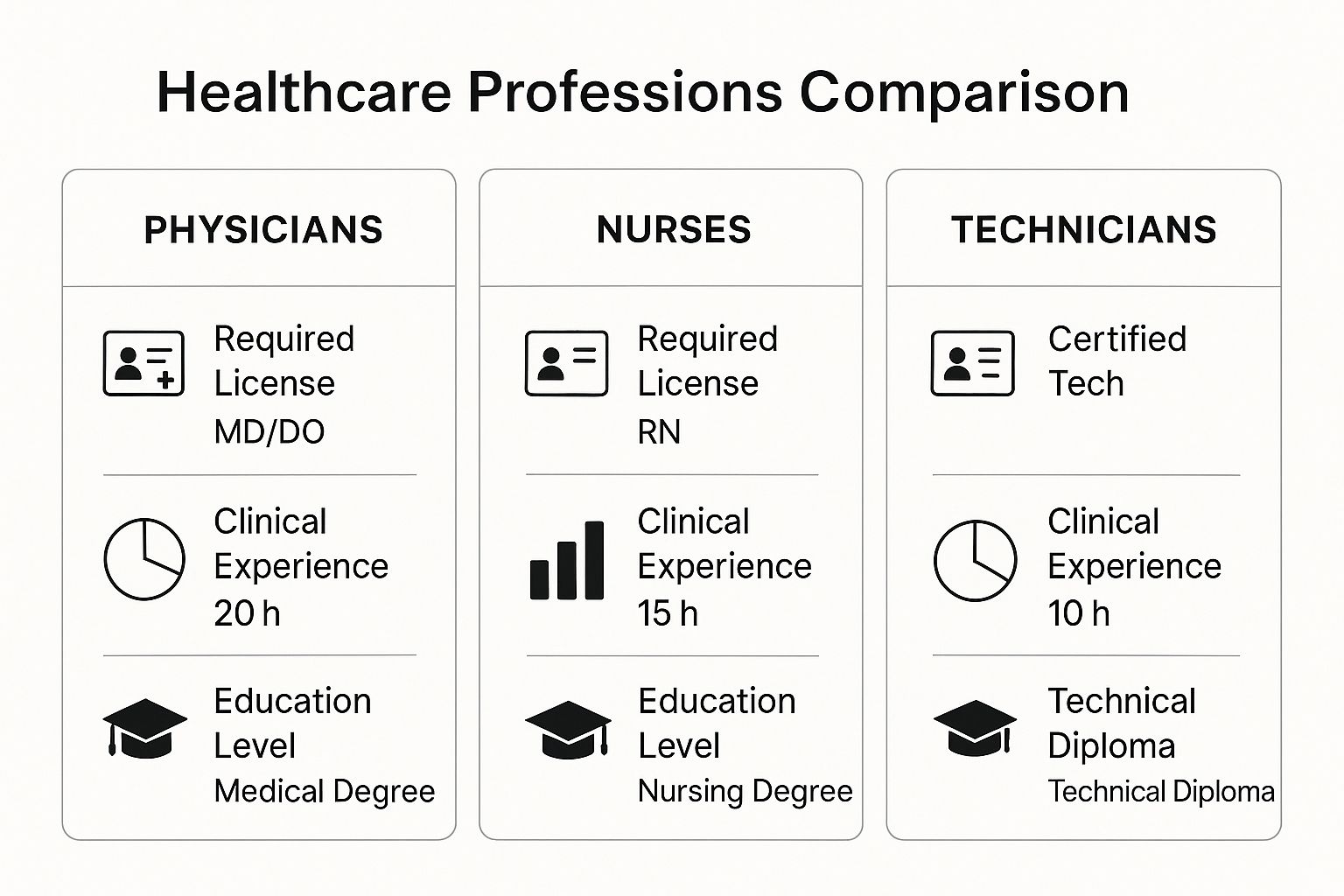
As you can see, the entry points are designed to build on the expertise you already have, not make you start from square one.
Let me give you a real-world example. Imagine Sarah, an RN who has spent five years in a busy wound care clinic. She sees patients day-in and day-out who are prime candidates for HBOT. Her active RN license and all that hands-on experience with chronic wounds mean she's already met the main prerequisites. For her, the next logical step is enrolling in an accredited 40-hour introductory course that will connect her existing skills to the specifics of hyperbaric medicine.
This is a pretty common story. If you're curious about the kinds of conditions that drive professionals like Sarah to get certified, our guide on what the hyperbaric chamber is used for provides a ton of good background.
Ultimately, the goal of these requirements isn't just to hand out another piece of paper. It's to build a team of practitioners who are truly competent and confident. It’s a principle that’s central to the work of pioneers like Dr. Louis Hilliard, the inventor of the med bed and owner of Life Force MedBeds, who has always championed the blend of advanced technology with expert, hands-on care.
To find out more about our training programs and see how your background fits, go to our website for more information or call 770-948-4511.
Alright, you've confirmed you've got the right credentials. Now for the fun part: picking the right training program to get your hyperbaric oxygen therapy certification.
This is a big decision. The quality of your training doesn't just check a box; it directly shapes how competent and confident you'll be on the floor. Let's be honest, not all programs are the same, so you need to look for one accredited by a respected organization.
Choosing an Accredited HBOT Training Program
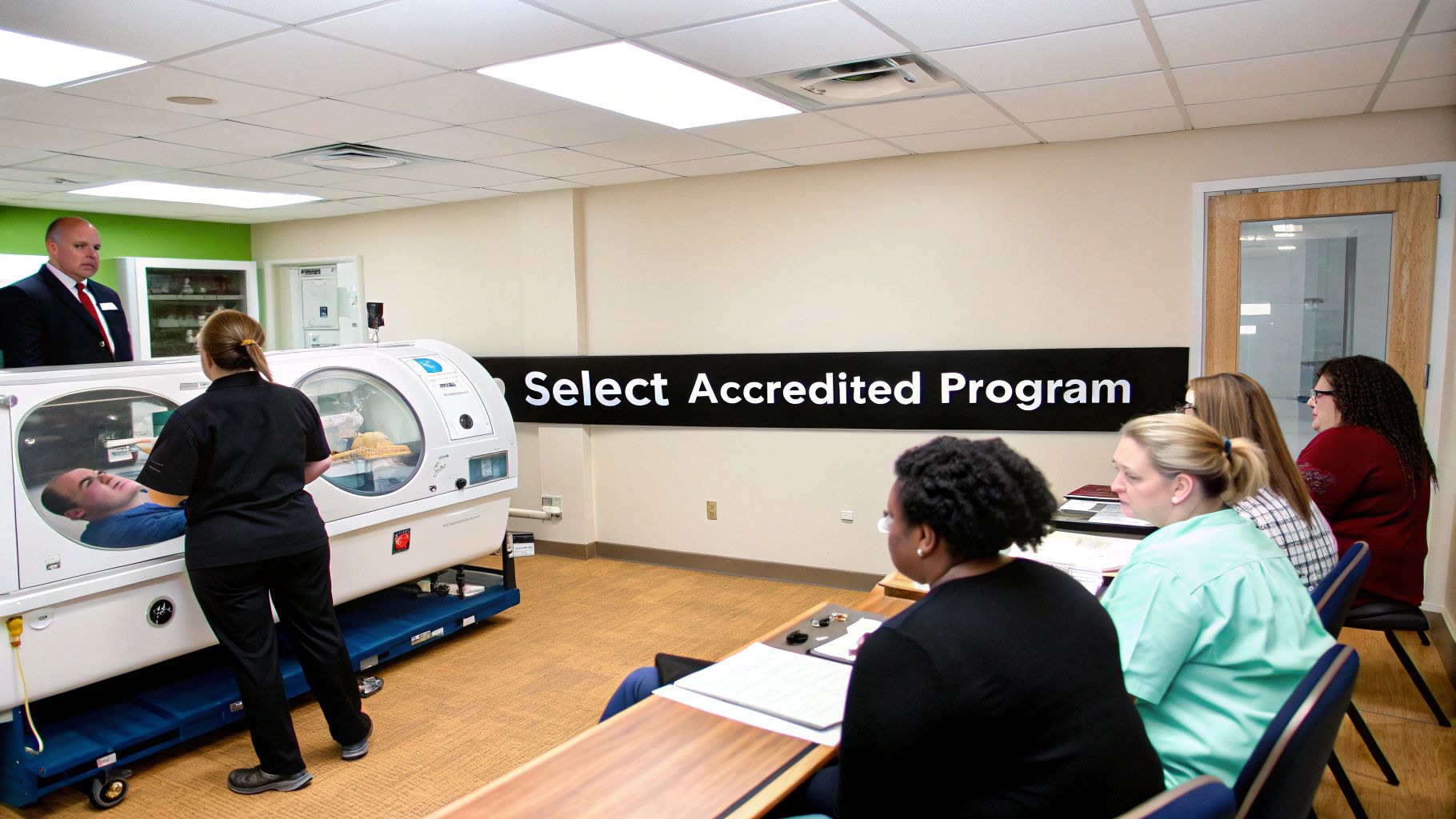
Accreditation is your guarantee that a program isn’t just winging it. It means they meet strict standards for their curriculum, safety protocols, and the quality of their instructors. Think of it as a seal of approval that shows they can prepare you for real-world clinical work.
This whole push for standardized certification really took off in the early 2000s, as clinical evidence and technology caught up with the practice. A major turning point was the Tenth European Consensus Conference on Hyperbaric Medicine back in 2016. That's when experts from around the globe came together and laid down the guidelines that now form the backbone of most certification programs. You can dive into the details in this European consensus report to see how it shaped modern standards.
Evaluating Program Formats and Curriculum
HBOT training isn’t something you can just learn from a textbook. It’s a hands-on discipline, and your program needs to reflect that. You're looking for a solid mix of foundational knowledge and practical, in-person experience that fits your schedule.
When you're comparing your options, keep an eye out for these must-haves:
- Hybrid Learning: Many of the best programs offer a blended model. You can cover the theory with online modules at your own pace and then come in for the hands-on clinicals.
- Real Clinical Hours: This is absolutely non-negotiable. You need supervised hours where you're actually operating chambers, managing patient sessions, and running through emergency drills.
- Heavy Focus on Safety: The curriculum has to be packed with safety training. I'm talking about everything from pre-dive equipment checks and patient screening to fire suppression protocols.
A great program teaches you more than just the "how-to." It digs deep into the "why" behind every single procedure. Understanding the physics and physiology is what separates a button-pusher from a true hyperbaric professional.
What to Look For in a Syllabus
When a program sends you their syllabus, really scrutinize it. Does it just skim the surface, or does it offer deep dives into patient assessment, specific treatment protocols for approved conditions, and detailed emergency procedures?
Another pro tip: find out what kind of equipment you'll be training on. Technology in this field is always advancing, and you want to learn on chambers that are relevant to what's actually being used in clinics today. If you want to get a head start, you can explore our guide on the types of hyperbaric chambers for sale to see what's out there. This will help you ask smarter questions when you talk to training centers.
The table below breaks down some of the common certification pathways to help you see where you might fit in.
Comparing Top HBOT Certification Pathways
Choosing the right certification depends heavily on your professional background and career goals. This table provides a quick look at the typical routes for different roles in the hyperbaric medicine field.
| Professional Role | Typical Certification Body | Core Curriculum Focus | Training Duration |
|---|---|---|---|
| Physician | UHMS, ABPM | Advanced diagnostics, treatment oversight, research | 40-60 hours + Fellowship |
| Registered Nurse (RN) | NBDHMT (CHRN) | Patient care, safety protocols, clinical assessment | 40-50 hours |
| Technologist / Technician | NBDHMT (CHT) | Chamber operations, equipment maintenance, emergency procedures | 40 hours |
| Respiratory Therapist (RT) | NBDHMT (CHT), added specialization | Gas physics, patient monitoring, ventilator management | 40 hours |
As you can see, each path is tailored. The goal, a mission championed by Dr. Louis Hilliard, the inventor of the med bed and owner of Life Force MedBeds, is to ensure every patient is in the hands of a skilled, confident, and safety-focused professional.
If you want more info on finding the perfect certification path for you, go to our website for more information or call 770-948-4511.
How to Prepare for Your Certification Exam
Getting through your accredited training program is a huge milestone, but you’ve still got one final hurdle: the certification exam. This is the moment you prove you have the deep knowledge and sharp critical thinking needed to safely manage hyperbaric treatments. Believe me, success here comes from smart, focused prep—not a last-minute cram session.
The very first thing you need to do is get your hands on the exam blueprint from your certification body. This document is your treasure map. It breaks down the entire exam, showing you exactly which topics will be covered and the percentage of questions dedicated to each area, from physics and safety protocols to patient management.
Creating Your Study Blueprint
Don't just glance at the blueprint; use it to build a real study plan. Be honest with yourself about your weak spots and give those topics extra attention. For example, if you feel great about clinical applications but get a little shaky on the finer points of gas physics, your study schedule should reflect that.
Most exams for hyperbaric oxygen therapy certification are multiple-choice, though some might throw in a practical or oral component. Knowing the format ahead of time is key to how you'll prepare.
- For Multiple-Choice Questions: Get ahold of as many practice questions as you can. This gets you comfortable with the style and pace. More importantly, focus on understanding why an answer is correct, not just memorizing the fact itself.
- For Practical Assessments: This is all about muscle memory. Run through those emergency shutdown procedures until they’re automatic. Do your pre-dive safety checks so many times they become second nature.
The exam isn't designed to trick you. It’s there to confirm you’re competent. Every single question ties back to a real-world scenario you could genuinely face while operating a chamber or caring for a patient.
Leveraging the Right Resources
Your course material from the training program is your foundation, but don't stop there. Supplementing it with other resources can give you a serious advantage. Try to find a study group, whether it’s online or with a few classmates. Talking through complex topics and quizzing each other makes the information stick.
Here’s another powerful strategy: think like the person who wrote the exam. When you're reviewing a topic, ask yourself, "How would they test me on this?" For instance, when you study the contraindications for HBOT, don't just make a list. Picture a patient walking in and imagine having to spot the risk and clearly explain your clinical decision.
This deeper level of thinking ensures you’re not just spitting back information but can actually apply it when it counts. It’s a principle championed by pioneers like Dr. Louis Hilliard, the inventor of the med bed and owner of Life Force MedBeds. He has always emphasized that true expertise is born from blending solid theoretical knowledge with practical, life-saving application.
For more information on our advanced training programs and how we prepare you for success, go to our website for more information or call 770-948-4511.
Keeping Your Certification Current for Career Growth

Getting your hyperbaric oxygen therapy certification isn’t the finish line—it’s actually where the next phase of your career begins. Think of it as your license to keep learning in a field that’s always moving forward. Keeping that credential active is everything if you want to stay competent, relevant, and in the running for better opportunities.
To do this, you'll need to stay on top of your continuing education. Certifying bodies require a certain number of Continuing Medical Education (CME) or Continuing Education Unit (CEU) hours, usually every one or two years. This is how they ensure your skills are sharp and you're up to date on the latest safety protocols, clinical research, and tech in the field.
How to Meet Your Continuing Education Requirements
Meeting your CEU requirements doesn't have to be a drag. There are plenty of ways to get your hours in while actually learning something useful.
- Go to Conferences and Seminars: Industry events are great for picking up new information and, just as importantly, connecting with other professionals.
- Sign Up for Advanced Workshops: You can find specialized courses focused on wound care, neurological uses of HBOT, and other niche areas.
- Join Online Webinars: Many organizations offer online learning that you can fit into a packed clinical schedule, which is a lifesaver for many of us.
These high standards for competency didn't just appear overnight. The Undersea and Hyperbaric Medical Society (UHMS) has played a huge role, creating advanced programs like the Program for Advanced Training in Hyperbaric Medicine (PATH). This is designed for non-physician practitioners and requires about 100 hours of continuing education. It's this kind of tiered system that keeps patient safety at the forefront. You can check out the UHMS PATH course details to get a feel for how these advanced programs are structured.
Your certification is more than just a piece of paper—it’s a key. It opens doors to roles that were locked before, giving you a real chance to influence patient care.
Opening Up New Career Paths
When you hold a current hyperbaric oxygen therapy certification, your career options really expand. It’s a clear signal to employers that you’re serious about your craft, which immediately puts you in the running for leadership roles.
It's common for certified professionals to move into positions with more responsibility and a bigger impact.
- Clinical Management: You could find yourself as a clinic supervisor or even a safety director, managing the day-to-day and making sure care standards are top-notch.
- Research Opportunities: Certification can be your ticket into clinical trials, where you get to contribute to the research that pushes our entire field forward.
- Teaching Roles: Many experienced pros eventually become instructors, passing on their knowledge to the next generation of hyperbaric technicians and clinicians.
This idea of always learning and improving is a core value for pioneers like Dr. Louis Hilliard, the inventor of the med bed and owner of Life Force MedBeds. He believes that ongoing education is crucial for getting the most out of advanced healing technologies.
To see how our systems and training can help you advance your career, go to our website for more information or call 770-948-4511.
Common Questions About HBOT Certification
Getting into hyperbaric oxygen therapy is a big step, and naturally, you’ve got questions. It's smart to wonder about the real cost, how much time it'll take, and where your certification can take you. I get these questions all the time, so let's clear the air and give you the straightforward answers you need.
How Much Does HBOT Certification Cost?
Let's talk numbers. The price tag for an introductory 40-hour course can be all over the map, usually landing somewhere between $800 and $2,500.
But here's a pro tip: always ask what's included. Does that price cover your exam fees? What about study guides or the hands-on clinical hours you'll need? Sometimes those are extra, and you don’t want any surprises.
How Long Will It Take?
The core course itself is often a whirlwind week. But that’s just the beginning.
Once you factor in dedicated study time to really nail the exam and schedule your required clinical practice, the whole process from start to finish might take several weeks or even a couple of months. It’s a marathon, not a sprint.
International Recognition and Program Differences
"Will my certification be good in other countries?" This is a big one, and the answer comes down to the accrediting body. Certifications from the big players like the Undersea and Hyperbaric Medical Society (UHMS) or the National Board of Diving and Hyperbaric Medical Technology (NBDHMT) carry a lot of weight worldwide.
Why? Because their standards are backed by serious data. The UHMS, for example, approves HBOT for 14 specific medical conditions. This isn't just a guess; it's supported by massive initiatives like the International Multicenter Registry for Hyperbaric Oxygen Therapy (MRHOT), which has been collecting patient data from centers globally since 2011. This is how they refine the rules and keep the standards high. You can see just how extensive this data collection is and how it supports international standards.
A key thing to understand is that a physician’s certification is very different from a technician’s. The doctor's track is all about diagnosis and overseeing treatment plans. The technician's training, on the other hand, is laser-focused on running the chamber safely, keeping a close watch on patients, and knowing exactly what to do in an emergency.
Finally, people often ask if they can just do it all online. While online classes are great for learning the theory, they're no substitute for hands-on experience. Any program worth its salt will have a mandatory in-person clinical part. You simply can't learn how to handle real-world situations from behind a screen.
As the inventor of the med bed and owner of Life Force MedBeds, Dr. Louis Hilliard believes that solid preparation is everything. A practitioner who understands the details is one who can provide safe, effective care. His goal is to give you honest answers to help you on your path.
For more personalized answers to your questions, the team at Life Force Med Beds is ready to help. Please go to our website for more information or call us directly at 770-948-4511. Explore your certification options at https://lifeforcemedbeds.com.


