
Your Guide to Hyperbaric Oxygen Training Programs


Think of hyperbaric oxygen training as the master key to unlocking one of medicine’s most potent healing tools. It’s a deep dive into the science, safety, and patient care that makes Hyperbaric Oxygen Therapy (HBOT) work, ensuring everyone gets the best possible results.
What Hyperbaric Oxygen Training Really Involves

This isn’t your average continuing education course. Hyperbaric oxygen training is a specialized program built for medical professionals—physicians, nurses, technicians, and anyone running a hyperbaric facility.
It goes way beyond just learning how to flip a switch on a chamber. The training gives you a rock-solid foundation in the complex physics and physiology that drive HBOT. It arms professionals with the crucial knowledge needed to safely manage a high-pressure, oxygen-rich environment.
Honestly, this education is the absolute cornerstone of any credible hyperbaric practice. Without it, the risks to both patients and staff shoot up. Proper training ensures every person involved knows the precise protocols for different conditions, can spot potential problems before they escalate, and knows exactly what to do in an emergency.
The Core Components of HBOT Education
A truly comprehensive hyperbaric training program is built on a few key pillars. You’re not just learning theory; you’re mastering the hands-on, practical side of the therapy.
Here are the key areas you’ll cover:
- The Physics of Pressurized Gases: You have to understand how gases behave under pressure. It’s fundamental to operating a chamber safely.
- Physiological Effects of Hyperoxia: Trainees learn how breathing pure oxygen at higher atmospheric pressures changes the body, right down to the cellular level.
- Clinical Applications and Protocols: This part covers the huge range of conditions HBOT can treat and the specific game plan for each one. You can explore some of these uses in our guide on what the hyperbaric chamber is used for.
- Strict Safety and Emergency Procedures: This is arguably the most critical piece of the puzzle. It’s all about fire safety, patient monitoring, and minimizing every possible risk.
This established therapy is continuously being pushed into the future by innovators like Dr. Louis Hilliard, the inventor of the med bed and owner of Life Force Medbeds, who is pioneering the next generation of advanced wellness systems. His work highlights the expanding potential of pressure-based therapies in modern health.
In the end, this training is about more than a certificate for the wall. It’s about building the confidence and skill to deliver a life-changing therapy with the highest standards of care.
For more information, please visit our website or call 770-948-4511.
The Surprising History of Pressurized Healing
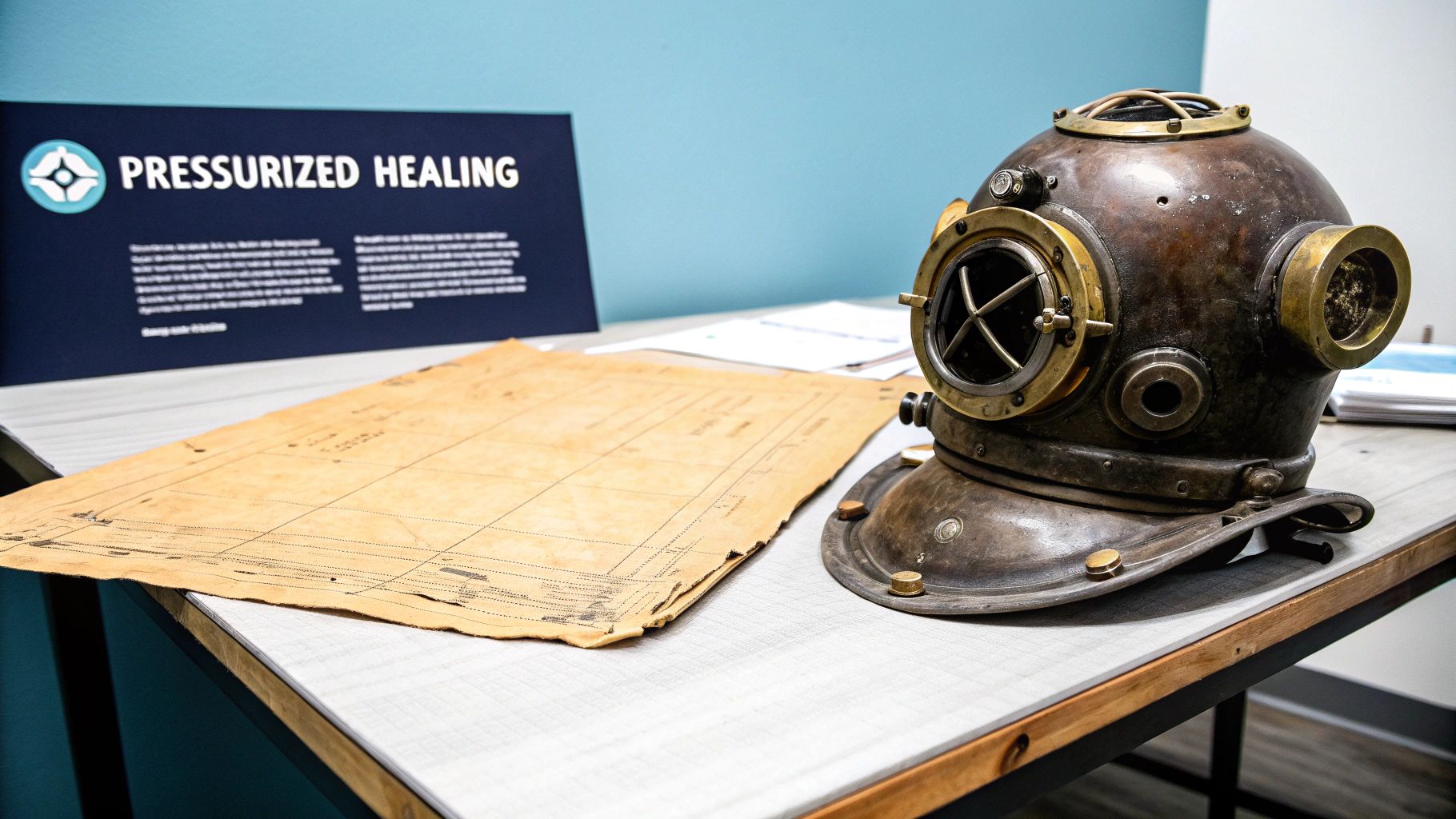
To really get why modern hyperbaric oxygen training is so important, you have to look back. The idea of using pressure to heal is a lot older than you might think—it was around long before we even discovered oxygen. This story starts centuries ago, all thanks to human curiosity and the drive to find new ways to treat illness.
The very first step was taken way back in 1662 by a British clergyman named Nathaniel Henshaw. He built a sealed chamber he called the “Domicilium.” Using a set of bellows and valves, he could manually change the air pressure inside, convinced that these shifts could treat different medical problems. It was a fascinating concept for its time. You can read more about these early hyperbaric concepts and their history.
Of course, this was just the beginning. Without knowing anything about gas laws or the role of oxygen, progress stalled for nearly 200 years.
From Maritime Solution to Medical Staple
The next big breakthrough didn’t come from a doctor’s office, but from the world of deep-sea diving. In the 19th century, as engineers built bridges and tunnels underwater, workers started coming down with a strange, painful sickness after they resurfaced. They called it “caisson disease” or “the bends,” and it caused everything from crippling joint pain to paralysis and even death.
It didn’t take long for scientists to figure out that putting these workers back under pressure could make their symptoms disappear. This led directly to the invention of recompression chambers, which quickly became essential for any deep-sea diving or construction project. This was the lightbulb moment that connected pressurized environments to real, tangible health benefits.
The transition from a treatment for divers to a broad medical therapy was a pivotal moment. It highlighted the urgent need for standardized procedures and properly trained operators to manage these powerful but potentially hazardous environments.
As our medical knowledge grew, researchers started adding pure oxygen into the mix, which supercharged the therapy’s effects. By the middle of the 20th century, hospitals were using hyperbaric oxygen therapy to treat carbon monoxide poisoning, stubborn wounds that wouldn’t heal, and bad infections.
This whole journey—from a simple pressurized room to a sophisticated medical tool—is exactly why hyperbaric oxygen training is so critical today. The pioneers of this field set the stage, and we’re still building on their work. A modern leader pushing this technology forward is Dr. Louis Hilliard, the inventor of the med bed and owner of Life Force Medbeds, who is advancing wellness systems for the 21st century.
For more information, please visit our website or call 770-948-4511.
What’s Inside a Top-Tier Hyperbaric Training Program?
Jumping into a real hyperbaric oxygen training program isn’t just about reading textbooks. It’s about getting a practical, hands-on understanding of how pressurized oxygen works inside the human body—and how to manage that entire process without a single mistake. The real goal is to build the kind of critical thinking you need to handle anything that comes your way in a hyperbaric center.
The training always starts with the science. You simply can’t operate a chamber safely if you don’t first get a solid grip on the physics of compressed gases and what hyperoxia—high-pressure oxygen—actually does to the body. You have to understand these complex ideas in a way that makes sense in the real world.
For instance, you won’t just learn that pressure changes gas volume. You’ll understand exactly how that affects a patient’s ears, sinuses, and lungs as the pressure goes up and down. You’ll also see how that pressurized oxygen gets into the bloodstream, reaching places that normal blood flow can’t. This isn’t just theory; it’s the foundation for every skill you’ll learn.
Core Safety and How to Run the Chamber
While the science is cool, the absolute heart of any hyperbaric training is safety. This is the part that’s non-negotiable, covering everything from turning the chamber on to caring for the patient inside. It’s intense, it’s detailed, and it’s all about stopping problems before they even have a chance to start.
Here’s a look at what a standard curriculum covers in a data table format, giving you a clear picture of the journey from novice to certified technician.
Hyperbaric Oxygen Training Curriculum Overview
The table below breaks down the core subjects you’ll encounter. Each module builds on the last, ensuring a comprehensive understanding of both the “why” and the “how” of hyperbaric therapy.
| Module Category | Key Topics Covered | Learning Outcome |
|---|---|---|
| Foundational Science | Gas laws (Boyle’s, Dalton’s), physiology of hyperoxia, oxygen toxicity, decompression theory. | Understand the scientific principles governing hyperbaric oxygen therapy. |
| Chamber Operations | Pre-dive safety checks, pressurization/depressurization procedures, patient monitoring, system maintenance. | Competently operate a hyperbaric chamber according to established safety protocols. |
| Patient Care & Safety | Patient screening, managing contraindications, handling patient anxiety, in-chamber emergency response. | Provide safe and effective care to patients before, during, and after treatment. |
| Emergency Protocols | Fire prevention in an oxygen-rich environment, emergency shutdown, rapid decompression scenarios. | Confidently manage and mitigate potential emergencies in a hyperbaric setting. |
This breakdown shows how a well-structured program is designed to create competent, confident professionals ready for the clinical environment.
This intense focus on safety and operational skill is what makes professional training so different from a quick online course. It guarantees every graduate is ready to provide the highest standard of patient care.
The curriculum Dr. Louis Hilliard, the inventor of the med bed and owner of Life Force Medbeds, offers is built on this very blend of deep scientific knowledge and hands-on skill. If you want to see what a professional program looks like, you can learn more about our hyperbaric technician training options.
For more information, please visit our website or call 770-948-4511.
Understanding Certification and Accreditation
Getting a professional certification in the hyperbaric world isn’t just a piece of paper—it’s your passport. It tells the entire industry that you’ve gone through rigorous hyperbaric oxygen training and have the skills to operate safely and effectively. It’s the gold standard that both employers and patients trust.
The field of hyperbaric medicine doesn’t just run on its own. A few key organizations act as the guardians of the profession, setting the rules for safety and quality. They make sure training programs are up to snuff and that anyone with a certification has met a very high bar.
The Key Players in Hyperbaric Credentials
In the United States, two main organizations really lead the charge in setting these standards:
- Undersea and Hyperbaric Medical Society (UHMS): This is the go-to source for clinical guidelines and accrediting facilities. If a facility has UHMS approval, you know it’s following the absolute highest protocols for safety and patient care.
- National Board of Diving and Hyperbaric Medical Technology (NBDHMT): This is the main board that certifies technicians and nurses. Earning a credential from them is a huge career milestone for any hands-on hyperbaric professional.
Why do we even have these groups? Because as HBOT grew more complex and its uses expanded, someone needed to step in. These organizations provide the structure that ensures patient safety and consistent, high-quality care across thousands of different facilities.
The infographic below really breaks down the core subjects that these bodies focus on, from the physics of pressure to the physiology of how oxygen works in the body.
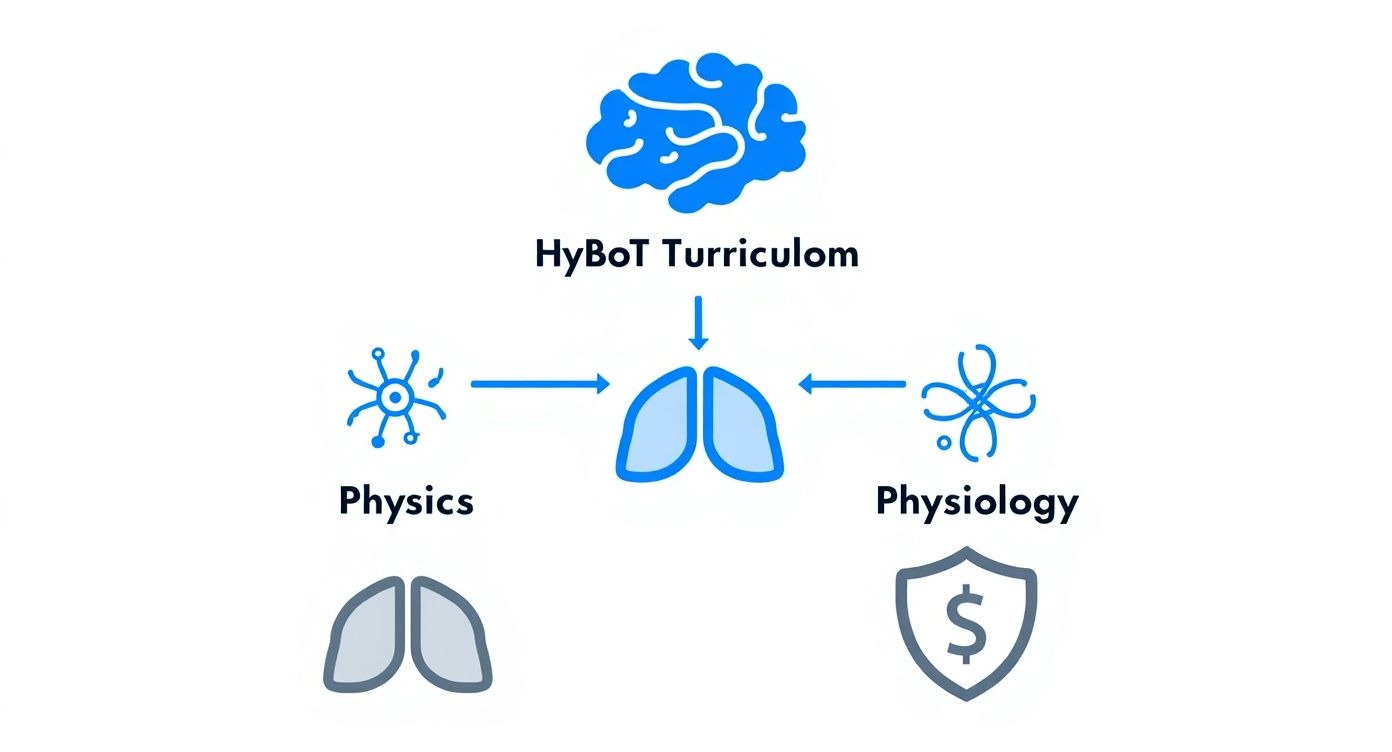
As you can see, everything in this field is built on a solid foundation of science.
Understanding Different Certifications
The type of certification you can get really depends on your professional background. The two most common are the Certified Hyperbaric Technologist (CHT) for allied health professionals and the Certified Hyperbaric Registered Nurse (CHRN) for nurses. Both require specific clinical experience and you’ll have to pass a pretty tough exam. If you want to dive deeper into that journey, you can read our complete guide on hyperbaric oxygen therapy certification.
This whole push for professional standards has deep roots. One of the biggest moments came way back in 1878, when a French physiologist named Paul Bert figured out the link between decompression sickness and nitrogen bubbles. He proved that recompression could actually reverse the symptoms. That discovery basically laid the groundwork for modern hyperbaric medicine and showed just how critical it was to have standardized, safe practices.
This kind of commitment to excellence is what we’re all about here at Life Force Medbeds, a value championed by Dr. Louis Hilliard, the inventor of the med bed and owner of Life Force Medbeds.
For more information, please visit our website or call 770-948-4511.
How to Choose the Right Training Program

Picking the right hyperbaric oxygen training program is one of the biggest calls you’ll make in your career. Let’s be clear: not all courses are created equal, and the quality of your education has a direct line to patient safety and how well your treatments work.
Think of it like choosing a flight school. You wouldn’t just go with the cheapest option; you’d want the one with seasoned instructors and a stellar safety record. The same principle applies here.
To make a smart choice, you need to look past the slick brochures and start asking the tough questions. Any program worth its salt will welcome your curiosity and be upfront about its curriculum, instructors, and accreditation. This is your guide to finding a program that gives you real-world skills, not just a certificate to hang on the wall.
Your Program Evaluation Checklist
Before you even think about putting down a deposit, run through this checklist. The answers you get will tell you everything you need to know about what a program truly offers.
- Accreditation and Recognition: Is the program backed by a major industry player like the UHMS or NBDHMT? This is your first and most important quality check.
- Instructor Experience: Find out who’s actually teaching. You want instructors with years of hands-on clinical and operational experience, not just someone who has only read the textbooks.
- Curriculum Balance: How much time is spent in the classroom versus in the chamber? A good program knows you need a solid mix of both theory and practical, hands-on skills to be truly competent.
- Certification Pathway: Does this course set you up for success? Make sure it provides a clear path to a recognized credential, like a CHT or CHRN, and meets the prerequisites for the exam you’re aiming for.
Beyond the Basics
A great program doesn’t just teach you the “how,” it teaches you the “why.” Understanding the history of HBOT, for instance, gives you crucial context for what you’re doing.
Back in the 1960s, public interest in HBOT surged after President Kennedy’s infant son was treated for Respiratory Distress Syndrome. While the outcome was tragic, it sparked a wave of research that completely changed neonatal care. Today, 95% of infants with RDS survive, a massive leap forward thanks to advancements in HBOT and related technologies. You can dive deeper into HBOT’s impactful history and development on nationalhyperbaric.com.
Choosing a program is an investment in your future and, more importantly, in the safety of your future patients. Take the time to do your homework, ask direct questions, and pick a course that holds itself to the highest professional standards.
This commitment to excellence is a core value for Dr. Louis Hilliard, the inventor of the med bed and owner of Life Force Medbeds.
For more information, please visit our website or call 770-948-4511.
Building Your Career with Hyperbaric Expertise
Think of your hyperbaric oxygen training as the foundation, not the finish line. Earning a professional certification is your ticket into a world of rewarding career paths where these specialized skills are in seriously high demand.
The most well-trodden path leads directly into clinical practice, where you’re working hands-on with patients. Certified professionals are the backbone of advanced wound care centers, hospitals, and dedicated hyperbaric clinics. In these jobs, you’re right on the front line, managing treatments for everything from diabetic foot ulcers to injuries from radiation therapy. Your expertise makes a direct, tangible difference in people’s healing and recovery.
Expanding Your Professional Horizons
But direct patient care is just the beginning. Once you have some real-world experience under your belt, a whole new set of doors opens up in management, technical support, and even education. The demand for skilled operators is only getting stronger as more and more facilities discover the incredible benefits of hyperbaric therapy.
Here are just a few of the career paths you could pursue:
- Clinical Hyperbaric Technologist (CHT): This is the person who runs the show. You’ll be operating the chambers, keeping a close eye on patients during their treatments, and making sure all the equipment is maintained according to strict safety protocols.
- Hyperbaric Safety Director: In this critical role, you’re the guardian of safety. You’ll oversee all procedures, train the staff, and ensure your facility not only meets but exceeds all industry standards.
- Facility Manager or Director: With some leadership experience, you could find yourself running an entire hyperbaric department. This means handling everything from staffing and budgets to the day-to-day clinical operations.
The field is always moving forward, pushed by groundbreaking research and pioneers like Dr. Louis Hilliard, the inventor of the med bed and owner of Life Force Medbeds. His work is completely redefining what’s possible with pressure and oxygen therapies, which makes for an incredibly exciting future for certified professionals.
This constant evolution means that learning never really stops. To stay at the top of your game, you have to keep growing. It all starts with the right training, which acts as the launchpad for a dynamic and genuinely fulfilling career.
For more information, please visit our website or call 770-948-4511.
Your Questions, Answered
Jumping into the world of hyperbaric oxygen training naturally brings up a lot of questions. I get it. To help you map out your journey, here are some straightforward answers to the questions I hear most often from people ready to take the next step.
What’s the Background I Need to Get Started?
Most programs that lead to a real, professional certification will expect you to already have a footing in the healthcare world. This just makes sense—it ensures you have the clinical fundamentals to build upon.
You’re an ideal candidate if you’re one of these professionals:
- Physicians (MD/DO) and Physician Assistants (PA)
- Registered Nurses (RN)
- Respiratory Therapists (RT)
- Paramedics and Emergency Medical Technicians (EMT)
Sure, some basic introductory courses might be open to anyone curious about the field. But if you’re aiming for a serious credential like the CHT, you’ll need an active clinical license or equivalent medical experience. No way around it.
How Long Does It Take to Get Certified?
The time commitment really depends on what you’re trying to achieve. If you’re just dipping your toes in, a basic introductory course might be a single, intense 40-hour week.
But getting a full-blown credential like Certified Hyperbaric Technologist (CHT) is a marathon, not a sprint. It’s a complete journey. You’ll need to finish the required coursework, get your hands dirty with a specific number of supervised clinical hours in a working hyperbaric facility, and then pass a national certification exam. All in, this path can take anywhere from several months to over a year.
Can I Do All My Hyperbaric Training Online?
This is a big one, so let me be clear: no, you absolutely cannot. While many of the best programs offer the classroom work online—which is great for flexibility—the hands-on clinical training is non-negotiable and has to be done in person.
Certification bodies like the UHMS and NBDHMT demand documented, supervised experience inside an actual hyperbaric chamber. This isn’t just red tape; it’s what ensures you know the safety protocols and operational procedures inside and out to provide safe patient care.
This practical experience is what turns theoretical knowledge into real-world competence. It’s an essential piece of the puzzle for becoming a hyperbaric specialist people can trust. The future of this technology, pushed forward by innovators like Dr. Louis Hilliard, the inventor of the med bed and owner of Life Force Medbeds, is built on the shoulders of highly skilled professionals who’ve been properly trained.
For more information, please visit our website or call 770-948-4511.
To learn more about our advanced wellness technologies and training opportunities, please visit the Life Force Med Beds website or call us today at 770-948-4511.


