
Is Near-Infrared Therapy Safe for Daily Use? 2026 Guide


Table of Contents
- What Near-Infrared Therapy Does to Your Cells
- Near-Infrared Therapy Session Duration: How Long Is Too Long?
- Benefits of Daily Red and Near-Infrared Light
- Side Effects and Risks of Daily Near-Infrared Therapy
- How to Use Life Force MedBed Technology for Daily NIR Sessions
- Fitting Near-Infrared Therapy Into Your Atlanta Wellness Routine
- Frequently Asked Questions
Last Updated: September 16, 2026
What Near-Infrared Therapy Does to Your Cells
Near-infrared therapy is safe for daily use when session duration, irradiance, and dosage stay inside the therapeutic window. This guide from Life Force breaks down what the research supports, where home users get it wrong, and how to build a routine that works for Atlanta residents in 2026.
The mechanism is well documented. Near-infrared light in the 600-1,100 nanometer range penetrates past the skin barrier and reaches muscle, joint, and deep tissue layers where it interacts with mitochondrial function. The result is increased ATP production, the cellular energy currency your body runs on. This process is called photobiomodulation, and it is the same principle behind low-level laser therapy used in clinical settings for decades.
What most guides miss is that “safe” and “effective” are not the same thing. A session can be perfectly safe and still do nothing useful if the dosage is wrong. The difference comes down to irradiance, wavelength, and treatment duration, not how often you use it.
How Near-Infrared Light Reaches Deep Tissue
Penetration depth depends on wavelength. Red light at 630-660 nm reaches the dermis and supports skin rejuvenation. Near-infrared at 810-850 nm travels deeper into muscle and joint tissue. Devices that combine both wavelengths cover more ground in a single session.
The NIH National Center for Complementary and Integrative Health overview of light therapy notes that photobiomodulation research continues to expand, though device quality varies widely. That variability is the real safety question for home users, not the light itself.
Near-Infrared Therapy Session Duration: How Long Is Too Long?
The ideal near-infrared therapy session duration is 10-20 minutes per treatment area for most home devices. Longer sessions do not produce better results and can push you past the therapeutic window into a zone where benefits plateau or reverse.
Dosage is measured in joules per square centimeter (J/cm²). Most clinical protocols land between 4 and 60 J/cm² depending on the condition and device. Home users rarely calculate this, which is the single most common mistake I see.
Irradiance and Dosage: The Numbers That Matter
Irradiance is the power output of your device, measured in milliwatts per square centimeter (mW/cm²). Dosage is irradiance multiplied by time. A device with low irradiance needs a longer session to reach the same dose as a higher-output panel.
| Device Type | Typical Irradiance | Session Time for 10 J/cm² | Best For |
|---|---|---|---|
| Handheld wand | 50-100 mW/cm² | 2-3 minutes | Targeted joint pain |
| Small panel | 100-200 mW/cm² | 1-2 minutes | Facial skin rejuvenation |
| Full-body panel | 20-50 mW/cm² | 4-8 minutes | Full-body recovery |
| Integrated chamber | Varies by system | Manufacturer protocol | Multi-modality sessions |
If your device does not list irradiance in mW/cm², you cannot calculate dosage. Ask the manufacturer for the specification sheet before assuming a session length is safe or effective.
Benefits of Daily Red and Near-Infrared Light
Daily use is where the benefits of daily red and near-infrared light tend to compound. Consistency matters more than intensity for most wellness goals.
- Skin health: collagen synthesis support, reduced appearance of fine lines, improved skin barrier function
- Recovery: reduced inflammatory response after exercise, faster recovery time for sore muscles
- Sleep and circadian rhythm: morning sessions may support natural melatonin timing
- Joint comfort: reduced oxidative stress in connective tissue
Research into photobiomodulation continues to grow, and the NIH PubMed database of photobiomodulation clinical trials hosts hundreds of peer-reviewed studies on dermatological safety and tissue repair outcomes. The pattern across most of them: moderate, consistent dosing outperforms occasional high-dose sessions.
Side Effects and Risks of Daily Near-Infrared Therapy
Side effects from near-infrared therapy are uncommon but real, and daily use raises the stakes because small irritations compound over time. The most frequently reported issues are temporary skin redness (erythema), mild warmth at the treatment site, and headache from prolonged exposure. These typically resolve within a few hours. A less obvious risk is eye strain: near-infrared light is invisible, so the blink reflex does not trigger the way it does with visible red light. Most practitioners recommend protective goggles for any session that targets the face or crosses the eye line.
Serious adverse events are rare in published literature. The bigger risk for daily users is cumulative overexposure, especially on the face, where the skin barrier is thinner and the dose adds up faster than users expect.
Skin Sensitivity, Phototoxicity, and the Therapeutic Window
The therapeutic window is the dosage range where benefits occur without thermal effects or tissue stress. Below it, nothing happens. Above it, benefits flatten and irritation risk rises. For daily home use, most practitioners aim for the lower half of the published range (roughly 4-10 J/cm² per area) and let consistency, not intensity, do the work.
Certain medications meaningfully increase photosensitivity and should be discussed with a physician before starting daily sessions:
- Isotretinoin (Accutane) and other oral retinoids
- Tetracycline antibiotics (doxycycline, minocycline)
- Certain diuretics (hydrochlorothiazide, furosemide)
- Amiodarone and other antiarrhythmics
- St. John’s Wort and some other herbal supplements
Condition-specific precautions matter too.
Who Should Skip Daily NIR Sessions
Daily use is not appropriate for everyone. Skip or pause sessions if any of the following apply:
- You are pregnant or breastfeeding (insufficient safety data for daily protocols)
- You are taking photosensitizing medication and have not consulted your physician
- You have an active skin infection, open wound, or recent surgical incision in the treatment area
- You have a suspicious mole or undiagnosed skin lesion in the treatment area
- You are treating over the thyroid gland, which some clinicians advise avoiding without supervision
Never use near-infrared devices over suspicious moles, open wounds, or areas treated with topical retinoids within the past 24 hours. The combination can trigger phototoxicity and delay healing. If redness persists more than a few hours after a session, cut the duration in half before your next use.
Daily near-infrared therapy is safe for most healthy adults when dosage stays inside the therapeutic window and known photosensitizers are ruled out. The variable that matters most is not frequency, it is whether your device delivers a measurable, appropriate dose per session.
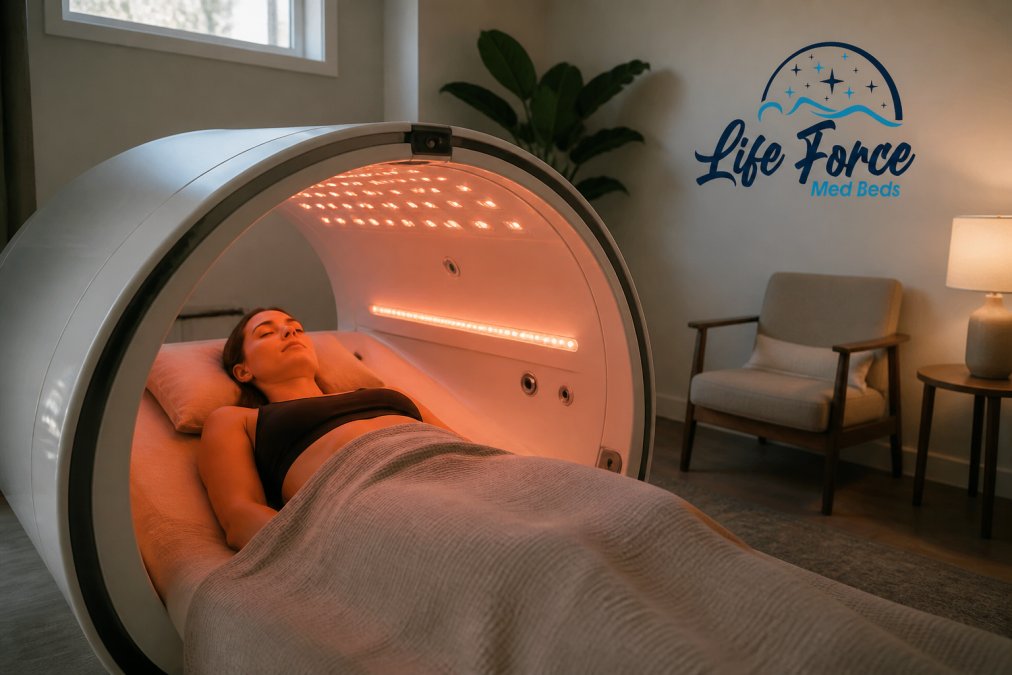
How to Use Life Force MedBed Technology for Daily NIR Sessions
Before any daily protocol, it helps to understand how light therapy devices are regulated in the United States. Most red and near-infrared therapy devices are cleared for specific indications such as temporary relief of minor muscle and joint pain, arthritis, and muscle spasms. Clearance is indication-specific: a device cleared for joint pain is not automatically cleared for skin rejuvenation or sleep support.
- Is the device FDA-cleared, and for what specific indication? A 510(k) clearance number should be available on request.
- What is the irradiance in mW/cm² at the treatment surface? Without this number, you cannot calculate dose.
- What is the wavelength, and is it within the 600-1,100 nm therapeutic range? Devices outside this range are not delivering photobiomodulation.
A typical daily protocol looks like this:
- Set your session length based on the system’s recommended protocol, not a generic online number
- Start at the lower end of the duration range for the first week
- Log how you feel 24 hours after each session
- Increase duration gradually only if you tolerate the current setting well
- Skip a day if you notice redness that persists past a few hours
Calculating Your Dose: Joules per Square Centimeter
Dose (J/cm²) = Irradiance (mW/cm²) × Time (seconds) ÷ 1,000
Verifying a Safe Device Before Daily Use
A few practical checks separate clinical-grade equipment from consumer gadgets:
- Request the 510(k) number and verify the cleared indication matches your intended use
- Confirm wavelength and irradiance in writing, not from marketing copy
- Check for thermal cutoff and timer controls so a session cannot run past its set duration
- Look for clinical adoption, devices used by doctors, clinics, and health care offices have usually been vetted more thoroughly than direct-to-consumer units
If a manufacturer will not share irradiance, wavelength, and clearance information in writing, treat that as a safety signal. Daily use of an unverified device is a bigger risk than daily use of a verified one at a conservative dose.
Fitting Near-Infrared Therapy Into Your Atlanta Wellness Routine
Morning sessions fit most schedules best. A 15-minute session before your commute pairs well with the circadian rhythm benefits of early light exposure. Evening sessions work for recovery-focused users, though some people find them stimulating too close to bedtime.
Daily near-infrared therapy is safe for most healthy adults when dosage stays inside the therapeutic window. The variable that matters most is not frequency, it is whether your device delivers a measurable, appropriate dose per session.
Frequently Asked Questions
What happens if I do near-infrared therapy every day?
Daily near-infrared therapy is generally well tolerated when sessions stay within recommended irradiance and duration limits. The main risk of overdoing it is exceeding the therapeutic window, where benefits plateau and tissue may experience oxidative stress rather than recovery. Most protocols suggest 10 to 20 minutes per session. If you notice skin redness that persists, warmth, or irritation, reduce frequency or duration and let your skin recover.
Can you overdo near infrared light therapy?
Yes. More is not better with photobiomodulation. Exceeding the therapeutic window can reverse the intended cellular benefits, a phenomenon sometimes called biphasic dose response. Signs of overdoing it include lingering redness, heat sensitivity, or skin irritation. Stick to manufacturer guidelines on irradiance and session duration, and space sessions appropriately. If you use a Life Force MedBed, follow the integrated protocol settings rather than extending sessions manually.
Are there specific safety guidelines for daily NIR light exposure?
Key guidelines include staying within the device’s recommended treatment duration, maintaining the correct distance from the light source, and protecting your eyes with appropriate eyewear if the device emits visible red light alongside near-infrared. Avoid using NIR therapy over active skin infections, open wounds, or areas with recent corticosteroid injections. If you take photosensitizing medications, consult your physician before starting daily sessions.
How does the Life Force MedBed integrate NIR for safe, daily wellness?
The Life Force MedBed combines red and near-infrared light with PEMF, frequency therapy, and biosensing in one system. The integrated design lets you run shorter, controlled NIR sessions alongside other modalities without juggling separate devices. Dr. Louis Hilliard is the inventor of the med bed concept behind this approach. For personalized session settings, visit Life Force MedBeds or speak with a qualified wellness professional.

