
Med Bed Training: A Complete 2026 Guide


Table of Contents
- What Is Med Bed Training?
- Understanding Med Bed Technology and Operational Protocols
- Step-by-Step Med Bed Training Curriculum
- Certification and Professional Credentialing
- Wellness Technology Integration for Healthcare Providers
- Hyperbaric Chamber Business Consulting and Med Bed Operations
- Common Training Mistakes and How to Avoid Them
- Frequently Asked Questions
Last Updated: September 30, 2026
What Is Med Bed Training?
Med bed training teaches healthcare professionals and wellness practitioners how to operate, maintain, and apply advanced medical bed technology in clinical and wellness settings.
Dr. Louis Hilliard, the inventor of the med bed, pioneered technology that combines multiple therapeutic modalities into a single integrated system. Today, med bed training has become essential for practitioners in Atlanta and across the country who want to offer modern wellness solutions to their clients.
Med bed training covers how bioresonance, frequency therapy, light therapy, PEMF, and other integrated technologies work together. Practitioners who complete proper med bed training can confidently operate equipment, troubleshoot issues, and explain the science to clients.
The most common mistake new trainees make is skipping the safety module. Equipment-related incidents almost always stem from inadequate understanding of operational protocols, not equipment failure.
Understanding Med Bed Technology and Operational Protocols
Modern med beds integrate multiple therapeutic systems into one platform. Understanding each component is the foundation of effective med bed training.
Core Technologies You’ll Learn
Bioresonance and bioimpedance measure the body’s electrical properties to create a baseline wellness profile and reveal cellular health and tissue function.
Frequency and Rife-based systems deliver therapeutic vibrations at specific frequencies tailored to different wellness goals and individual clients.
Red and near-infrared light therapy penetrates tissue to support cellular energy production, with training covering wavelength ranges, exposure times, and safety considerations.
PEMF (pulsed electromagnetic field) technology stimulates cellular activity, with training covering magnetic field strength, pulse patterns, and integration with other modalities.
Sound and vibration therapy uses acoustic frequencies to promote relaxation and support circulation.
Grounding and electron-balancing concepts explain how the system supports the body’s natural electrical balance.
Safety Standards and Patient Care
Safety training covers contraindications, screening protocols, emergency procedures, equipment maintenance, and patient assessment. Practitioners must screen clients for medical conditions, implanted devices, or medications that may require modified protocols. Documentation and informed consent templates protect both practitioner and client.
The difference between a competent practitioner and an excellent one is thorough pre-session screening and the ability to modify protocols based on individual client needs.
Step-by-Step Med Bed Training Curriculum
Professional med bed training follows a structured progression. Each module builds on previous knowledge.
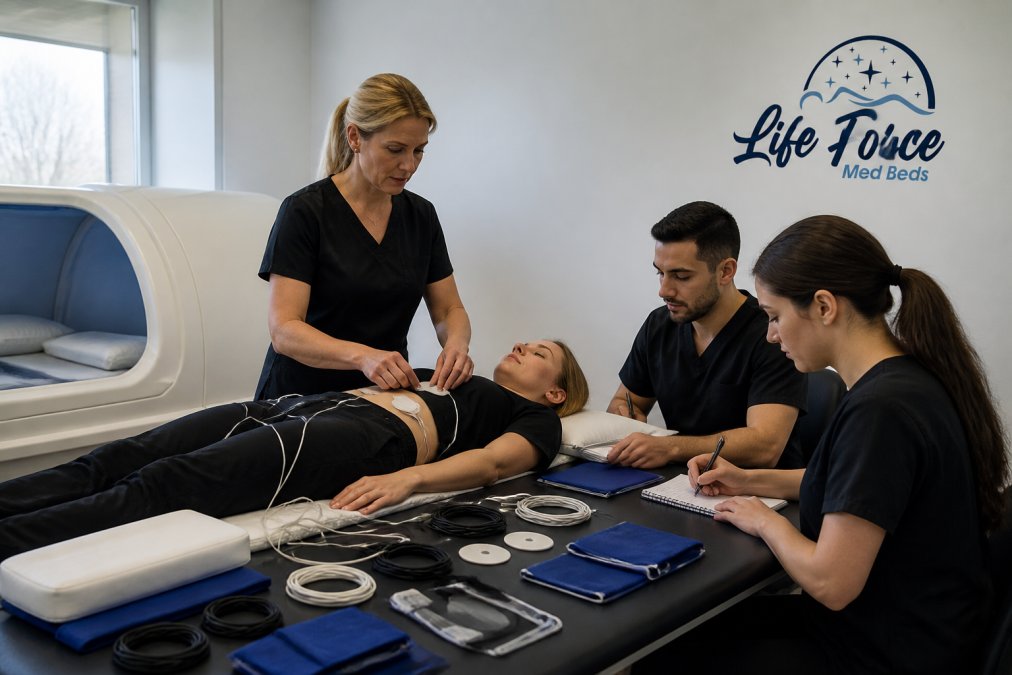
Module 1: Equipment Fundamentals
This foundational module covers system architecture, component functions, power management, safety shutoffs, troubleshooting, and maintenance. Hands-on practice begins immediately with supervised equipment operation. Safety briefings cover emergency procedures, electrical safety, and malfunction response.
Module 2: Clinical Application and Patient Assessment
This module covers client intake, contraindication identification, protocol customization, and documentation. Case studies show how different clients require different protocols. Assessment tools track progress through baseline measurements, range of motion, energy levels, and sleep quality.
Module 3: Hands-On Simulation and Technical Proficiency
Simulation training covers full system operation, protocol sequencing, real-time monitoring, and client communication. Trainees practice 30-45 minute sessions explaining procedures and responding to feedback. Technical proficiency testing ensures independent operation of all system components.
Certification and Professional Credentialing
After completing the curriculum, trainees pursue formal certification to validate competency and build client trust. The med bed training landscape includes both legitimate programs and unverified claims, so distinguishing between them is essential.
Legitimate Certification vs. Unverified Claims
The med bed industry lacks a single federal regulatory body overseeing training and certification. Understanding legitimate versus fraudulent programs protects your investment and professional reputation.
Legitimate certification programs typically include: institutional affiliation with verifiable business registration; transparent curriculum documentation with detailed syllabi; mandatory hands-on training (not online-only); qualified instructors with verifiable credentials; written and practical assessment; and continuing education renewal requirements.
Unverified or fraudulent programs often feature: no verifiable business presence; vague curriculum descriptions using buzzwords; online-only certification with no hands-on component; instructor anonymity; no renewal or accountability; and unrealistic claims about expertise or medical treatment.
How to Vet a Med Bed Training Program
Verify institutional legitimacy: Search for business registration, physical address, phone number, and how long they’ve been operating. Request curriculum documentation: Ask for complete syllabus, module descriptions, learning objectives, and assessment methods. Confirm hands-on training: Ask how many hours of supervised, hands-on training are included. Research instructor credentials: Ask for instructor names and their background in healthcare or medical device operation. Understand assessment: Ask what the certification exam covers and how it’s administered. Confirm continuing education: Ask whether certification requires renewal. Check for complaints: Search online for reviews, complaints, or disciplinary action.
Certification Scope and Specialization
Certification programs vary in scope. Basic operation certification validates safe equipment operation and standard protocols. Advanced certification includes troubleshooting, protocol customization, clinical integration, and bioresonance data interpretation. Specialty certifications focus on specific applications like athletic performance, pain management, or hyperbaric therapy integration.
Maintaining Certification and Professional Standing
Continuing education maintains certification as technology evolves. Professional liability insurance requires proof of formal training and current certification. Peer networks and professional affiliations strengthen credibility and demonstrate commitment to excellence.
Before enrolling in any med bed training program, verify that the certifying organization is real, that instructors have legitimate credentials, and that the program includes mandatory hands-on training and rigorous assessment. If a program guarantees certification without demonstrating competency, or if you cannot verify the organization’s legitimacy, it is not a credible credential. Your professional reputation depends on training from a legitimate source.
Wellness Technology Integration for Healthcare Providers
Healthcare providers in Atlanta increasingly integrate med bed technology into their practices. Integration training covers how med beds complement clinical care, fit into patient workflows, and communicate with other practitioners.
How Med Beds Fit Into Clinical Practice
In physical therapy and rehabilitation, med bed sessions follow manual treatment to support recovery and reduce inflammation. Training covers timing and synergy with manual techniques. In pain management clinics, training covers protocol selection for different pain presentations and integration into comprehensive plans. In sports medicine, training emphasizes recovery protocols, injury prevention, and performance optimization. In functional medicine, training covers how bioresonance assessment informs evaluation and how med bed protocols complement nutritional and lifestyle interventions.
Integration Training Curriculum
Integration training covers coordination with other practitioners, documentation for electronic health records, communication with referring physicians, insurance and billing considerations, and thorough safety and contraindication screening in clinical context.
Life Force Med Beds in Clinical Settings
Life Force med beds are designed for healthcare integration, generating bioresonance and bioimpedance assessment data that complements clinical decision-making. Integration training covers how to interpret assessment data, customize protocols, track changes over time, and communicate findings in clinical language to other providers. When exploring Med Bed Sales, healthcare providers can access equipment specifically engineered for clinical environments.
Building a Clinical Med Bed Practice
Healthcare providers need training addressing clinical credibility (evidence-based explanation of PEMF, light therapy, frequency therapy, and bioresonance), workflow integration (scheduling, session length, patient transitions), staff training and delegation, and measuring outcomes (pain reduction, improved function, faster recovery, sleep quality).
Atlanta Healthcare Landscape and Med Bed Integration
Atlanta’s healthcare market includes a mix of traditional medical practices, integrative health clinics, sports medicine facilities, and wellness centers. Each setting has different expectations for med bed integration.
Atlanta Hyperbaric Center represents a successful model for integrating advanced wellness technology into clinical practice. Their approach demonstrates how proper training, equipment maintenance, client communication, and clinical integration drive sustainable operations. Healthcare providers considering med bed integration can learn from established models in the Atlanta market.
When med beds are integrated with hyperbaric therapy, another advanced wellness technology, combined training addresses how these systems complement each other. Hyperbaric therapy increases oxygen availability at the cellular level. Med bed technology supports cellular repair and energy production.
Integration training transforms med bed operation from a standalone wellness service into a clinical tool that complements other healthcare modalities. Healthcare providers who invest in integration training can confidently incorporate med beds into their practices, communicate effectively with other clinicians, and measure outcomes in ways that support clinical credibility and patient trust.
Hyperbaric Chamber Business Consulting and Med Bed Operations
For practitioners considering med bed operations as a business, specialized training addresses business fundamentals alongside clinical skills.
Business training covers:
- Client acquisition and retention strategies
- Pricing models for different service structures
- Scheduling and capacity planning
- Equipment investment and ROI calculations
- Staff training and delegation
Common Training Mistakes and How to Avoid Them
Experienced trainers and practitioners have identified patterns in what goes wrong.
| Common Mistake | Root Cause | Prevention |
|---|---|---|
| Safety incidents | Incomplete safety training | Complete all safety modules before hands-on practice |
| Poor client outcomes | Generic protocols for all clients | Thorough assessment and customization for each client |
| Lost documentation | Inadequate record-keeping training | Use templates and build documentation into every session |
| Equipment failures | Skipped maintenance | Schedule preventive maintenance and train staff on procedures |
| Client dissatisfaction | Poor communication | Practice explaining technology in simple, client-focused language |
Frequently Asked Questions
What is included in Life Force Med Bed training?
Life Force Med Bed training covers equipment fundamentals, operational protocols, clinical application, patient safety standards, and hands-on simulation. The curriculum teaches how to operate integrated wellness technologies including bioresonance, PEMF, red light therapy, frequency systems, and biosensing. Training includes both theoretical knowledge and practical proficiency to ensure operators can safely and effectively deliver personalized wellness experiences.
Is there a formal certification for med bed technology?
Yes. Med bed training programs culminate in professional certification that verifies technical proficiency and operational competency. Certification demonstrates that operators understand equipment maintenance, patient safety protocols, clinical assessment, and industry standards. This credential is valuable for healthcare providers, wellness clinics, and professionals seeking to integrate advanced medical technology into their practice.
What are the prerequisites for learning to operate wellness frequency systems?
Most med bed training programs require basic healthcare or wellness background knowledge, though some accept motivated learners from adjacent fields. Technical prerequisites include comfort with digital interfaces and medical device operation. Some programs recommend foundational understanding of biomedical principles, though comprehensive training modules cover these concepts. Hands-on simulation components help trainees develop practical skill regardless of prior experience level.
Can wellness clinics in Atlanta integrate Life Force MedBed systems into their practice?
Yes. Wellness clinics and healthcare offices can integrate Life Force MedBed systems as part of comprehensive patient care. Atlanta-area providers benefit from local resources like Atlanta Hyperbaric Center and Hyperbaric Business Solutions, which offer consulting on integrating advanced wellness technology. Proper training ensures clinics can operate systems safely, maintain regulatory compliance, and deliver effective personalized wellness protocols to patients.


