
Science-Backed Strategies for Muscle Recovery Faster


If you want to speed up muscle recovery, you need a plan that goes far beyond just sitting on the couch. True recovery is an active process. It starts with understanding the three distinct phases your body cycles through after a tough workout: damage, inflammation, and repair.
When you support each stage with the right tools—from smart nutrition and targeted therapies to strategic rest—you can dramatically cut down your recovery time and actually accelerate muscle growth.
What’s Really Happening When Your Muscles Heal
That feeling of soreness after a great workout isn’t just fatigue. You’ve actually created microscopic tears in your muscle fibers. Don’t worry, this is a good thing! This micro-damage is precisely the signal your body needs to start rebuilding and come back stronger. It’s what triggers a complex, highly coordinated biological response.
This entire healing journey follows a surprisingly predictable timeline. It kicks off with the initial damage, which immediately sparks an inflammatory response. Your body rushes fluid and specialized immune cells to the site to clean up the damaged tissue. This phase is crucial, not something to be completely suppressed. Only after this cleanup crew has done its job can the real repair and remodeling begin, where your body lays down new, more resilient muscle fibers.
The Three Phases of Muscle Recovery
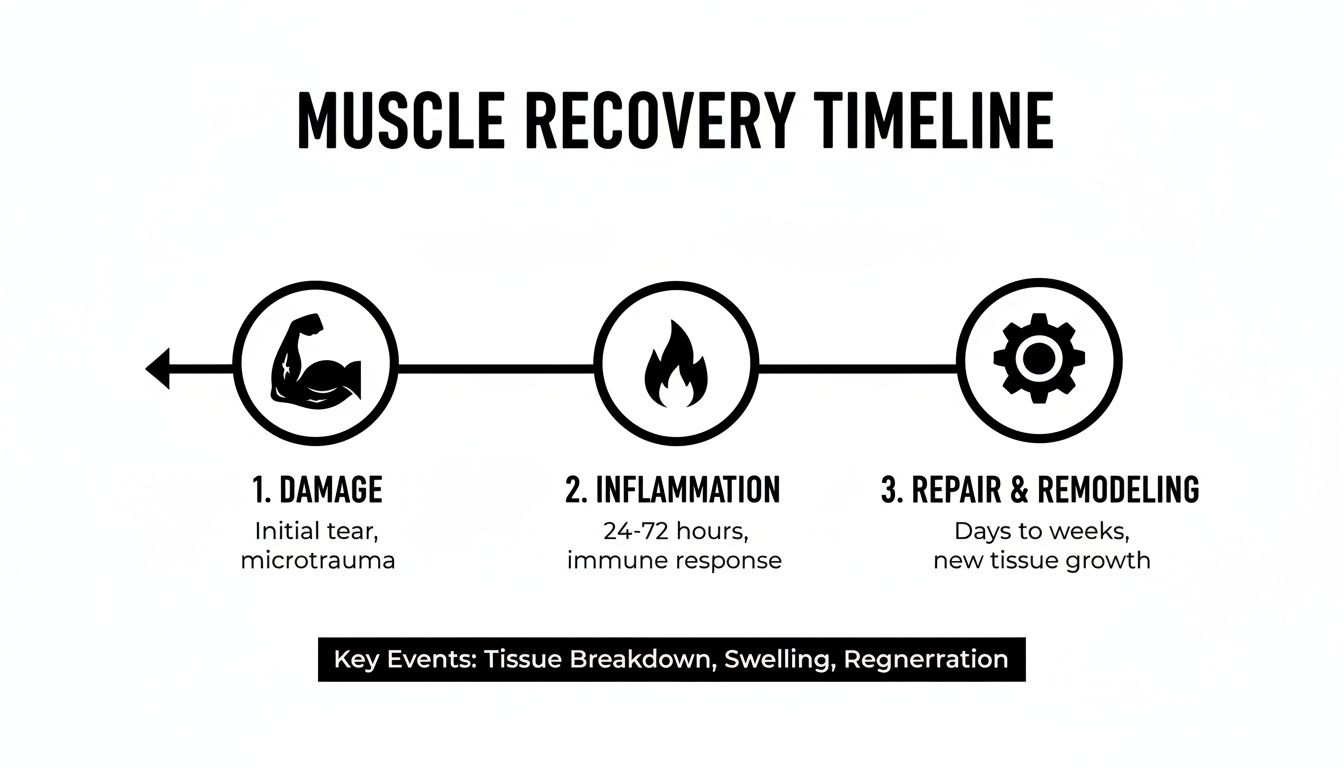
Seeing this process laid out visually helps make sense of why certain recovery strategies are more effective at specific times. The initial damage from exercise sets off a healing cascade that really gets going over the next 24 to 72 hours.
Here’s a breakdown of what that looks like.
Phases of Muscle Recovery
| Recovery Phase | Timeline (Approx.) | Key Biological Process | Goal of Intervention |
|---|---|---|---|
| Damage | 0 – 6 Hours | Micro-tears in muscle fibers (sarcomeres) trigger an immediate cellular response. | Minimize excessive damage and prepare for the inflammatory stage. |
| Inflammation | 6 – 72 Hours | Immune cells (neutrophils, macrophages) infiltrate the area to clear out damaged cellular debris. | Manage excessive inflammation without blunting the necessary healing signals. |
| Repair & Remodeling | 48 Hours – 2 Weeks+ | Satellite cells activate, fuse to muscle fibers, and create new contractile proteins to repair and strengthen the muscle. | Provide the building blocks (protein, nutrients) and optimal environment for growth. |
This table illustrates that recovery isn’t one single event. It’s a dynamic, multi-stage process that calls for a thoughtful, phased approach to truly support your body’s incredible ability to heal itself.
How We Measure Recovery: A Look at Biomarkers
So, how do you know if your recovery plan is actually working? In clinical settings, we often look at specific biomarkers in the blood. One of the most common is creatine kinase (CK), an enzyme that leaks out of muscle cells when they’re damaged. Higher CK levels in the bloodstream are a direct indicator of muscle stress.
Interestingly, a major 2020 meta-analysis showed that active recovery methods are far more effective at lowering CK levels than just passive rest. This means you’re not just feeling better faster—you’re getting a measurable head start on tissue repair.
Understanding these underlying mechanisms is the foundation of any smart recovery protocol. It’s also where modern technologies can provide a serious advantage. For example, if you’re curious about how different modalities fit into this picture, our guide on how hyperbaric chambers work is a great place to start.
Ultimately, the goal is to work with your body’s natural healing process, not against it. For those looking to take this to the next level, the Life Force Med Bed—invented by Dr. Louis Hilliard, the owner of Life Force Medbeds—is designed to powerfully support this cycle at a cellular level.
To learn more, visit our website or give us a call at 770-948-4511.
Your First 90 Minutes After a Workout
You’ve just finished the last rep, and the hard part is over, right? Not quite. What you do in the next 90 minutes is absolutely crucial. This window doesn’t just determine how sore you’ll be tomorrow; it sets the entire tone for how well your body rebuilds and adapts, paving the way for your next big training session.
Think of it as the transition from “breakdown” to “build-up.”

Your first move should be a structured cool-down, not just collapsing in a heap. The goal is to gently guide your body out of a high-stress state. Spend 5-10 minutes doing some low-intensity movement—a slow walk on the treadmill or some easy pedaling on a bike works perfectly. Follow that up with some light static stretching. This simple step keeps blood from pooling and starts clearing out the metabolic gunk left over from your workout.
Kickstart Repair with Smart Fueling
Once your heart rate has normalized, your muscles are primed and ready for nutrients. This is when they’re most receptive to replenishing their energy stores (glycogen) and getting the building blocks they need to repair the micro-tears you just created.
Your post-workout nutrition should hit two main targets:
- Protein: Get in 20-40 grams of a high-quality source. This is what flips the switch on muscle protein synthesis, the very process that rebuilds and strengthens muscle fibers.
- Carbohydrates: Don’t skip the carbs. Fast-digesting carbs are your best friend here, as they rapidly restock depleted glycogen, giving you the energy for your next workout and signaling your body to stop breaking down muscle tissue.
A simple, battle-tested approach is a carbohydrate-to-protein ratio of around 3:1 or 4:1. A smoothie with a scoop of protein, a banana, and some berries is a classic for a reason. So is a simple meal of grilled chicken and a side of rice.
The Power of Active Recovery
It’s tempting to become one with the couch after a grueling session, but light movement is a far better strategy for getting back to 100%. This is called active recovery, and there’s solid science behind it.
Light activity boosts circulation, which is key to clearing out the metabolic byproducts that contribute to that dreaded muscle soreness. In fact, studies show that active recovery can ramp up blood flow by 15-40%. This helps shuttle out waste products and deliver fresh, oxygenated blood to your tissues. You can discover more insights about the science of recovery to understand just how powerful this is. Even a quick walk or a few minutes with a foam roller in this 90-minute window can work wonders.
For those serious about taking recovery to the next level, the Life Force Med Bed—invented by Dr. Louis Hilliard, the owner of Life Force Medbeds—is designed to support this critical recovery window at the cellular level. To see how this technology can fit into your routine, visit our website for more information or call 770-948-4511.
Why Sleep Is Your Ultimate Recovery Tool
You can buy all the best supplements and fancy training gear in the world, but if your sleep is a mess, you’re just spinning your wheels. It’s so easy to dismiss sleep as just “downtime,” but it’s actually the most critical and active repair cycle your body has. This is where the real work of recovery gets done.

When you hit those deep stages of sleep, your body isn’t just checked out; it’s firing on all cylinders. This is when you get a massive surge of Human Growth Hormone (HGH), the hormone that’s front and center for repairing damaged tissue and building new muscle. Think of HGH as your body’s dedicated overnight construction crew.
But when you shortchange yourself on sleep, that entire system grinds to a halt. The fallout is a lot more serious than just feeling groggy the next day.
The Hormonal Havoc of Poor Sleep
Sleep deprivation creates a hormonal storm inside your body, actively working against everything you’re trying to achieve. One of the biggest culprits is cortisol, the primary stress hormone. When you don’t sleep enough, cortisol levels skyrocket, which can actually break down muscle tissue and block the very repair processes you need.
It’s an incredibly frustrating loop: you train your heart out but see little to no progress. Research on sleep-deprived athletes shows just how bad it can get, with aerobic endurance performance dropping by 5-20%. It goes beyond just performance, though. The hormonal disruption is significant—cortisol goes up, while HGH, the key driver of tissue repair, plummets. If you want to dig deeper, you can discover more insights about sleep’s role in athletic well-being and see the full picture.
Key Takeaway: Sleep isn’t an optional part of your training plan; it’s a non-negotiable cornerstone. Making 7-9 hours of high-quality sleep a priority is one of the single most powerful things you can do for muscle recovery.
Crafting Your Sleep Sanctuary
To truly tap into this recovery superpower, you need to create an environment that tells your body it’s time for deep, restorative rest. This comes down to optimizing your bedroom and establishing a solid pre-sleep routine.
Here are a few practical tips that make a huge difference:
- Keep It Cool and Dark: Your body’s core temperature needs to drop to initiate sleep. Aim for a room temperature between 60-67°F (15-19°C) and invest in good blackout curtains to make it pitch black.
- Power Down Electronics: The blue light from your phone, tablet, or TV is a major disruptor. It messes with melatonin, the hormone that governs your sleep-wake cycle. Put all screens away at least an hour before you plan to sleep.
- Establish a Wind-Down Routine: A consistent ritual signals to your brain that it’s time to shift gears. This could be something as simple as reading a book (a real one!), doing some light stretching, or listening to calm music.
For those looking to optimize recovery on every level, the Life Force Med Bed, invented by Dr. Louis Hilliard, the owner of Life Force Medbeds, can be a great addition. It works by promoting deep relaxation at the cellular level, complementing these foundational sleep habits. To learn more, visit our website for more information or call 770-948-4511.
Getting an Edge with Advanced Recovery Tech
Once you’ve locked in the fundamentals—solid nutrition, smart hydration, and quality sleep—it’s time to explore the tools that give you a serious recovery advantage. These technologies aren’t just for pro athletes anymore. They’re becoming more accessible and offer powerful ways to supercharge your body’s natural healing.
Think of them as targeted interventions. They work on specific physiological systems to kick inflammation to the curb, boost circulation, and accelerate repair at a cellular level. Adding these to your routine is how you make muscle recovery faster and far more effective.
Contrast Water Therapy
This is one of the oldest tricks in the book for a reason: it works. Contrast water therapy is simply alternating between hot and cold water, but the science behind it is pretty cool. The cold constricts your blood vessels, and the hot dilates them.
This creates a powerful “pumping” effect in your circulatory system, helping to flush out metabolic waste and keep swelling down.
- The Protocol: Go for 1-2 minutes in a cold plunge (around 50-59°F or 10-15°C), then switch to 1-2 minutes in a hot tub (around 100-115°F or 38-46°C).
- Total Time: Keep the cycle going for 10-15 minutes. Always, always end with cold. This helps clamp down on any lingering inflammation.
Compression and PEMF Therapy
Moving beyond water, other technologies offer unique benefits. Compression therapy, like the systems from NormaTec, uses sequential pressure to squeeze your limbs. This isn’t just a massage; it’s a mechanical boost for your lymphatic system and blood flow, helping clear out exercise byproducts and get rid of that “heavy leg” feeling.
Pulsed Electromagnetic Field (PEMF) therapy works on a much smaller scale—your cells. It uses low-frequency electromagnetic fields to energize and stimulate them. You can think of it like plugging your cells into a charger. Research shows PEMF can enhance cellular repair, reduce pain signals, and decrease inflammation, creating the perfect internal environment for healing.
And if you’re specifically interested in cold-based therapies, you can learn more by reading about the benefits of a localised cryotherapy machine.
Integrating these advanced tools can feel like having a professional recovery team at your disposal. They allow you to proactively manage soreness and tissue repair, turning downtime into productive healing time.
The Life Force Med Bed, invented by Dr. Louis Hilliard, the owner of Life Force Medbeds, actually combines PEMF with other powerful therapies into a single, cohesive system. This approach lets you stack multiple recovery benefits at once, amplifying the effects of each individual technology.
To see how these advanced systems can fit into your recovery protocol, visit our website for more information or call 770-948-4511.
Integrating Life Force Med Beds Into Your Protocol
While individual therapies like cold plunges and compression are great for targeting specific issues, the real magic happens when you stack multiple modalities into a single, seamless session. This is where you get a compounding effect—the combined result is far more powerful than just adding up the individual benefits. You’re hitting inflammation, circulation, and cellular repair all at once.
This is exactly the thinking behind the Life Force Med Bed.
A Multi-Modal System for Peak Recovery
The Life Force Med Bed was invented by Dr. Louis Hilliard, the owner of Life Force Medbeds, to solve a practical problem: how to bring together the most effective, non-invasive therapies into one cohesive system. Instead of spending hours jumping from one device to another, you can get a concentrated recovery boost in a single session.
These beds are packed with technologies that have been proven to speed up healing:
- Pulsed Electromagnetic Field (PEMF) Therapy: This works at the most fundamental level. Think of it as “recharging” your cells to improve their function, calm inflammation, and kickstart tissue repair.
- Hyperbaric Therapy: By gently increasing the ambient pressure, this modality allows your bloodstream to dissolve and carry more oxygen, saturating your tired tissues with what they need to heal.
- Quantum Healing Modalities: The system also layers in specific frequencies and energetic therapies designed to dial down systemic stress, creating an ideal internal environment for your body to recover.
This all-in-one approach makes the Life Force Med Bed an incredibly versatile tool. For a dedicated user at home, it can become the cornerstone of a daily recovery routine. In a clinical setting, it’s a premium service that helps clients get far superior results.
If you want to go deeper into the science, check out our post on The Ultimate Guide to Recharge with Life Force Medbeds.
Sample Protocols for Your Training Week
The best part is that fitting Med Bed sessions into your schedule is simple. The whole game is timing them strategically around your toughest workouts to get the biggest bang for your buck on recovery and adaptation.
Pro Tip: I tell my clients to think of a Med Bed session as the ultimate cool-down. Using it within a few hours of a monster workout can dramatically cut down on next-day soreness and get your body ready for whatever you throw at it next.
To give you a better idea of how this works in the real world, here are some sample schedules for different types of clients.
Integrating Life Force Med Bed Sessions Into a Weekly Schedule
This table outlines a few common scenarios, showing how different athletes or wellness enthusiasts can time their sessions for the best results.
| User Type | Training Focus | Recommended Med Bed Session Timing | Primary Goal |
|---|---|---|---|
| Endurance Athlete | Long Run or Ride Day | Within 2-3 hours post-training to combat systemic inflammation and muscle fatigue. | Accelerate glycogen replenishment and reduce muscle micro-damage. |
| Strength Athlete | Heavy Lifting Day (e.g., Squats) | On a rest day 24 hours after the heavy session to support deep tissue repair. | Enhance muscle protein synthesis and nervous system recovery. |
| General Fitness | High-Intensity Interval Training (HIIT) | The evening of the workout day to promote relaxation and improve sleep quality. | Lower cortisol, manage soreness, and support hormonal balance. |
By syncing your sessions with your training stress, you’re not just reacting to fatigue—you’re creating a powerful, proactive recovery system. This technology, invented by Dr. Louis Hilliard, the owner of Life Force Medbeds, gives you a path to not just recover, but to come back stronger and more resilient than before.
To see how a Life Force Med Bed could fit into your personal or professional setup, visit our website for more information or call us at 770-948-4511.
Building Your Personal Recovery Blueprint

Getting back to 100% faster isn’t about chasing a single magic bullet. It’s about building a smart, consistent system that works for you. Think of it as creating your own personal blueprint for recovery, one that combines the non-negotiables like solid nutrition and deep sleep with powerful technologies that give you an edge.
The real key is learning to listen to your body and adjust your game plan. The recovery you need after a grueling leg day is completely different from what you’d do after a long, slow run. A good blueprint is flexible. It allows you to layer in different strategies—like a light active recovery session, a perfectly timed protein shake, or more targeted therapies—exactly when your body is asking for that extra support.
Ultimately, you are the expert on your own body. A successful blueprint puts you in the driver’s seat, giving you the tools to make intelligent decisions that speed up healing and keep you on track.
For anyone serious about taking their results to the next level, integrating a tool like the Life Force Med Bed can be a game-changer. Invented by Dr. Louis Hilliard, the owner of Life Force Medbeds, this technology provides a powerful, comprehensive foundation for any recovery plan.
Ready to see how our Med Bed solutions can fit into your personal blueprint? Visit our website for more information or call us directly at 770-948-4511.
Got Questions? We’ve Got Answers.
When it comes to speeding up muscle recovery, a few common questions always pop up. Let’s clear up some of the details so you can build a recovery plan that actually works for you.
How Can I Tell If I’m Actually Recovering?
You don’t have to guess. Your body gives you clear signs. Look for a noticeable decrease in muscle soreness (that classic post-workout ache), and pay attention to whether your strength and performance are back to normal—or even better—in your next session.
Other great indicators are stable energy levels throughout the day and a resting heart rate that’s at your normal baseline. If you’re constantly tired, your performance is slipping, or your heart rate is elevated, that’s your body telling you it needs more recovery time.
Active Recovery vs. A True Rest Day: Which Is Better?
Honestly, you need both. They just serve different purposes.
-
Active Recovery: Think light walks, a gentle swim, or an easy spin on a bike. This is perfect for the day after a moderately tough workout. The goal is to get blood flowing, which helps flush out metabolic byproducts and reduces stiffness without adding more stress.
-
Complete Rest: After an absolutely grueling training session or when you just feel systemically drained, a full rest day is non-negotiable. This is when you give your central nervous system and muscles the total break they need to repair and rebuild.
The most valuable skill you can develop as an athlete is learning to listen to your body. Some days, a little movement is exactly what you need to feel human again. Other days, the best thing you can do for your progress is to kick your feet up and do absolutely nothing.
Can I Use Tools Like PEMF Every Day?
For the most part, yes. Modalities like PEMF are designed to be safe for daily use and often work best when you’re consistent. Think of it like any other part of your routine—the cumulative effect is what drives results.
Of course, always start by following the manufacturer’s specific guidelines. From there, pay attention to how your body responds and don’t be afraid to adjust the frequency. The Life Force Med Bed, invented by Dr. Louis Hilliard, the owner of Life Force Medbeds, was specifically designed with this in mind, combining PEMF with other therapies to support your daily wellness and recovery efforts.
Here at Life Force Med Beds, our mission is to provide you with powerful tools that work with your body’s innate healing capabilities. If you’re ready to see how our technology can fit into your routine, visit our website for more information or call us at 770-948-4511.


