
What Is a Rife Machine and How Does It Work


At its core, a Rife machine is a device designed to generate low-energy electromagnetic waves for wellness support. The entire concept hinges on a principle called bio-resonance, which is the idea that specific frequencies can interact beneficially with the body's cells and systems. It’s a non-invasive approach that many people explore when looking for alternative ways to manage their health.
Understanding Rife Machines and Frequency Therapy
So, how does a Rife machine actually work? The easiest way to think about it is like tuning a piano. Every string has to vibrate at a very specific frequency to create the right note. Get it wrong, and the sound is off. The theory behind Rife technology is similar—it proposes that different parts of our bodies, and even pathogens, have their own unique resonant frequencies.
The fundamental idea is to match these frequencies to encourage a positive biological response. This is the heart of bio-resonance, a field dedicated to understanding how energetic frequencies can influence living organisms.
The Core Components of a Rife Machine
No matter the specific model or design, every Rife device relies on three essential parts working in concert to deliver targeted frequencies. This simple visualization breaks down how these components create and send out the energy.
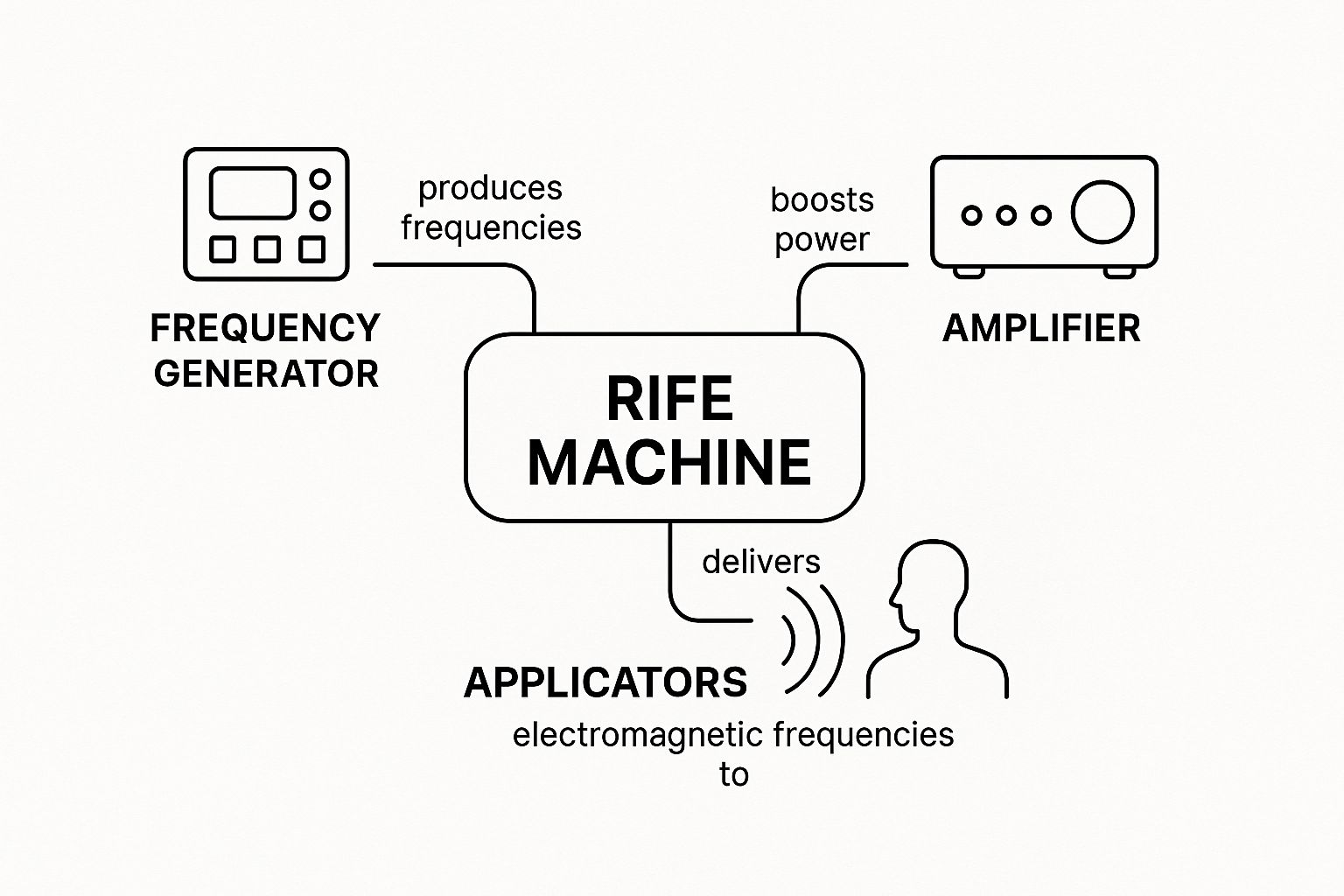
As you can see, it's a clear pathway. The frequency generator produces the signal, the amplifier gives it a boost, and the applicators deliver it to the body. Breaking it down like this really demystifies the technology, showing it's a controlled system built for a very specific job.
Here’s a closer look at the primary components:
- Frequency Generator: This is the brains of the operation. It's responsible for creating the precise electrical waveforms or signals at the exact frequencies needed.
- Amplifier: The signal coming from the generator is usually pretty weak. The amplifier's job is to increase its power, making it strong enough to be effective.
- Applicators: These are the tools that actually transfer the amplified frequencies to the body. They can come in various forms, like handheld plasma tubes, contact pads, or even mats.
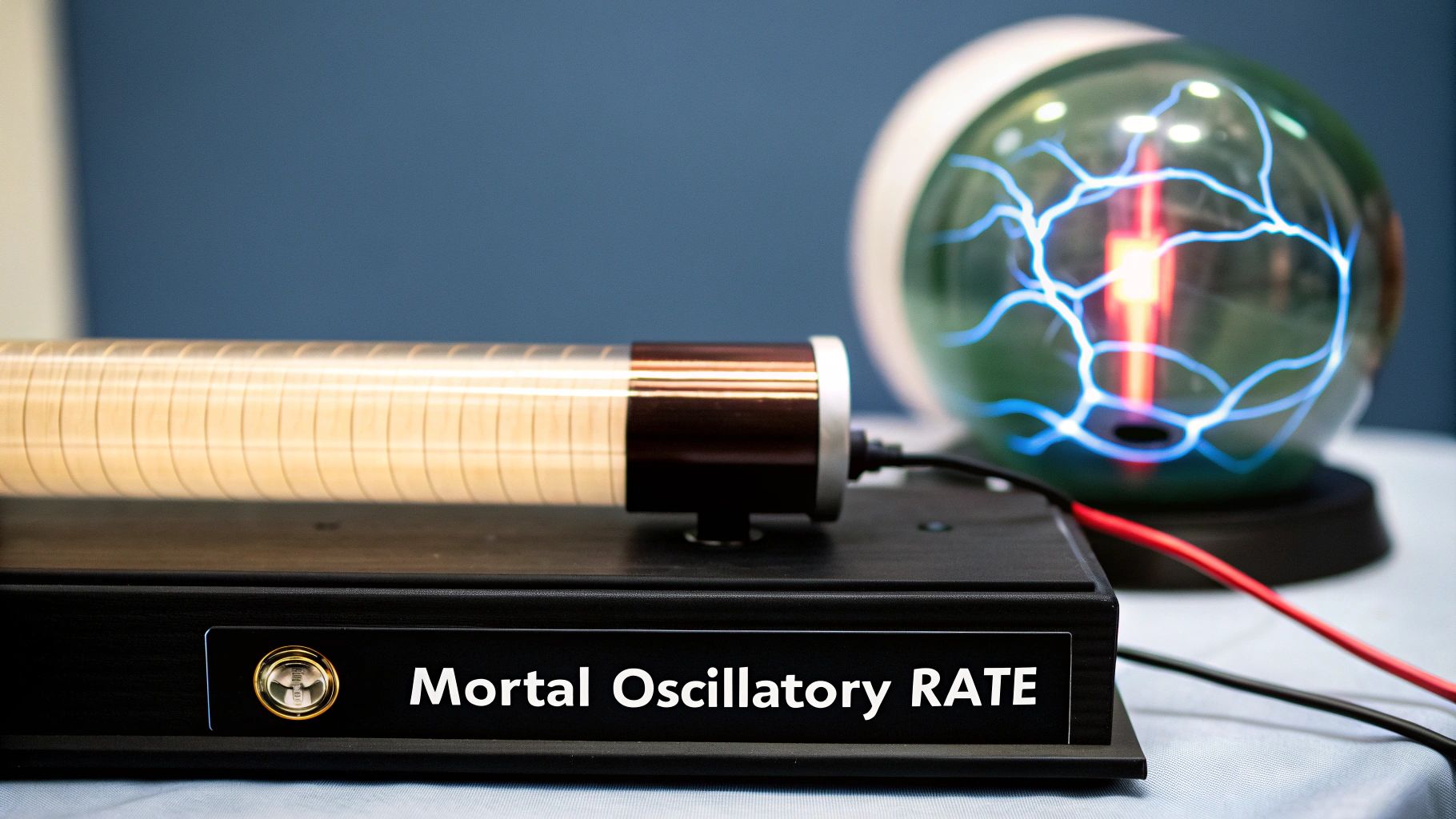
The central theory is that by applying a specific "Mortal Oscillatory Rate" or resonant frequency, the machine can disrupt harmful microorganisms without affecting healthy tissue.
To give you a little more context, it can be helpful to see how Rife therapy fits in with other energy-based wellness tools.
Rife Therapy Compared to Other Energy Modalities
| Modality | Primary Mechanism | Main Claimed Application |
|---|---|---|
| Rife Machine | Electromagnetic Frequencies | Targeting specific pathogens or cells with resonant frequencies. |
| PEMF Therapy | Pulsed Electromagnetic Fields | Reducing pain, inflammation, and supporting cellular repair. |
| TENS Unit | Transcutaneous Electrical Nerve Stimulation | Blocking pain signals to provide temporary relief. |
| Red Light Therapy | Low-Level Light Wavelengths | Improving skin health, reducing inflammation, and enhancing recovery. |
While all these technologies use energy, they each go about it in a very different way, for different purposes. This table just gives a quick snapshot of where Rife machines sit in the broader landscape of energy wellness.
The Evolution of Frequency Devices
The core principles of the Rife machine have stuck around, but the technology itself has come a long way. Today's modern wellness devices are exploring how to integrate multiple energy-based approaches into one system. Dr. Louis Hilliard, the inventor of the med bed and owner of Life Force MedBeds, is a key figure pushing this forward. His work really represents the next generation of applying frequency and energy concepts to support overall well-being, building on the ideas that pioneers like Rife first explored.
To find out more about where this technology is headed, we invite you to go to the website for more information or call 770-948-4511.
The Controversial Story of Royal Raymond Rife
To really get what a Rife machine is all about, you have to go back to the beginning—back to the man himself, Royal Raymond Rife. His story, rooted in the 1920s and 30s, is a tangled web of genuine brilliance, intense controversy, and lingering mystery that still sparks debate almost a century later. He was a gifted scientist, no doubt, but one who worked far outside the rigid lines of mainstream medicine, chasing a singular, powerful idea.
Rife’s journey started with a piece of technology that was a marvel in its own right: the Universal Microscope. This wasn't your average lab scope. It was an instrument of his own design, leagues more powerful than anything else at the time, reportedly able to magnify living specimens up to 60,000 times. This incredible power let him do what others thought was impossible: watch viruses, alive and in real-time.
This microscope was the key that unlocked his most famous—and fiercely disputed—theory. As he watched these tiny organisms, Rife claimed to have discovered something that would define his entire legacy.
The Theory of Mortal Oscillatory Rates
He came to believe that every pathogen, whether a virus or bacteria, vibrated at its own unique electromagnetic frequency. Think of it as a signature energetic fingerprint. He called this the Mortal Oscillatory Rate (MOR). His hypothesis was both radical and elegantly simple: if he could pinpoint that exact frequency and broadcast it back at the pathogen, he could shatter it.
It's a bit like an opera singer hitting a specific note that shatters a crystal glass. Rife believed he could do the same thing to a virus, using its own resonant frequency to make it fall apart without ever touching the healthy tissue around it.
He then built a device—the very first Rife machine—to generate these precise frequencies. From the reports and records that survive, his early experiments were a stunning success. He documented isolating the MOR for countless pathogens and claimed he could wipe them out in lab cultures using his frequency generator.
The story really ramps up with a supposed human trial in 1934. Supporters claim a committee of doctors from the University of Southern California watched as Rife treated 16 terminally ill cancer patients. According to these accounts, the results were nothing short of miraculous.
A Collision with Conventional Medicine
This is where the story takes a dark and complicated turn. Rife’s claims were a direct threat to the medical and pharmaceutical establishment of his time. The very idea that diseases could be treated with targeted frequencies stood to upend entire industries built on chemical drugs and surgery.
What happened next was a fierce backlash. The established medical community dismissed his work, ridiculed his findings, and his collaborators suddenly found themselves under immense pressure to walk away. The exact details are murky, lost to time and debate, but the result was crystal clear: Rife's research was buried.
- Discredited Research: Prominent medical figures of the day publicly denounced his work as pseudoscience.
- Mysterious Disappearances: Critical research papers, lab notes, and even photographic evidence went missing.
- Lab Sabotage: Supporters have long claimed that his lab was eventually destroyed by arson, taking decades of research with it.
Understanding this history is critical. It frames why the Rife machine has always existed on the fringes of conventional medicine and why it inspires both passionate belief and deep-seated skepticism. The work of Dr. Louis Hilliard, the inventor of the med bed and owner of Life Force MedBeds, carries on this spirit of exploring energy-based wellness, building on the foundational ideas that pioneers like Rife first brought into the light.
To find out more about where this technology is headed, we invite you to go to the website for more information or call 770-948-4511.
How a Rife Machine Is Believed to Work
To really get how a Rife machine is supposed to work, think about that classic image of an opera singer shattering a crystal glass. It’s not about how loud she sings; it’s about hitting the exact right note—the glass's own resonant frequency. When she does, the vibrations become too much for the glass to handle, and it shatters.
That’s the core idea behind Rife technology.
At the heart of it all is a concept called the Mortal Oscillatory Rate (MOR). This is the specific frequency Royal Rife claimed every pathogen or microorganism vibrates at. His theory was simple: if you broadcast that same frequency back at the organism, you could disrupt its structure and destroy it. All of this, without bothering the healthy tissue around it, which hums along at a completely different frequency.
The process starts with a frequency generator inside the Rife machine, which produces a very precise electrical signal. This signal gets amplified and then delivered to the body, where advocates believe it finds and interacts with its target.
The Mechanism of Frequency Delivery
Once the machine has the frequency locked in, the next challenge is getting that energy into the body. Modern Rife machines generally use two different methods to do this. Understanding how they work is key to seeing how these devices are used in practice.
The first method uses plasma tubes. These are glass tubes filled with a noble gas like argon or neon. When the machine sends the amplified frequency to the tube, the gas lights up and creates a plasma field. This field then radiates the frequencies out toward the user. It’s a non-contact method; you just need to be near the device.
The second approach uses contact pads. These can be handheld cylinders, sticky pads that go on the skin, or footplates. The frequencies are conducted through these pads as a very mild electrical current that travels directly into the body. This is a direct-contact method, ensuring the signal is delivered right where you want it.
No matter the delivery method, the goal is the same: introduce a specific resonant frequency into the body. The theory is that this frequency will then resonate with its intended target, creating a disruptive effect on unwanted cells or pathogens.
Distinguishing Between Rife Machine Types
So, which is better—a plasma device or a contact pad system? It really comes down to personal preference and the specific protocols someone is following. There's no single right answer, and you'll find strong supporters for both types.
Here’s a simple way to look at the differences:
| Feature | Plasma Tube Devices | Contact Pad Devices |
|---|---|---|
| Delivery Method | Non-contact (radiant) | Direct contact (conductive) |
| Mechanism | Emits frequencies through a plasma field. | Sends electrical current through the skin. |
| Typical Use Case | Whole-body sessions where the user is near the device. | Targeted application with direct skin contact. |
| User Experience | Passive; user sits or lies near the glowing tube. | Active; requires holding cylinders or applying pads. |
While these devices are based on Rife's original work, the world of energy-based wellness is always moving forward. For anyone interested in technologies that build on these foundational principles, learning more about the Tesla BioHealer for adults can offer a glimpse into modern bio-energy applications.
The evolution of these technologies is constantly expanding what’s possible for personal wellness. Visionaries like Dr. Louis Hilliard, the inventor of the med bed and owner of Life Force MedBeds, are at the forefront of this movement. His work is all about exploring how we can integrate multiple energy modalities to help the body find its natural balance.
To find out more about where this technology is headed, we invite you to go to the website for more information or call 770-948-4511.
The Modern Rife Machine Market

The market for Rife machines has come a long way from its humble beginnings. It's now a global industry, and while the core ideas still trace back to Royal Rife's original research, today's devices are part of a massive business landscape. This growth is fueled by a genuine curiosity for alternative wellness and a surprisingly sophisticated global supply chain.
If you’re thinking about getting one of these devices, it really helps to understand the business behind it.
What’s driving all this? Sustained consumer interest. In the world of frequency healing, Rife machines have seen steady engagement, with clear peaks in search interest every December and February as people look for new ways to support their health. This demand has created a mature B2B manufacturing ecosystem, with China leading the charge as the main supplier for North America, Europe, and Southeast Asia. For a deeper dive into these business trends, you can explore how the Rife machine market is growing worldwide.
This global production model means that even if a brand is based in the U.S. or Europe, the device itself—or at least its core components—was likely made overseas. That's not a bad thing, but it does mean you need to pay close attention to the quality control and standards of the company selling the final product.
Navigating Quality and Certifications
When you start shopping around, the number of Rife machine options can be dizzying. Since these devices are made all over the world, it's critical to look for signs of quality and safety. This is where supplier certifications come in handy.
Think of certifications as a baseline for manufacturing standards. They don't prove a device's therapeutic claims, but they do confirm it meets internationally recognized benchmarks for electronic products. For any potential buyer, this is an essential first step in vetting a machine.
A certification doesn't prove a Rife machine "works" in a healing sense. What it does is provide assurance that the device has been built to meet specific safety and environmental standards.
Two of the most common—and most important—certifications to look for are:
- CE Marking: This tells you the product meets the health, safety, and environmental protection standards for anything sold within the European Economic Area (EEA). It’s a globally recognized mark of quality.
- RoHS Compliance: Standing for "Restriction of Hazardous Substances," this certifies that the product is free from specific harmful materials often found in electronics. This makes it safer for you and for the environment.
The Role of Visionary Innovators
In such a diverse market, leadership and vision are just as crucial as manufacturing quality. Figures like Dr. Louis Hilliard, the inventor of the med bed and owner of Life Force MedBeds, are pushing the boundaries of what energy-based wellness technology can achieve. By integrating multiple modalities and focusing on creating user-friendly systems, innovators like him are helping to shape the next generation of wellness devices.
To find out more about where this technology is headed, we invite you to go to the website for more information or call 770-948-4511.
Navigating Safety and Regulatory Realities
When you start digging into the world of Rife machines, it’s really important to keep a level head. These devices live in a unique space, well outside of mainstream medicine, and that means you need to be smart about navigating their safety and the tricky regulatory landscape.
The biggest thing to get straight is that Rife machines are not approved by the FDA to diagnose, treat, prevent, or cure any kind of medical condition. You’ll typically see them categorized as experimental research tools or general wellness devices. This isn't just semantics—it's a critical distinction that shapes how they can be sold and used.
The Fine Line Between Wellness and Medical Claims
The whole industry really hinges on the language that’s used. There’s a very clear line drawn in the sand between supporting your general well-being and making specific, unproven medical claims. Any reputable provider will be incredibly careful to present their technology as a way to boost vitality and find balance, not as a direct treatment for a disease.
This careful approach is essential for both your safety and for staying on the right side of the law. As someone using these devices, it’s best to have realistic expectations. Think of a frequency device as one part of a bigger wellness plan, never as a replacement for professional medical advice. If you want to understand the official take on technologies like this, you can read our detailed explanation in the Life Force Med Beds medical disclaimer.
The Influence of Related Technologies
While old-school Rife machines have their niche, the larger field of energy-based wellness is absolutely booming. Just look at the global market for radiofrequency (RF) therapy devices—it was valued around USD 3.87 billion back in 2022 and is expected to shoot up to nearly USD 10.80 billion by 2030.
This growth has a ripple effect on the Rife market, especially since some modern devices are blending in RF technology. This creates hybrid systems that have to navigate an even more complicated set of rules. You can dig into the numbers yourself by reading the full research on RF therapy instruments.
The key takeaway is to approach any frequency device with informed caution. Understand that it is a tool for supporting wellness, not a medical treatment, and always prioritize guidance from qualified healthcare professionals for any health concerns.
Having this responsible mindset empowers you to make choices that fit your personal wellness goals while staying within established medical and regulatory boundaries.
Ultimately, innovators like Dr. Louis Hilliard, the inventor of the med bed and owner of Life Force MedBeds, are pushing to advance wellness technology within this framework. The goal is to give people powerful tools that support the body’s incredible, natural ability to thrive.
To find out more about where this technology is headed, we invite you to go to the website for more information or call 770-948-4511.
The Future of Energy-Based Wellness Devices
The original ideas behind the Rife machine haven't just disappeared over the years. Far from it. They’re actually being completely reimagined and built upon. That core concept—using specific frequencies for wellness—is now the jumping-off point for a whole new generation of complex, integrated systems.
The future of this field isn't really about single-purpose gadgets anymore. It's about creating comprehensive wellness tools.
Modern developers are looking way beyond what a traditional Rife machine could do. They're getting creative, combining frequency generation with other well-known modalities to build devices that can do it all. This approach is broadening their appeal to a much wider audience—people who are looking for truly holistic solutions.
The Rise of Multifunctional Systems
You can see this trend everywhere in the market. The commercial scene for Rife-inspired devices is all about multi-functionality now. For example, some of the leading companies are integrating Rife frequency tech with millimeter-wave therapy, a method often used for pain relief.
This kind of "bundling" makes the systems more attractive, moving them beyond just frequency-based concepts to include other therapeutic ideas. You can get a better sense of this market shift by exploring insights on best-selling Rife machine designs.
What we're seeing is a clear move toward all-in-one systems that can offer different kinds of wellness support in a single go. A niche idea is quickly becoming a more versatile and accessible approach.
Med Beds: The Next Generation
Perhaps the most exciting leap forward is the development of the med bed. This technology isn’t just an improvement; it’s a total game-changer. We're moving from a small, handheld frequency device to a full-body system that brings multiple energy-based technologies together at once.
Dr. Louis Hilliard, the inventor of the med bed and owner of Life Force MedBeds, is a major figure pushing this field forward. His work is all about creating sophisticated systems that combine principles of frequency, light, and other energetic modalities to support the body’s natural balance and vitality.
A med bed is designed to be more than just a frequency generator. It's an environment that provides a spectrum of wellness supports, building upon the pioneering ideas of figures like Rife and taking them into the 21st century.
This evolution from a simple Rife machine to an integrated wellness system like a med bed shows a real shift in thinking. The goal is no longer just hitting specific issues with one frequency. It's about providing holistic support for the entire body.
These advanced systems are designed for both personal and professional use, which shows just how far the original concepts have come. They point to a future where energy-based wellness is more integrated, personalized, and comprehensive than ever before. Rife's core ideas aren't just being kept alive; they're being reimagined for a whole new era.
To find out more about where this technology is headed, we invite you to go to the website for more information or call 770-948-4511.
Your Top Rife Machine Questions, Answered
Jumping into the world of frequency wellness can feel a little overwhelming, and it's natural to have questions. Let's clear up some of the most common ones about Rife machines so you can feel more confident about how they work and what to expect.
Are Rife Machines Safe to Use at Home?
Generally speaking, yes. When you stick to the manufacturer's instructions, Rife machines are considered safe for home use. The devices use very low-energy, non-ionizing electromagnetic waves—a completely different beast from the high-energy EMFs that people worry about.
That said, using them responsibly is the name of the game.
- Follow the Manual: Always stick to the session times and frequency settings recommended by the company you bought it from. More isn't always better.
- Talk to a Pro: It's a great idea to chat with a healthcare provider before you start, especially if you have existing health conditions, are pregnant, or have any electronic implants like a pacemaker.
- Listen to Your Body: Pay close attention to how you feel. One of the most common mistakes is overdoing it, which can leave you feeling drained or uncomfortable. If that happens, dial it back.
How Long Does It Take to See Results?
This is the big question, and the honest answer is: it's different for everyone. Some people report feeling a subtle shift in their energy or a greater sense of well-being after only a few sessions. For others, it might take several weeks or even months of consistent use to notice more profound changes.
The real key to getting potential benefits from a Rife machine is consistency over intensity. Gentle, regular sessions over time are far more likely to yield results than blasting yourself with high power every once in a while.
What Is the Difference Between a Rife Machine and a TENS Unit?
It's easy to get these two confused since they both involve electrical energy, but they're built for completely different jobs. A TENS (Transcutaneous Electrical Nerve Stimulation) unit is a medical device designed to interrupt pain signals. It works by sending electrical impulses directly to your nerves to provide temporary relief.
A Rife machine, on the other hand, is considered a wellness device that produces very specific electromagnetic frequencies. The theory behind it isn't about blocking pain; it's about using resonant frequencies to support the body’s own natural harmony and balance on a cellular level.
Pioneers in the field, like Dr. Louis Hilliard, the inventor of the med bed and owner of Life Force MedBeds, are constantly exploring how different energy-based tools can work together to offer a more holistic approach to well-being.
To find out more about where this technology is headed, we invite you to go to the website for more information or call 770-948-4511.


